
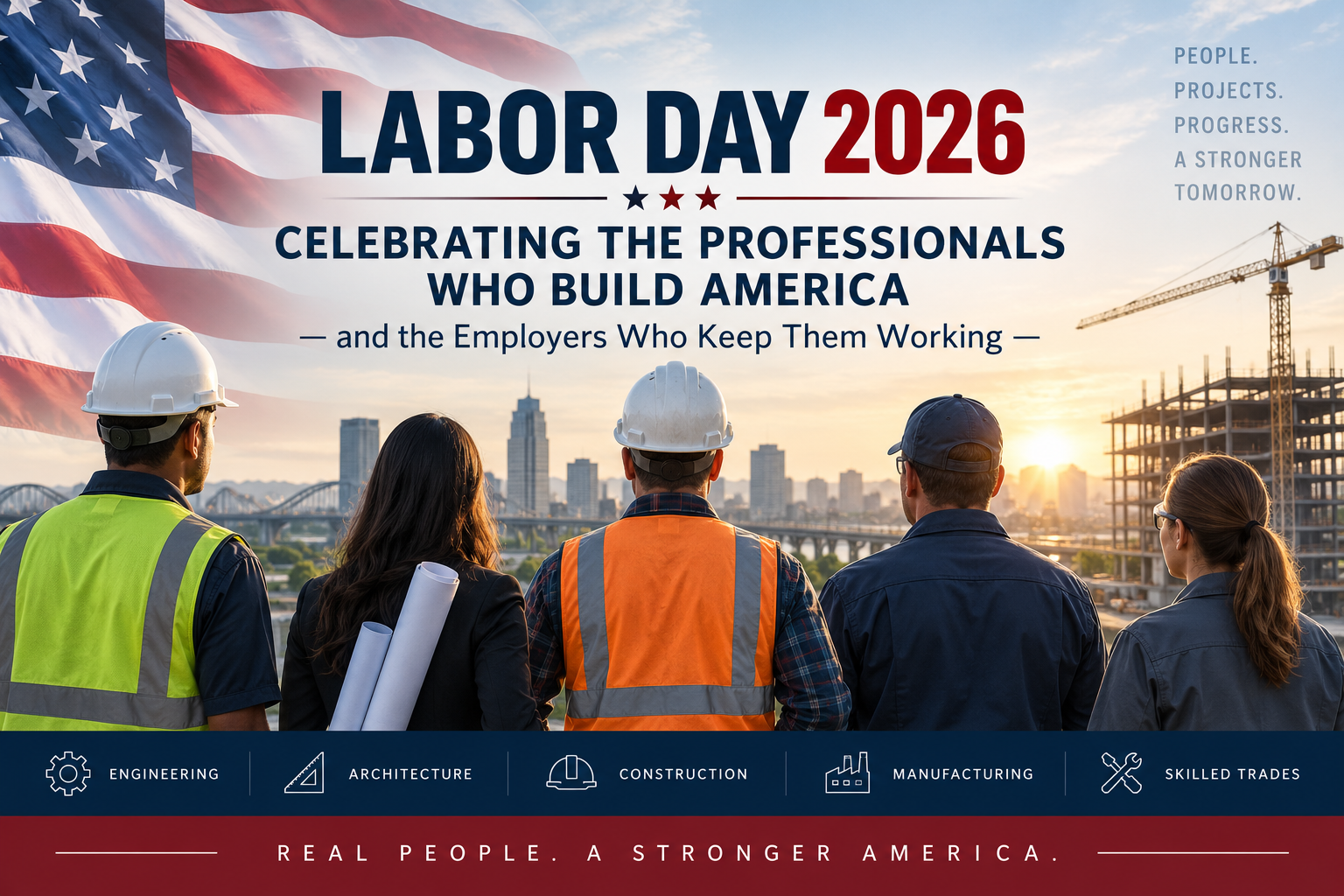
Labor Day is an opportunity to recognize the people whose skills, expertise, and hard work keep America building, producing, designing, and moving forward.
Engineers solve the technical problems behind products and infrastructure. Architects transform ideas and requirements into spaces where people live and work. Construction professionals turn designs into reality. Manufacturing teams keep facilities running and products moving out the door. Skilled tradespeople bring the hands-on expertise that countless projects and operations depend on.
For employers, their importance becomes especially clear when one of these professionals is suddenly missing.
A critical engineer resigns in the middle of a project. A construction superintendent is needed before work can move forward. A manufacturing facility adds capacity but cannot find the technical talent required to support it. A design firm wins new business and needs another experienced architect sooner than expected.
At that point, an open position is no longer simply an HR issue. It can become a project, production, capacity, delivery, or revenue issue.
This Labor Day, recognizing the professionals who build America also means recognizing how important it is for employers to attract, retain, and replace specialized talent when the business depends on it.
Labor Day Recognizes the People Behind America’s Projects and Production
Much of the work we depend on every day begins with professionals whose contributions may not always be visible to the public.
Behind a new building is a team of architects, engineers, construction managers, superintendents, tradespeople, and specialists.
Behind a manufactured product are engineers, operations leaders, quality professionals, technicians, maintenance teams, and production employees.
Behind infrastructure are professionals responsible for designing, planning, constructing, inspecting, maintaining, and improving the systems communities and businesses rely on.
Labor Day offers an opportunity to recognize those contributions—not only as individual jobs, but as interconnected professions that make economic activity possible.
For employers, these roles also represent something critical: capability.
When the right professionals are in place, companies can take on projects, increase production, solve technical problems, meet deadlines, and pursue growth. When critical positions remain vacant, that capacity can quickly become constrained.
Engineers Turn Complex Problems Into Working Solutions
Engineers are responsible for solving some of the most technically demanding problems businesses face.
Mechanical engineers develop and improve equipment, systems, and products. Civil and structural engineers help make infrastructure and buildings possible. Electrical engineers design and support complex electrical systems. Manufacturing engineers improve processes, productivity, and production capabilities.
Across disciplines, engineering talent can influence everything from product development and project execution to quality, efficiency, safety, and long-term business performance.
That also makes experienced engineers difficult to replace when they leave.
A vacancy can mean responsibilities are redistributed to an already busy engineering team. Projects may have fewer technical resources available. Reviews and deliverables can take longer. Managers may spend valuable time recruiting instead of managing engineering work.
When a new project, expansion, or customer requirement creates an unexpected need for additional engineering capacity, employers may face the same challenge from another direction: they need qualified talent before their existing team becomes a bottleneck.
Finding an engineer is one task.
Finding an engineer with the right discipline, technical experience, industry background, project exposure, location, compensation expectations, and career interests can be considerably harder.
Architects Shape the Built Environment
Architects and design professionals occupy a critical position between a project’s vision and its execution.
They must balance client objectives with design requirements, codes, technical constraints, budgets, schedules, and coordination across multiple disciplines.
Experienced project architects, designers, BIM professionals, and other architectural specialists can therefore be essential to keeping projects progressing.
When firms become busier, however, workload can change much faster than headcount.
Winning a major project is good news. But it can immediately create a staffing question:
Do we have enough experienced people to deliver it?
An architectural firm that cannot add capacity quickly enough may place additional pressure on its existing employees. Project schedules can become more difficult to manage, and senior professionals may find themselves absorbing work that would otherwise be handled by another team member.
Recruiting becomes particularly challenging when the firm needs someone with a specific combination of software knowledge, building-type experience, technical capabilities, licensure, leadership ability, and geographic availability.
That is why specialized recruiting can become valuable before workload pressure turns into a larger operational problem.
Construction Professionals Turn Plans Into Reality
Construction depends on people who can coordinate complicated work under real-world conditions.
Project managers, superintendents, estimators, construction managers, field engineers, and skilled tradespeople must keep projects progressing while balancing schedules, subcontractors, materials, budgets, quality requirements, safety considerations, and changing conditions.
When one of those positions is vacant, the consequences can extend well beyond recruiting.
A superintendent vacancy, for example, is not simply an empty box on an organizational chart. The superintendent plays a central role in coordinating activity in the field and keeping work moving according to plan.
The same applies to experienced project managers, estimators, and other project-critical professionals.
Construction companies frequently need these people at the same time their competitors do. The strongest candidates may already be employed and may not be actively applying to online job advertisements.
That creates an important distinction for employers:
Posting a construction position is not necessarily the same as recruiting for it.
When the need is urgent, employers may have to actively reach qualified professionals rather than wait for the right candidate to find the opening.
Manufacturing Professionals Keep America Producing
Manufacturing depends on an enormous range of technical and operational expertise.
Manufacturing engineers help improve production processes. Quality professionals protect standards and consistency. Maintenance and reliability specialists help keep equipment operating. Operations leaders coordinate people and production. Technicians and skilled workers provide the hands-on knowledge necessary to keep facilities functioning.
When these positions are filled by capable professionals, the result may be visible in productivity, quality, uptime, throughput, and reliable customer delivery.
When key positions are vacant, the absence can become equally visible.
An unfilled technical role may increase the workload on other employees. A lack of engineering resources may slow process improvements. Maintenance gaps can place additional pressure on existing personnel. Missing leadership can make it harder to manage production demands or expansion.
For manufacturers trying to increase capacity, launch new products, install equipment, improve processes, or open new facilities, recruiting can become directly connected to execution.
The question becomes less about filling a vacancy eventually and more about finding the right person in time to support the business.
The Cost of an Empty Technical Position Does Not Stop With Recruiting
Employers sometimes evaluate vacancies primarily in terms of recruiting activity: how long the job has been posted, how many applications have arrived, or how many interviews have been scheduled.
For technical and project-critical positions, the more important question may be:
What is happening to the business while this position remains open?
Depending on the role, an extended vacancy can contribute to:
- Increased workloads for existing employees
- Overtime pressure
- Slower project execution
- Reduced engineering or design capacity
- Production constraints
- Missed delivery targets
- Delayed expansion initiatives
- Management time diverted toward recruiting
- Greater pressure on high-performing employees
These effects will vary by company and position. But the underlying principle is straightforward: some vacancies cost considerably more than the recruiting effort required to fill them.
That is why hiring urgency should be evaluated according to business impact—not simply the number of days a position has been open.
What Employers Can Do When a Critical Position Suddenly Opens
When an important employee resigns or a new business requirement creates an immediate staffing need, employers have several options.
Start by activating internal and employee referral networks. Existing employees may know qualified professionals with relevant technical experience.
Review previous applicants and candidates who reached advanced stages of earlier searches. A candidate who was not right for one opening may be well suited for another.
Expand the geographic search when the position permits it. Employers competing for highly specialized professionals may unnecessarily limit their candidate pool by searching too narrowly.
Evaluate the job requirements carefully. Determine which qualifications are truly essential and which are preferences. An unnecessarily restrictive job description can eliminate capable candidates before a conversation occurs.
Review compensation against the level of experience being requested. If qualified candidates consistently decline because expectations and compensation are misaligned, extending the search without addressing that issue is unlikely to solve the underlying problem.
Most importantly, do not confuse urgency with lowering hiring standards.
A fast hiring process should still evaluate technical capabilities, relevant experience, career motivations, compensation expectations, and fit with the organization’s needs.
The goal is not to make a rushed hire.
The goal is to create a recruiting process capable of reaching and evaluating qualified candidates faster.
When Internal Recruiting Isn't Reaching Enough Qualified Candidates
Job advertisements and internal recruiting can work well for many positions.
They can become less effective when the required candidate profile is narrow, the local talent pool is limited, or the professionals an employer wants to reach are already employed.
That is when the recruiting strategy may need to shift from collecting applications to actively identifying candidates.
A specialized recruiter can help employers reach professionals beyond the company’s immediate network and applicant pool.
This can be particularly useful when:
- A position is affecting a project or production schedule
- The role requires specialized technical experience
- Previous job postings have generated few qualified candidates
- The strongest potential candidates are likely already employed
- The company is expanding into a new market or location
- Internal recruiters are managing too many openings simultaneously
- Hiring managers need additional recruiting capacity quickly
For hard-to-fill technical positions, specialization matters because understanding the role is part of finding the right candidates.
Where DAVRON Fits When Technical Hiring Becomes Urgent
DAVRON specializes in recruiting for engineering, architecture, construction, and manufacturing positions.
That focused approach is important because technical recruiting often requires more than matching a job title with a résumé.
Employers may need a candidate with a particular engineering discipline, project background, software platform, manufacturing process, building type, technical certification, leadership level, or combination of experience.
DAVRON’s specialized recruiting focus is designed around those types of hiring challenges.
For employers, working with a specialized recruiter can add another recruiting channel without requiring the internal team to rely exclusively on incoming applications.
It can be especially valuable when a vacancy is difficult to fill, the candidate requirements are highly specific, or business conditions have made hiring more urgent than originally expected.
Employers can also speak directly with a live DAVRON recruiting specialist about their hiring requirements, providing an immediate way to discuss the position, candidate profile, and recruiting challenge.
The objective is straightforward: help employers reach qualified candidates for the technical positions their businesses depend on.
A Labor Day Message to the Professionals Who Keep America Moving
Labor Day is ultimately about people.
It is about the engineer solving a problem that has never been solved exactly that way before.
The architect balancing creativity with technical requirements and real-world constraints.
The superintendent coordinating hundreds of moving pieces on a construction site.
The manufacturing engineer improving a process that will produce thousands—or millions—of products.
The technician diagnosing the problem that brought production to a stop.
The skilled tradesperson whose experience turns drawings and specifications into something tangible.
And the countless other professionals whose work keeps projects progressing, facilities operating, products moving, and communities growing.
Their contributions deserve recognition.
For employers, Labor Day can also serve as a reminder that skilled people are not simply headcount. They represent knowledge, experience, capacity, continuity, and the ability to execute.
Appreciating that workforce means investing in the people already on the team—and being prepared to find the next qualified professional when a critical need arises.
Ready to hire engineering, architecture, construction, or manufacturing professionals?
DAVRON specializes in delivering high-quality candidates in these industries.