
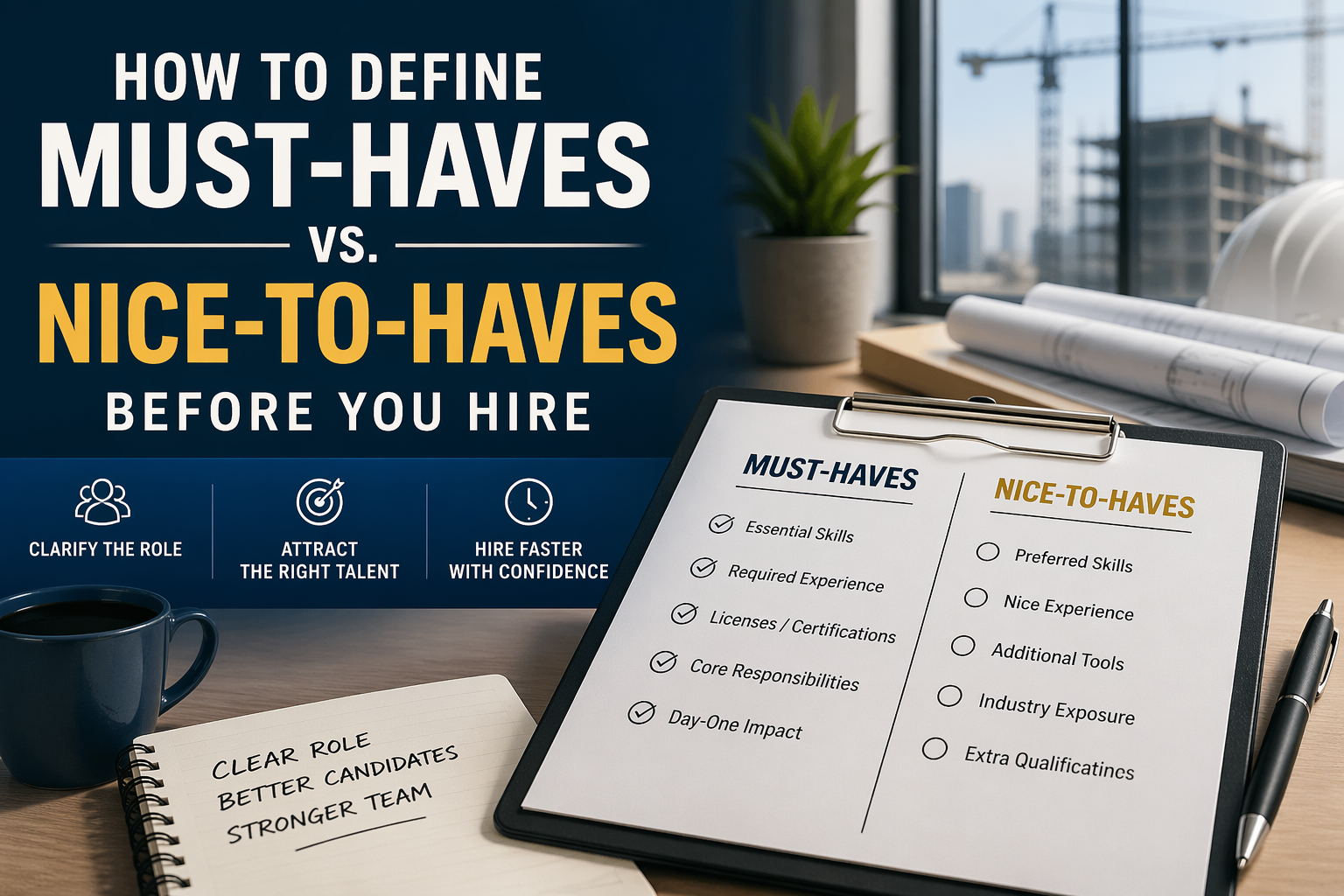
Before you open a role, approve a job description, or start reviewing candidates, you need to know which qualifications are truly necessary and which ones are simply preferred. That decision affects how quickly you hire, how strong your candidate pool is, and how aligned your team stays throughout the process.
When employers do not separate must-haves from nice-to-haves early, the search often becomes harder than it needs to be. The role stays open longer, the candidate pool narrows, interview feedback gets inconsistent, and strong applicants are ruled out for reasons that may have little to do with actual job performance. In technical hiring especially, unclear or inflated requirements can turn a realistic search into an unnecessarily difficult one.
Defining the difference up front helps you hire with more clarity and fewer delays.
What a Must-Have Really Means
A must-have is a qualification, skill, or level of experience the person genuinely needs to succeed in the role. It is tied directly to doing the work, meeting business expectations, managing risk, or stepping into responsibilities that cannot wait.
In most cases, a true must-have is connected to one of a few practical realities. The person may need the skill immediately to perform on day one. The requirement may be tied to safety, licensing, compliance, or quality standards. It may be necessary to keep a project moving, manage a client relationship, or make technical decisions without a long ramp-up period.
For example, if you are hiring a civil engineer who must stamp plans, the license may be non-negotiable. If you are hiring a superintendent to take over an active construction site, field leadership experience is likely essential. If you need a manufacturing engineer to improve an existing production process right away, certain hands-on process knowledge may belong in the must-have category.
A real must-have should always be easy to defend. It should be there because the role depends on it, not because it sounds good in a job description.
What a Nice-to-Have Really Means
A nice-to-have is something that would improve the fit, shorten onboarding, or match an ideal background, but is not required for success in the job.
This is where many employers become too restrictive. A candidate may not come from the exact same industry, may not have used one preferred software platform, or may not match every preferred credential, yet still be fully capable of succeeding in the role. In many cases, those preferences are useful but not essential.
That distinction matters because nice-to-haves often get treated like hard requirements during the hiring process. Once that happens, the search becomes narrower than the business actually needs.
Why Hiring Teams Often Overbuild the Role
This usually happens for understandable reasons. Hiring managers want someone who can contribute quickly. Leadership wants to avoid mistakes. HR wants the process to be structured. Team members want someone who feels like a perfect fit. Over time, those perspectives can turn a focused role into a long list of demands.
Sometimes employers are trying to solve multiple business problems with one hire. Sometimes they are replacing a strong employee and want an exact replica. Sometimes they are trying to eliminate all training time. And sometimes several stakeholders contribute preferences without ever ranking what matters most.
In engineering, architecture, construction, and manufacturing, this becomes even more common because technical roles already require a certain level of specialization. If employers continue adding preference after preference on top of a limited talent pool, the search often becomes harder, slower, and more expensive than expected.
What Happens When You Get It Wrong
When must-haves and nice-to-haves are blurred together, the effects show up quickly.
The first issue is usually a smaller candidate pool. Strong applicants may decide not to apply because they do not meet every listed item. Others may be screened out even though they could do the job well.
The second issue is time. The more rigid and overbuilt the role becomes, the longer it usually takes to find candidates who match it. That delay affects project schedules, team performance, output, and management focus.
The third issue is compensation pressure. If the employer is effectively describing a rare combination of skills, credentials, software knowledge, and industry experience, the market may price that candidate much higher than the original budget anticipated.
The fourth issue is inconsistency in interviews. If the hiring team has not aligned around what matters most, each interviewer ends up evaluating candidates differently. One person focuses on technical skill, another on industry background, another on communication style, and no one is working from the same definition of success.
Finally, employers often lose strong candidates for the wrong reasons. Some of the best hires are not perfect matches on paper. They are people with strong fundamentals, relevant experience, and the ability to ramp up quickly. When every preference becomes a requirement, those candidates are often filtered out too early.
A Better Way to Sort Requirements Before You Hire
A useful way to think about this is to pressure-test every requirement before the role goes live.
Start by asking what the person actually needs to do on day one. If the role requires immediate ownership of technical work, project leadership, client communication, compliance responsibility, or field execution, those capabilities may be true must-haves. If the skill can be learned during onboarding without creating risk or disruption, it may belong in the nice-to-have category instead.
Next, ask what is tied directly to business risk. Requirements related to safety, regulations, certifications, quality, and core project execution deserve more weight than preferences based on familiarity or convenience.
Then ask what can realistically be trained. Employers often narrow their own search unnecessarily by assuming too much needs to be present on day one. Internal systems, certain software tools, reporting methods, and company-specific processes can often be taught if the person has the right foundation.
It also helps to separate what is role-critical from what is manager-preferred. A manager may strongly prefer someone from a direct competitor, one exact project type, or one specific operating environment. That may be understandable, but preference is not the same as necessity. If the candidate can perform the job well without that exact background, it should not automatically be treated as a must-have.
Most importantly, define the real problem the hire is meant to solve. Are you trying to reduce backlog, improve production, manage projects more effectively, support growth, replace a retiring specialist, or build a new capability? Once the business need is clear, the role requirements usually become clearer too.
Why Internal Alignment Matters Before Recruiting Begins
A better search starts before any candidates are contacted.
HR, the hiring manager, and leadership should agree on the purpose of the role, the few qualifications that are truly non-negotiable, the areas where flexibility is acceptable, and the kind of candidate the market is likely to produce at the approved compensation level.
This matters because many hiring problems are not really recruiting problems. They are role-definition problems.
When the team is not aligned at the start, that confusion tends to appear later as changing expectations, conflicting interview feedback, rejected finalists, or stalled decisions. Those issues extend the search and often force the employer to revisit the role after losing valuable time.
Why This Matters in Technical Hiring
In DAVRON’s markets, this issue is especially important because the roles are often specialized and tied directly to project delivery, production performance, quality, and operational results.
A mechanical engineering role, for example, may genuinely require product design experience, tolerance knowledge, or familiarity with a specific manufacturing environment. But it may not require mastery of one exact CAD platform if the candidate has worked in comparable systems and can adapt quickly.
An architecture firm may need someone with strong construction document experience and coordination ability, but not necessarily someone from one narrowly defined project background if the technical capabilities transfer well.
A construction employer may need a superintendent with proven field leadership, scheduling coordination, and subcontractor oversight, while remaining flexible on whether the candidate has worked on the exact same asset type.
A manufacturing company may need someone who can solve process problems, improve throughput, and support production goals quickly, but not necessarily someone from one identical plant environment if the core engineering and operational skills are strong.
These distinctions shape whether the search is realistic or unnecessarily restrictive.
When Outside Help Makes Sense
Some roles are easy to define internally. Others are not.
If the position is highly technical, newly created, repeatedly open, or tied to an important business objective, it often helps to get outside input before the search begins. This is where a specialized recruiter can add value earlier in the process.
A recruiter with experience in engineering, architecture, construction, or manufacturing hiring can help employers determine which requirements are essential, which ones are limiting the search unnecessarily, and what kind of candidate is actually realistic in the market. That perspective can improve the role definition before time is lost on a search built around the wrong criteria.
For DAVRON, this is part of the value of specialization. When employers are trying to hire technical professionals, role clarity is not a minor detail. It is one of the factors that most directly shapes the outcome of the search.
Get Help Clarifying the Role
If you are still defining the position, that does not mean you are too early to get recruiting support. In many cases, that is the best time to get it.
Clarifying must-haves versus nice-to-haves before the search starts can help you move faster, improve alignment, attract stronger candidates, and avoid building a role around unrealistic expectations. For technical hiring, that early clarity often makes the difference between a focused search and a frustrating one.
Ready to hire engineering, architecture, construction, or manufacturing professionals?
DAVRON specializes in delivering high-quality candidates in these industries.
Ready to hire engineering, architecture, construction, or manufacturing professionals?
DAVRON specializes in delivering high-quality candidates in these industries.