
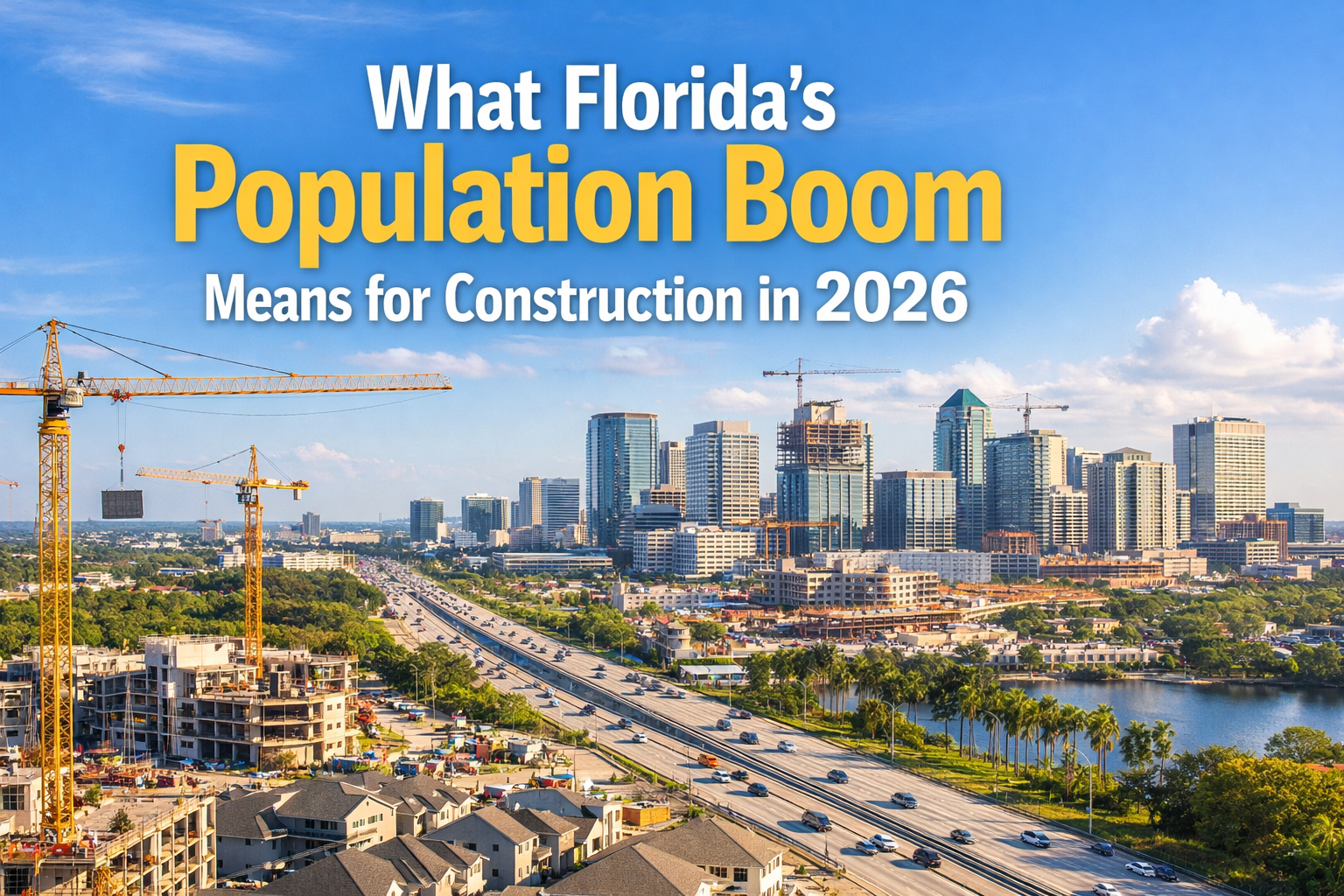
Florida has been one of the fastest-growing states in the U.S. for several years—and the effects are being felt across every corner of the construction industry. From new housing developments and highways to hospitals and logistics hubs, the Sunshine State’s population surge is creating massive demand for new infrastructure and skilled construction professionals.
With Florida’s population estimated at over 23.4 million residents in 2025, up nearly 9% since 2020, the pressure to build is only intensifying.
For contractors, developers, and engineers, the message is clear: Florida’s growth is translating directly into construction opportunities—but also new challenges.
Florida’s Population Growth Is Still Accelerating
Migration has been the primary driver of Florida’s population expansion. Hundreds of thousands of people continue to move to the state each year, attracted by:
No state income tax
Warm climate and lifestyle
Expanding job opportunities
Remote and hybrid work flexibility
In 2025 alone, estimates suggest nearly 467,000 new residents moved to Florida, pushing the population close to 24 million people.
Looking ahead, projections indicate the state could reach nearly 26 million residents by 2035, adding more than 2.6 million people in just a decade.
That kind of population surge effectively means a new mid-sized city is being added to Florida every year, placing enormous pressure on housing and infrastructure.
Housing Demand Is Driving Massive Residential Construction
The most immediate impact of Florida’s population boom is the surge in housing construction.
New residents require:
Single-family homes
Multifamily apartments
Retirement communities
Mixed-use developments
Florida issued over 173,000 building permits in 2024, reflecting sustained demand for new housing.
Between 2020 and 2024 alone, the state built more than 760,000 new homes, illustrating how aggressively developers have responded to migration trends.
However, the rapid growth has also created new challenges:
Rising land prices
Higher insurance costs
Zoning and permitting delays
Infrastructure strain in growing metros
For builders, this means projects are abundant—but efficient planning and cost control are more important than ever.
Infrastructure Is Struggling to Keep Up
Population growth doesn’t just mean new homes—it requires entire ecosystems of infrastructure.
Cities across Florida are investing heavily in:
Road expansions and highway upgrades
Public transportation improvements
Schools and universities
Hospitals and healthcare facilities
Water and utility systems
Construction spending tied to infrastructure, commercial buildings, and housing has become one of the largest drivers of Florida’s economy. The construction industry contributes over $200 billion annually to the state economy and supports millions of jobs statewide.
Fast-growing regions such as Tampa, Orlando, Jacksonville, and South Florida are seeing particularly intense development pressure.
Industrial and Logistics Construction Is Exploding
Another under-reported effect of population growth is the boom in industrial and logistics construction.
As Florida’s population increases, so does demand for:
Distribution centers
Cold storage facilities
Manufacturing upgrades
Port and logistics infrastructure
E-commerce expansion and global supply chain changes are accelerating this trend. Warehousing and logistics projects have become some of the fastest-growing construction sectors in the state heading into 2026.
This growth is especially visible near major ports and interstate corridors in cities like Miami, Tampa, and Jacksonville.
Labor Shortages Are Becoming a Major Constraint
While demand for construction is booming, the labor supply is struggling to keep up.
Florida’s construction industry is already experiencing shortages in key roles such as:
Project managers
Superintendents
Estimators
Skilled trades (MEP, framing, drywall, concrete)
Safety and QC professionals
Industry forecasts suggest the competition for construction talent will intensify through 2026, as project pipelines expand faster than the available workforce.
For companies, recruiting and retaining skilled workers could become the biggest competitive advantage.
Key Challenges the Industry Must Watch
Despite strong demand, several risks could affect Florida construction in 2026:
1. Housing affordability
Home prices have risen dramatically, potentially slowing buyer demand.
2. Insurance and climate risks
Hurricanes and rising insurance costs are impacting development economics.
3. Permitting and regulatory delays
Rapid growth is putting pressure on local planning departments.
4. Infrastructure strain
Some regions are struggling to keep utilities and transportation systems aligned with growth.
Companies that adapt to these challenges will be best positioned to thrive.
What This Means for Contractors and Developers
Florida’s population boom is fundamentally reshaping the construction landscape.
The biggest opportunities will likely emerge in:
Residential housing developments
Infrastructure and public works
Healthcare and education facilities
Industrial and logistics projects
Mixed-use urban developments
In short, Florida is transitioning from a fast-growing state to a mega-growth construction market.
FAQ
Why is Florida’s population growing so fast?
Florida’s growth is fueled primarily by domestic migration, job opportunities, warm weather, and favorable tax policies.
Which cities are seeing the most construction?
Tampa, Orlando, Miami, Jacksonville, and emerging markets like Lakeland are among the fastest-growing development hubs.
Is Florida facing a housing shortage?
In many areas, yes. Population growth has often outpaced housing supply, leading to high prices and increased construction activity.
What construction sectors will grow the most in 2026?
Residential housing, logistics facilities, infrastructure projects, healthcare buildings, and mixed-use developments are expected to lead growth.
Sources
U.S. Census Bureau — Florida Population Estimates (Updated 2024)
https://www.census.gov/quickfacts/fact/table/FLBusiness Insider — Florida housing market trends and homebuilding activity (June 2025)
https://www.businessinsider.com/florida-home-price-drops-insurance-real-estate-trend-sales-market-2025-6Seacoast Bank — Florida Residential Demographic Growth Trends (2025 report)
https://seacoastbd.com/floridas-2025-residential-demographicsKEYT News — Florida population growth and infrastructure concerns (July 2025)
https://keyt.com/news/2025/07/10/floridas-population-boom-raises-infrastructure-concerns-along-gulf-coastWorldMetrics — Florida Construction Industry Statistics (2024–2025)
https://worldmetrics.org/florida-construction-industry-statisticsApproach Talent — Florida Construction Sector Forecast 2026 (Industry analysis)
https://www.approachtalentusa.com/blog/florida-construction-sector-forecast-2026