
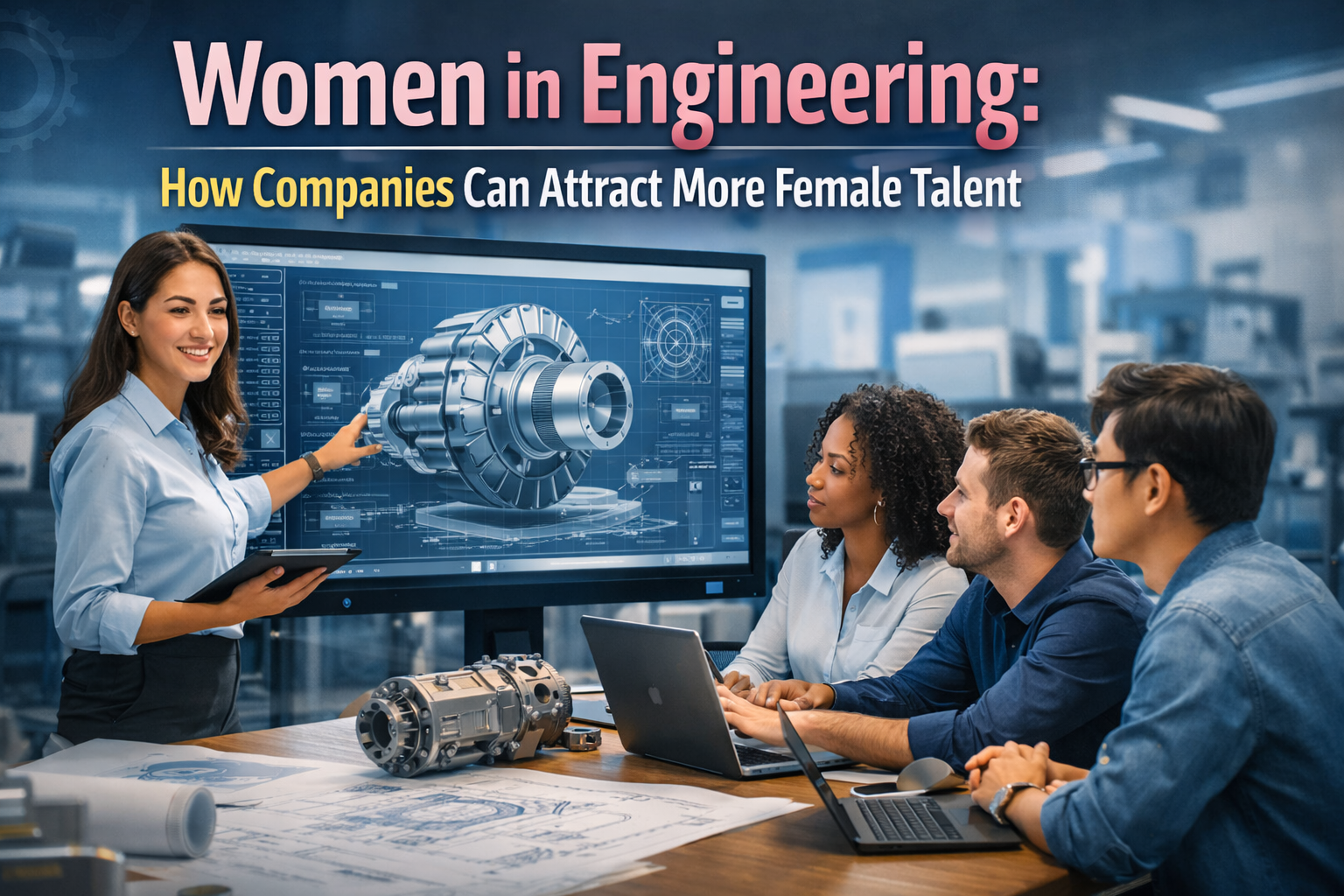
Engineering drives innovation—from infrastructure and manufacturing to AI and renewable energy. Yet despite decades of progress, women remain significantly underrepresented in engineering roles.
In the United States, women make up only about 16% of engineers and architects, according to the American Society of Mechanical Engineers (2024). At the same time, women represent roughly 26% of the overall STEM workforce, showing that engineering still lags behind other technical fields in gender representation.
This gap represents more than a diversity issue—it’s a missed opportunity for innovation and growth. Research consistently shows that diverse teams outperform less diverse ones, generating better solutions, stronger collaboration, and improved business outcomes.
As March marks Women’s History Month, organizations across the engineering sector have an opportunity to reflect on how they recruit, support, and retain female talent. Companies that build inclusive hiring strategies are not only improving equity—they’re strengthening their competitive advantage.
Why Diverse Engineering Teams Perform Better
Diversity in engineering teams leads to measurable improvements in innovation, productivity, and financial performance.
Better Problem-Solving and Innovation
Engineering challenges rarely have simple solutions. Teams composed of people with different backgrounds and perspectives are more likely to identify blind spots and develop creative solutions.
Studies show that gender-diverse teams can significantly improve creativity and collaboration, particularly when companies foster inclusive environments that ensure every team member’s ideas are valued.
Stronger Financial Performance
The benefits of diversity extend beyond innovation. Corporate research has repeatedly found that organizations with strong gender diversity in leadership are more likely to outperform industry averages in profitability.
Companies that actively invest in inclusive workplaces often see improved employee engagement, higher retention, and stronger financial performance.
Higher Quality Technology and Products
Diverse engineering teams also build better products. When developers and engineers bring different perspectives to the design process, they are more likely to consider a broader range of users.
Research examining AI development teams found that diverse groups often produce higher-quality code and more successful project outcomes, demonstrating that diversity has measurable technical benefits.
The Current State of Women in Engineering
Despite progress, the engineering industry still struggles with gender representation.
Key statistics highlight the gap:
Women represent about 26% of the STEM workforce in the United States.
Only around 16% of engineers are women.
Growth in female representation within engineering has increased slowly over the past two decades.
Researchers often describe this challenge as the “leaky pipeline” problem, where women leave engineering careers at higher rates due to workplace culture issues, lack of mentorship, or limited advancement opportunities.
For companies struggling to fill engineering positions, this represents a major opportunity. Attracting and retaining more women in engineering can significantly expand the available talent pool.
Strategies for Inclusive Hiring in Engineering
1. Write Job Descriptions That Encourage Female Applicants
Many engineering job descriptions unintentionally discourage women from applying.
Research shows women are less likely to apply for a position unless they meet nearly all of the listed requirements, while men often apply even if they meet only some of them.
Companies can improve applicant diversity by:
Removing unnecessary or overly rigid requirements
Avoiding aggressive or masculine-coded language
Emphasizing growth opportunities and training
Even small changes in job descriptions can significantly increase female applicant rates.
2. Showcase Female Role Models in Engineering
Representation matters. When women see others succeeding in engineering roles, they are more likely to pursue similar careers.
Companies can strengthen recruitment by:
Highlighting female engineers on company websites and social media
Featuring women in leadership in recruiting materials
Encouraging engineers to participate in STEM outreach programs
Visible role models help challenge the stereotype that engineering is a male-dominated profession.
3. Build Strong Mentorship and Sponsorship Programs
Mentorship plays a critical role in career development for engineers—especially women entering male-dominated industries.
Effective programs often include:
Pairing junior engineers with experienced mentors
Leadership sponsorship programs for high-potential employees
Peer support networks and employee resource groups
These initiatives help women navigate career challenges and accelerate professional growth.
4. Offer Flexible Work and Family-Friendly Policies
Work-life balance continues to be a major factor influencing employee retention.
Many organizations are expanding caregiver benefits, flexible schedules, and hybrid work options to better support working parents and caregivers. Companies that offer these benefits often see improvements in employee satisfaction and retention.
Flexible workplace policies also make engineering careers more accessible to a broader range of professionals.
5. Partner with Universities and STEM Organizations
Long-term solutions require strengthening the pipeline of women entering engineering.
Successful strategies include:
Internship programs targeting female engineering students
Partnerships with organizations such as the Society of Women Engineers (SWE)
Scholarships or sponsorships supporting STEM education
Organizations that invest early in talent development often build stronger recruitment pipelines and long-term industry relationships.
Building an Inclusive Engineering Culture
Recruitment alone is not enough—retention matters just as much.
Engineering companies must also focus on creating workplace cultures where diverse perspectives are valued and employees feel supported.
This can include:
Addressing unconscious bias in hiring and promotion decisions
Ensuring equal access to leadership opportunities
Encouraging collaborative and inclusive team environments
When inclusion accompanies diversity, organizations unlock the full creative and innovative potential of their engineering teams.
The Business Case Is Clear
Engineering companies facing talent shortages cannot afford to overlook half the workforce.
By embracing inclusive hiring strategies, organizations can:
Access a broader talent pool
Improve innovation and problem-solving
Strengthen financial performance
Build products that better serve diverse populations
In today’s competitive engineering landscape, diversity is not just a social priority—it’s a strategic advantage.
FAQ
Why are women underrepresented in engineering?
Several factors contribute, including cultural stereotypes, limited early exposure to STEM education, workplace bias, and retention challenges within engineering environments.
Do diverse engineering teams perform better?
Yes. Research consistently shows that diverse teams improve creativity, innovation, and financial performance across many industries.
What can companies do to attract more women engineers?
Key strategies include inclusive hiring practices, mentorship programs, flexible work policies, visible role models, and partnerships with STEM organizations.
Why does diversity matter in engineering design?
Engineering solutions impact diverse populations. Teams with broader perspectives are more likely to design products that work effectively for a wider range of users.
Sources
American Society of Mechanical Engineers (ASME). A Snapshot of Women in Engineering Today. Published 2024.
https://www.asme.org/topics-resources/content/infographic-a-snapshot-of-women-in-engineering-today
European Centre for Women and Technology. 100 Women in STEM Statistics. Published 2025.
https://ecwt.eu/news/100-women-in-stem-statistics-2025/
Harvard Division of Continuing Education. Why Gender Equity in the Workplace Is Good for Business. Published 2023.
https://professional.dce.harvard.edu/blog/why-gender-equity-in-the-workplace-is-good-for-business/
Society of Women Engineers. Women in Engineering and STEM: A Review of the 2024 Literature. Published 2024.
https://swe.org/magazine/women-in-engineering-and-stem-a-review-of-the-2024-literature/
McKinsey & Company & LeanIn.Org. Women in the Workplace Report. Published 2024.
https://www.mckinsey.com/featured-insights/diversity-and-inclusion/women-in-the-workplace
Heise Online. Women in Tech Teams: Diversity Is Doing Better. Published 2024.
https://www.heise.de/en/background/Women-in-tech-teams-Diversity-is-doing-better-10340566.html