
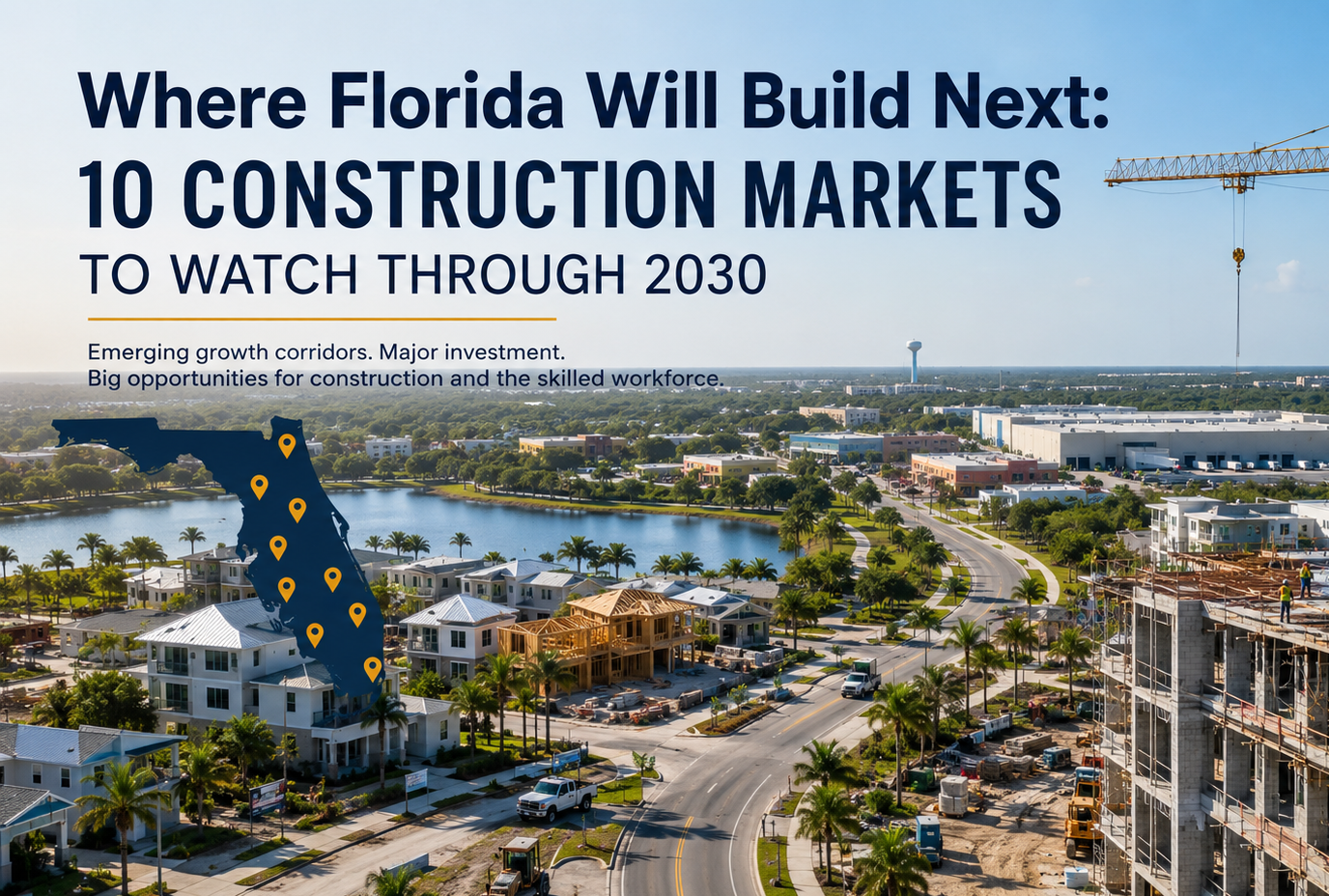
Florida’s next construction boom will not be confined to Miami, Orlando, Tampa, and Jacksonville.
Population growth is pushing farther into secondary metros and development corridors where housing, roads, utilities, healthcare facilities, industrial buildings, logistics centers, and commercial projects must follow. For construction companies, developers, engineering firms, architecture firms, and manufacturers, that creates opportunity—but it can also create a workforce problem.
When development reaches a market faster than the skilled workforce does, employers can find themselves competing for the same construction superintendents, project managers, estimators, civil engineers, MEP engineers, architects, designers, and other technical professionals.
That makes workforce planning part of market planning.
The latest population data provides an early indication of where pressure is building. From July 2024 to July 2025, Ocala was the fastest-growing metropolitan area in the United States at 3.4%, while Lakeland–Winter Haven grew 2.7% and Punta Gorda grew 2.7%, placing all three among the country’s five fastest-growing metros.
Florida’s latest official projections reinforce the longer-term trend. The state is projected to grow from approximately 23.38 million residents in 2025 to 24.91 million in 2030, with substantial growth projected in counties including Polk, Osceola, Manatee, St. Lucie, St. Johns, Sumter, Lee, Marion, and Nassau.
For employers deciding where to pursue work next, these 10 markets deserve attention.
1. Lakeland–Winter Haven and Polk County: Florida's I-4 Growth Engine
Lakeland–Winter Haven is no longer simply the territory between Tampa and Orlando.
The metro grew from approximately 851,400 residents in 2024 to nearly 874,800 in 2025, a 2.7% increase that made it the fourth-fastest-growing U.S. metro during that period. Florida’s latest projections put Polk County at approximately 846,900 residents in 2025 and more than 936,500 by 2030.
What may get built
Polk County’s location along the I-4 corridor gives it unusual access to both the Tampa Bay and Orlando markets. Continued population and employment growth can support demand for:
- industrial and distribution facilities
- residential communities
- roads and transportation infrastructure
- water and wastewater infrastructure
- healthcare facilities
- schools and public facilities
- retail and commercial construction
Why employers should care
Polk County offers contractors and developers access to one of Florida’s most important inland growth corridors without operating directly inside Tampa or Orlando.
But that same location can create recruiting competition. Experienced construction and engineering professionals may have opportunities across a wide Central Florida territory.
Employers expanding into Polk County should expect demand for project managers, superintendents, estimators, civil engineers, land-development professionals, MEP talent, and industrial construction expertise to remain important.
2. Ocala and Marion County: Rapid Growth Is Becoming an Infrastructure Story
Ocala may be the clearest example of why construction firms should look beyond Florida’s largest cities.
The Ocala metro grew 3.4% between July 2024 and July 2025, making it the fastest-growing metro area in the country. That followed 4% growth in the prior Census reporting period.
Florida projects Marion County’s population to rise from roughly 433,800 in 2025 to 471,100 by 2030.
Population growth is also translating into infrastructure work. Marion County’s January 2026 project report includes multiple road widening, reconstruction, right-of-way and new-road projects, including work around SR 40, SW 80th Avenue, NW 49th/35th Street and the Marion Oaks area.
What may get built
Ocala’s growth points toward continued demand for:
- roads and transportation improvements
- residential development
- utilities and drainage
- healthcare facilities
- commercial projects
- schools and public infrastructure
- industrial and distribution space
Why employers should care
Rapid growth can expose a mismatch between project demand and the number of experienced professionals already living in a secondary market.
Civil engineers, project managers, superintendents, estimators, land-development engineers, survey professionals, utility specialists, and CAD/BIM professionals could become increasingly valuable as Marion County expands.
Contractors waiting until a project is ready to mobilize may discover that qualified local candidates are already working.
3. Port St. Lucie and the Treasure Coast: Residential Growth Meets Industrial Development
Port St. Lucie deserves attention for more than housing growth.
Florida projects St. Lucie County to increase from approximately 394,100 residents in 2025 to 438,200 in 2030. Port St. Lucie itself reports a population exceeding 260,000 in 2025.
The employment side of the equation is equally important.
Port St. Lucie’s FY 2025–26 budget identifies a pipeline that includes a 595,000-square-foot Costco distribution facility, a proposed 250,000-square-foot manufacturing facility, a 160,000-square-foot distribution facility, and additional manufacturing development.
The Costco project is planned as a multi-phase development ultimately totaling approximately 1.87 million square feet and more than 500 jobs.
What may get built
Watch for continued activity in:
- manufacturing
- distribution and logistics
- industrial facilities
- residential communities
- mixed-use development
- healthcare
- roads and utilities
- public and recreational infrastructure
Why employers should care
Port St. Lucie is developing a more diverse construction market.
That can increase demand for professionals with experience in industrial construction, manufacturing facilities, civil infrastructure and large residential developments—not simply traditional commercial construction.
Project managers, superintendents, civil engineers, MEP engineers, manufacturing engineers and estimators may become particularly important.
4. Palm Bay–Melbourne and the Space Coast: Advanced Manufacturing Is Driving Specialized Construction
Brevard County presents a different kind of opportunity.
This is not simply population-driven construction. The Space Coast is attracting major aerospace and advanced-manufacturing investment that requires highly specialized facilities and technical expertise.
In May 2026, Blue Origin announced a $600 million expansion at its Cape Canaveral campus involving an estimated 830,000-square-foot upper-stage manufacturing facility and 500 aerospace jobs.
Lockheed Martin has also announced a $140 million advanced-manufacturing facility in Titusville expected to support up to 300 private-sector jobs.
Florida’s Space Coast economic-development organization reports that manufacturing employment in Brevard County has increased 19% since 2001 even as manufacturing employment declined nationally over the same period.
What may get built
The Space Coast should remain important for:
- aerospace manufacturing facilities
- advanced manufacturing
- laboratories and technical facilities
- industrial construction
- transportation and utility infrastructure
- housing supporting workforce growth
- commercial and public facilities
Why employers should care
Specialized projects require specialized people.
Employers may need construction managers, project engineers, MEP engineers, electrical engineers, mechanical engineers, manufacturing engineers, controls professionals, architects and other candidates who understand sophisticated technical environments.
That talent pool is much narrower than the pool for conventional construction.
5. Sarasota–Bradenton and Manatee County: Southwest Growth Keeps Moving
The Sarasota–Bradenton region continues to expand beyond its established urban areas into new residential and commercial corridors.
Florida’s latest projection puts Manatee County at approximately 466,800 residents in 2025 and more than 517,200 by 2030—an increase of roughly 50,000 residents in five years. Sarasota County is projected to increase from about 487,600 to 525,800 during the same period.
Current Manatee County development proceedings also reflect continued activity involving residential communities, healthcare and commercial development, including proposals connected to Parrish-area development and a freestanding emergency facility.
What may get built
Potential demand includes:
- residential communities
- healthcare
- commercial centers
- schools
- transportation improvements
- utilities
- mixed-use development
- public infrastructure
Why employers should care
As development moves farther from Sarasota and Bradenton’s established cores, contractors need people capable of managing large greenfield projects and the infrastructure surrounding them.
Civil engineers, land-development professionals, project managers, superintendents, estimators, architects and MEP professionals are likely to remain critical.
6. Fort Myers–Cape Coral and Lee County: Growth, Infrastructure and Resilience
Southwest Florida remains one of the state’s major long-term development stories.
Florida projects Lee County to grow from approximately 839,200 residents in 2025 to more than 914,100 by 2030.
Growth at that scale requires far more than houses.
Lee County Utilities specifically operates a development program covering developer-funded water and wastewater infrastructure for projects ranging from individual improvements to the systems required for full-scale residential and commercial development.
Cape Coral is also planning transportation capacity improvements involving Burnt Store Road, the Cape Coral and Midpoint bridges, and support for a potential I-75 interchange at Del Prado Boulevard.
What may get built
Expect continued opportunity around:
- residential construction
- water and wastewater systems
- transportation
- bridges and roadway capacity
- stormwater and resilience projects
- healthcare
- commercial construction
- public infrastructure
Why employers should care
Southwest Florida creates a broad technical hiring challenge because growth involves both vertical construction and civil infrastructure.
Companies may need superintendents and project managers alongside civil engineers, utility engineers, structural engineers, MEP engineers, estimators and infrastructure specialists.
7. Punta Gorda and Charlotte County: A Smaller Market With Outsized Growth Signals
Punta Gorda is exactly the kind of secondary market construction employers can overlook.
The Punta Gorda metro grew 2.7% from 2024 to 2025, making it the fifth-fastest-growing U.S. metro in the Census Bureau’s latest rankings.
Development is visible on the ground as well.
Charlotte County’s late-2025 major-project report identified projects including commercial construction, a hotel, public facilities, continued residential permitting at Babcock Ranch and a proposed subdivision of more than 300 single-family lots. The county reported more than 36,000 permits issued during FY 2024–25.
Transportation is another factor. The Charlotte County–Punta Gorda MPO lists the Harborview Road widening program among its highest priorities, with one segment programmed for construction in FY 2026.
What may get built
Watch for:
- residential communities
- roads
- utilities and stormwater
- commercial centers
- hospitality
- healthcare
- public facilities
- resilience infrastructure
Why employers should care
Smaller markets can become difficult hiring markets quickly because they begin with a smaller pool of experienced technical professionals.
An employer winning several projects in Charlotte County may need to recruit beyond Punta Gorda and Port Charlotte, potentially drawing candidates from Fort Myers, Sarasota, Tampa or farther away.
8. Kissimmee–St. Cloud and Osceola County: Orlando's Growth Is Moving South
Kissimmee and St. Cloud should not be viewed only as extensions of Orlando.
Osceola County is becoming a significant growth corridor in its own right.
Florida projects Osceola County’s population to increase from approximately 484,900 in 2025 to 562,900 in 2030—growth of about 78,000 people in five years.
Infrastructure and higher-density development are following.
A 2025 Osceola County agreement involving St. Cloud identified approximately $25.2 million in framework road improvements associated with development south of Nolte Road.
Meanwhile, the NeoCity Center development framework includes plans for mixed-use, office and hotel parcels as well as public infrastructure and a performing arts center.
What may get built
The corridor presents opportunities in:
- master-planned residential development
- roads and transportation
- utilities
- mixed-use projects
- offices
- hospitality
- technology-oriented facilities
- public infrastructure
Why employers should care
Osceola County employers compete not only with each other but with the enormous Orlando construction and engineering labor market immediately to the north.
Companies pursuing projects here may need to recruit aggressively for civil engineers, project managers, superintendents, estimators, MEP engineers, architects and land-development professionals.
9. The Villages–Wildwood and Sumter County: Development Requires Infrastructure Behind It
The Villages–Wildwood corridor illustrates how sustained residential growth creates a second wave of construction.
Florida projects Sumter County to grow from approximately 162,500 residents in 2025 to 187,000 in 2030—an increase of roughly 15%.
And development is still being planned.
Financial records for Village Community Development District No. 15 describe approximately 1,378 acres within Wildwood with 3,616 planned residential units in Phase I and another 3,700 in Phase II, supported by roadway, drainage, lighting, multimodal, water and wastewater infrastructure.
Sumter County has also cited continued growth around Wildwood as a reason for planning additional public-safety infrastructure, including a new fire station along the U.S. 301 corridor.
What may get built
Continued growth can support:
- residential communities
- healthcare
- roads
- water and wastewater infrastructure
- drainage
- public-safety facilities
- retail and services
- recreational facilities
Why employers should care
This is another market where the local technical workforce may not expand at the same pace as development.
Civil engineers, utility specialists, construction managers, superintendents, estimators and professionals experienced in large master-planned communities could be particularly important.
10. St. Johns and Nassau Counties: North Florida's Growth Is Moving Beyond Jacksonville
The final market is better understood as a corridor.
Development north and south of Jacksonville is creating opportunities that are increasingly distinct from the city’s urban core.
Florida projects St. Johns County to grow from approximately 348,300 residents in 2025 to 405,700 in 2030, an increase of more than 57,000 people. Nassau County is projected to grow from approximately 107,100 to 119,300 over the same period.
That makes the broader St. Johns–Nassau growth corridor one to watch even when individual projects are associated with the larger Jacksonville economy.
What may get built
Population expansion can drive:
- master-planned residential communities
- schools
- healthcare facilities
- roads
- water and wastewater systems
- commercial development
- industrial and logistics projects
- municipal infrastructure
Why employers should care
Employers pursuing projects in these counties may find themselves competing for talent across the entire Northeast Florida market.
Civil engineers, project managers, superintendents, estimators, architects, MEP professionals and land-development specialists may have multiple options without needing to relocate.
That makes early recruiting especially valuable.
Why Secondary Florida Markets Can Become Hard Hiring Markets Quickly
A smaller market does not necessarily mean an easier hiring market.
In fact, the opposite can happen.
A major metro may have thousands of engineers and construction professionals spread among hundreds of employers. A fast-growing secondary market begins with a smaller talent base. Add several large developments at once, and experienced professionals can suddenly receive attention from multiple employers.
Four factors tend to amplify the problem.
Project demand can grow faster than the workforce
New residents create immediate demand for housing, roads, utilities, schools, healthcare and commercial services. Developing the experienced professionals needed to design and manage those projects takes much longer.
Major projects can absorb a meaningful share of local talent
One major industrial facility, infrastructure program or master-planned development can employ numerous project managers, engineers, superintendents and technical specialists.
Several simultaneous projects can significantly tighten the market.
Geography matters
Candidates in Ocala, Punta Gorda, Wildwood or St. Cloud may not consider a project 60 or 90 minutes away to be part of the same labor market, even when employers do.
Commutes, relocation requirements and hybrid-work limitations can shrink the realistic candidate pool.
The best candidates may never apply
Experienced superintendents, project managers and engineers are frequently already employed.
Posting another job advertisement may generate applicants without reaching the specific professionals an employer wants.
That becomes especially important when a company enters a market where it has a limited professional network.
What Construction Employers Should Do Before Entering a Florida Growth Market
Companies often evaluate a new market by looking at project pipelines, competitors, customers, margins and capital requirements.
Workforce availability belongs in the same analysis.
Before committing significant resources to an emerging Florida market, employers should identify the positions that could constrain execution.
Which roles must be located locally?
Which can support the project regionally?
Which positions will require market-specific experience?
What compensation will be necessary?
Will relocation be realistic?
How long will the hardest position actually take to fill?
The answers can influence whether a company is ready to pursue a project.
Employers should also build candidate pipelines before vacancies become emergencies. Establishing relationships with potential project managers, superintendents, engineers and estimators before an award can significantly improve the options available when work begins.
What If You Win a Project and Need People Immediately?
This is where market growth becomes a business problem rather than a recruiting problem.
A contractor wins a major project. A superintendent resigns. A client accelerates the schedule. A manufacturer approves an expansion. An engineering firm suddenly has more work than its existing staff can support.
Now someone is needed quickly.
Employers generally have several options:
- activate existing professional and employee-referral networks
- recruit candidates from adjacent Florida markets
- expand the search nationally when relocation makes sense
- identify qualified professionals working for competitors or related companies
- use targeted direct recruiting instead of relying exclusively on applicants
- engage a specialized recruiting firm to expand candidate reach quickly
For experienced and highly specialized positions, job postings alone may not be enough.
Many of the strongest candidates are working. They may not be browsing job boards or submitting applications, but they may consider the right opportunity when approached directly.
This is where DAVRON can support employers facing urgent or difficult technical hiring needs.
Rather than functioning as a broad generalist staffing company, DAVRON specializes in recruiting for engineering, architecture, construction, and manufacturing positions. That focus can be especially valuable when an employer needs a difficult-to-find professional in an emerging market where the local candidate pool is limited.
How DAVRON Helps Employers Hire in Florida's Emerging Construction Markets
Entering a new market can create a recruiting disadvantage.
Local competitors may already know the available superintendents, engineers, project managers and estimators. A company entering the region may have excellent projects and a strong employment opportunity but little connection to the local candidate network.
Specialized recruiting can help bridge that gap.
DAVRON focuses on technical hiring across engineering, architecture, construction, and manufacturing. That makes DAVRON particularly relevant when an employer:
- is entering a Florida market where it has limited recruiting reach
- needs to hire for a project-critical position
- cannot find enough qualified candidates locally
- requires specialized engineering or construction experience
- wants to reach employed professionals who are not actively applying
- needs to expand a search regionally or nationally
- has already spent valuable time trying to fill the position internally
The objective is not simply to generate more résumés.
For technical positions, employers need candidates whose experience actually aligns with the project, discipline, environment, responsibilities and location.
As Florida’s secondary construction markets grow, that distinction becomes increasingly important.
Frequently Asked Questions
What Florida cities are growing fastest for construction?
There is no single authoritative ranking of Florida cities by future construction volume. However, population growth and current development activity make markets including Ocala, Lakeland–Winter Haven, Port St. Lucie, Punta Gorda and several surrounding growth corridors worth watching. Ocala, Lakeland–Winter Haven and Punta Gorda were all among the five fastest-growing U.S. metros by percentage between July 2024 and July 2025.
What Florida construction markets should contractors watch through 2030?
Beyond Miami, Orlando, Tampa and Jacksonville, strong candidates include Lakeland–Winter Haven, Ocala, Port St. Lucie, the Space Coast, Sarasota–Bradenton, Fort Myers–Cape Coral, Punta Gorda, Kissimmee–St. Cloud, The Villages–Wildwood, and the St. Johns–Nassau corridor. The opportunity differs by market, so contractors should evaluate population projections alongside actual infrastructure, industrial, residential and commercial investment.
Is construction growth moving beyond Miami, Orlando, Tampa, and Jacksonville?
Yes. Census estimates show substantial growth in secondary Florida metros, and state projections point to continued expansion in numerous counties outside the four largest urban cores. The type and scale of construction will vary significantly by market.
Which Florida markets may need more construction professionals?
Markets experiencing rapid population growth, industrial investment and infrastructure expansion are likely to create additional demand for construction and engineering professionals. The specific needs depend on project mix. Industrial markets may create greater demand for MEP and manufacturing expertise, while residential growth corridors may put more pressure on civil engineering, land development and construction management talent.
Why are superintendents and project managers difficult to hire in fast-growing markets?
Experienced superintendents and project managers combine technical knowledge, leadership ability and direct project experience. In rapidly growing markets, several contractors may compete for a relatively small pool of professionals who meet all three requirements. Many qualified candidates are also employed and may never respond to conventional job advertisements.
How can construction companies recruit employees in a new Florida market?
Start before the project begins. Map the local candidate pool, benchmark compensation, determine how far candidates realistically commute, consider relocation where appropriate and recruit employed professionals directly. Employers with limited local networks can also work with a specialized construction and engineering recruiter such as DAVRON to broaden the search.
When should a contractor start recruiting before a new project begins?
For difficult-to-fill leadership and technical positions, recruiting should begin as soon as the employer has enough confidence in the project to define the position and evaluate candidates. Waiting until mobilization reduces options and turns a planned search into an urgent one.
The Bigger Question Is Not Just Where Florida Will Build
For contractors, developers, engineering firms, architecture firms and manufacturers, Florida’s emerging markets represent significant opportunity through 2030.
But identifying the next growth corridor is only half the decision.
The other question is whether your company can assemble the team required to compete and execute there.
Population growth can be projected. Projects can be pursued. New facilities can be designed. But experienced superintendents, project managers, estimators, engineers, architects and technical specialists cannot be created overnight.
Companies that anticipate those workforce requirements early will have more recruiting options than companies that wait until the project schedule makes the decision for them.
Ready to hire engineering, architecture, construction, or manufacturing professionals?
DAVRON specializes in delivering high-quality candidates in these industries.