
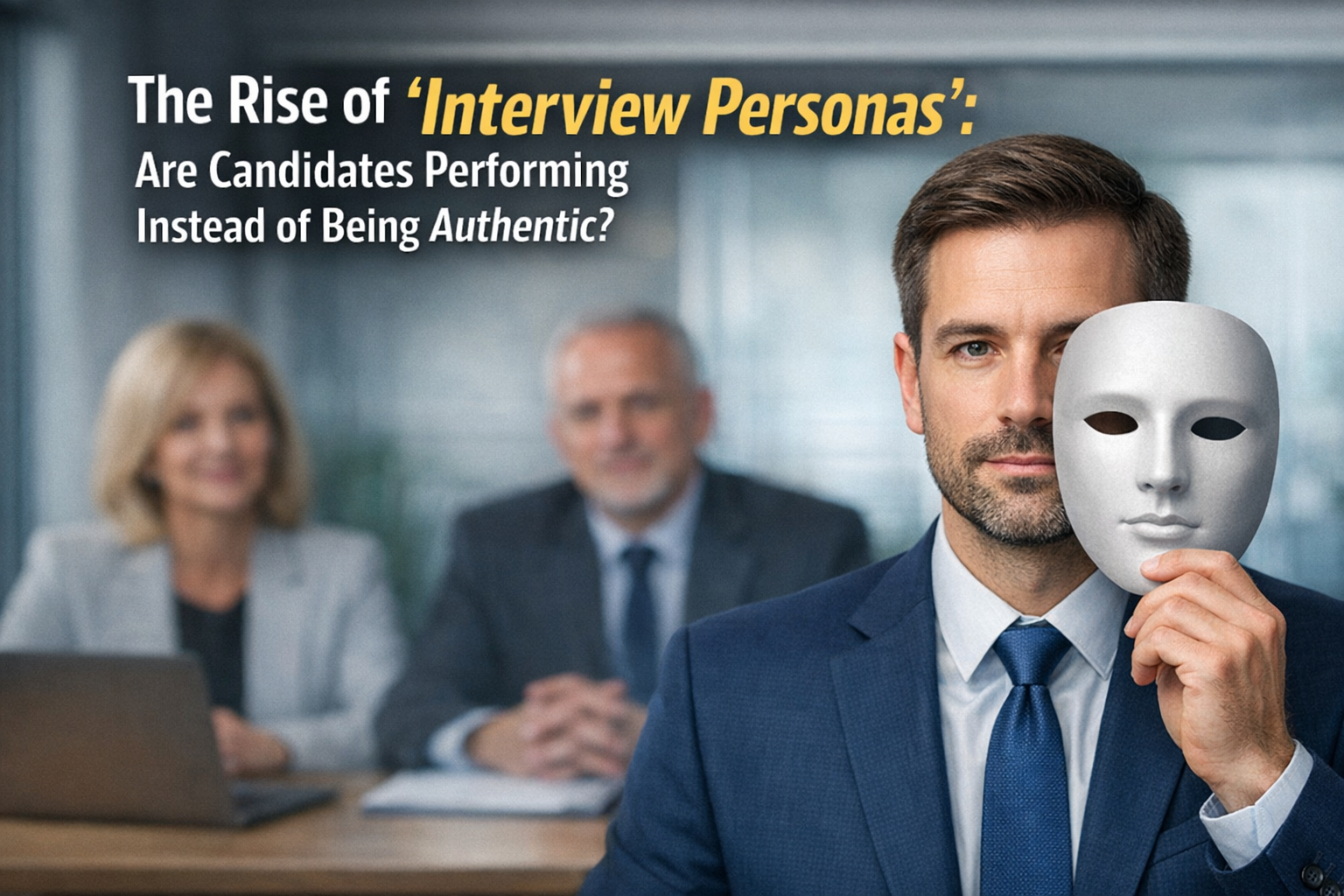
A polished interview has always involved some degree of performance. Candidates prepare stories, rehearse answers, adjust their tone, and present the most employable version of themselves. But in 2025 and 2026, that familiar polish appears to be evolving into something more deliberate: the interview persona.
The phrase captures a growing tension in hiring. As interviews become more structured, more remote, and more influenced by AI, candidates are increasingly tempted to deliver the version of themselves they think the system wants rather than the one that is most real. The result is a higher-stakes form of impression management, where authenticity can get squeezed out by strategy.
What Is an “Interview Persona”?
An interview persona is not exactly dishonesty, and it is not always malicious. In many cases, it is a curated professional identity built to survive a modern hiring process. That can mean memorized STAR answers, over-optimized body language, exaggerated confidence, or AI-polished responses that sound strong in the moment but reveal little about how the candidate actually thinks, collaborates, or solves problems.
As more organizations use AI in recruiting and interviewing, candidates have more reason to reverse-engineer what they believe evaluators want to hear. That makes the modern interview feel less like a conversation and more like a performance arena.
Why This Trend Is Growing Now
1. AI is changing how candidates behave
Research highlighted by Harvard Business Review in 2025 found that when candidates believed AI was assessing them, they emphasized analytical traits while downplaying human qualities like empathy and creativity.
In other words, the presence of AI does not just measure behavior—it changes it.
That shift creates a serious hiring risk: employers may end up selecting candidates who are best at performing for algorithms, not necessarily those best suited for real-world work.
2. Employers are worried about AI-assisted performance
Some companies are already pushing back.
Amazon, for example, issued guidance warning that using generative AI during interviews could lead to disqualification, framing it as an unfair advantage that distorts evaluation.
At the same time, organizations are revisiting in-person interviews—especially for final rounds—to better assess authenticity, communication, and real-time thinking.
3. Some companies are adapting instead of resisting
Not every employer sees this as a problem.
Some, like Meta, have explored allowing AI use in certain technical interviews, recognizing that AI is already part of the job itself. From this perspective, the real skill is not avoiding AI—it’s using it effectively.
This divide highlights a bigger question:
Should interviews test raw ability, or real-world performance augmented by technology?
Is Authenticity in Interviews Even Realistic?
Total authenticity in interviews has always been a bit of a myth.
Interviews are inherently artificial environments. Candidates are under pressure, employers are evaluating them, and both sides are managing impressions.
But there is a meaningful difference between:
Prepared authenticity (clear, thoughtful, honest communication)
Manufactured persona (over-optimized, scripted, and disconnected from reality)
When interviews reward perfect delivery over real insight, they unintentionally encourage candidates to lean into personas.
What Employers Should Watch For
Employers should be careful not to confuse polish with deception. Strong communicators are not inherently inauthentic—but overly uniform, overly rehearsed responses across candidates can be a warning sign.
To get more genuine insights, hiring teams can:
Ask follow-up questions that require real-time thinking
Use work samples or simulations
Focus on tradeoffs and decision-making, not just success stories
Compare consistency across multiple interview stages
The goal is not to eliminate performance—it’s to make substance more valuable than polish.
What Candidates Should Take From This
For candidates, creating an interview persona often feels like a survival strategy. Hiring processes can be opaque, competitive, and increasingly influenced by automation.
But over-optimizing comes with a risk: landing a role that doesn’t actually fit.
A highly polished persona might win the job, but it can also create misalignment once the real work begins.
The better approach is balance—prepare thoroughly, communicate clearly, but stay grounded in real experiences, honest strengths, and self-awareness.
The Bigger Hiring Question
The rise of interview personas says as much about employers as it does about candidates.
People perform when systems reward performance.
If hiring processes prioritize flawless answers, algorithm-friendly phrasing, and hyper-polished delivery, candidates will continue adapting accordingly.
That means the real issue is not whether candidates are being authentic.
It is whether hiring systems still allow authenticity to surface at all.
“Interview personas” describe a growing trend where candidates present highly optimized versions of themselves during interviews, often influenced by AI-driven hiring processes. Research shows candidates change their behavior when they believe AI is evaluating them, emphasizing analytical traits over human qualities. Meanwhile, employers are split—some are cracking down on AI-assisted interviews, while others are embracing AI as part of the evaluation process. The result is a hiring landscape where authenticity is harder to measure—and more important than ever.
FAQ
Are interview personas always dishonest?
No. Most are an extension of normal interview preparation. The issue arises when the performance masks how someone actually works.
Is AI the main cause of this trend?
AI is a major accelerant, but not the only factor. Structured interviews, competition, and remote hiring all contribute.
Are companies changing hiring practices because of this?
Yes. Some are reintroducing in-person interviews or redesigning assessments to better evaluate real skills.
Should candidates avoid preparation?
Not at all. Preparation is essential—but it should be rooted in real experience, not memorized perfection.
Sources and Publication Dates
Harvard Business Review, “How AI Assessment Tools Affect Job Candidates’ Behavior,” published July 14, 2025
https://hbr.org/2025/07/how-ai-assessment-tools-affect-job-candidates-behaviorHarvard Business Review, “Job Interviews Aren’t Evaluating the Right Skills,” published August 2025
https://hbr.org/2025/08/job-interviews-arent-evaluating-the-right-skillsSHRM, “Recruitment Is Broken. Automation and Algorithms Can’t Fix It,” updated 2026
https://www.shrm.org/topics-tools/news/hr-trends/recruitment-is-brokenSHRM, “In-Person Interviews Make a Comeback as Candidate AI Use Grows,” published January 2026
https://www.shrm.org/topics-tools/news/talent-acquisition/in-person-interviews-make-comeback-candidate-ai-use-growsBusiness Insider, “Amazon warns candidates against using AI in job interviews,” published February 2025
https://www.businessinsider.com/amazon-stop-people-using-ai-cheat-job-interviews-2025-2Business Insider / Meta reporting, “Meta will allow some candidates to use AI in coding interviews,” published August 2025
https://africa.businessinsider.com/news/meta-will-let-some-job-candidates-use-ai-in-their-coding-interviews/y5shk5rProceedings of the National Academy of Sciences (PNAS), AI behavior research, published 2025
https://www.pnas.org/doi/10.1073/pnas.2425439122