
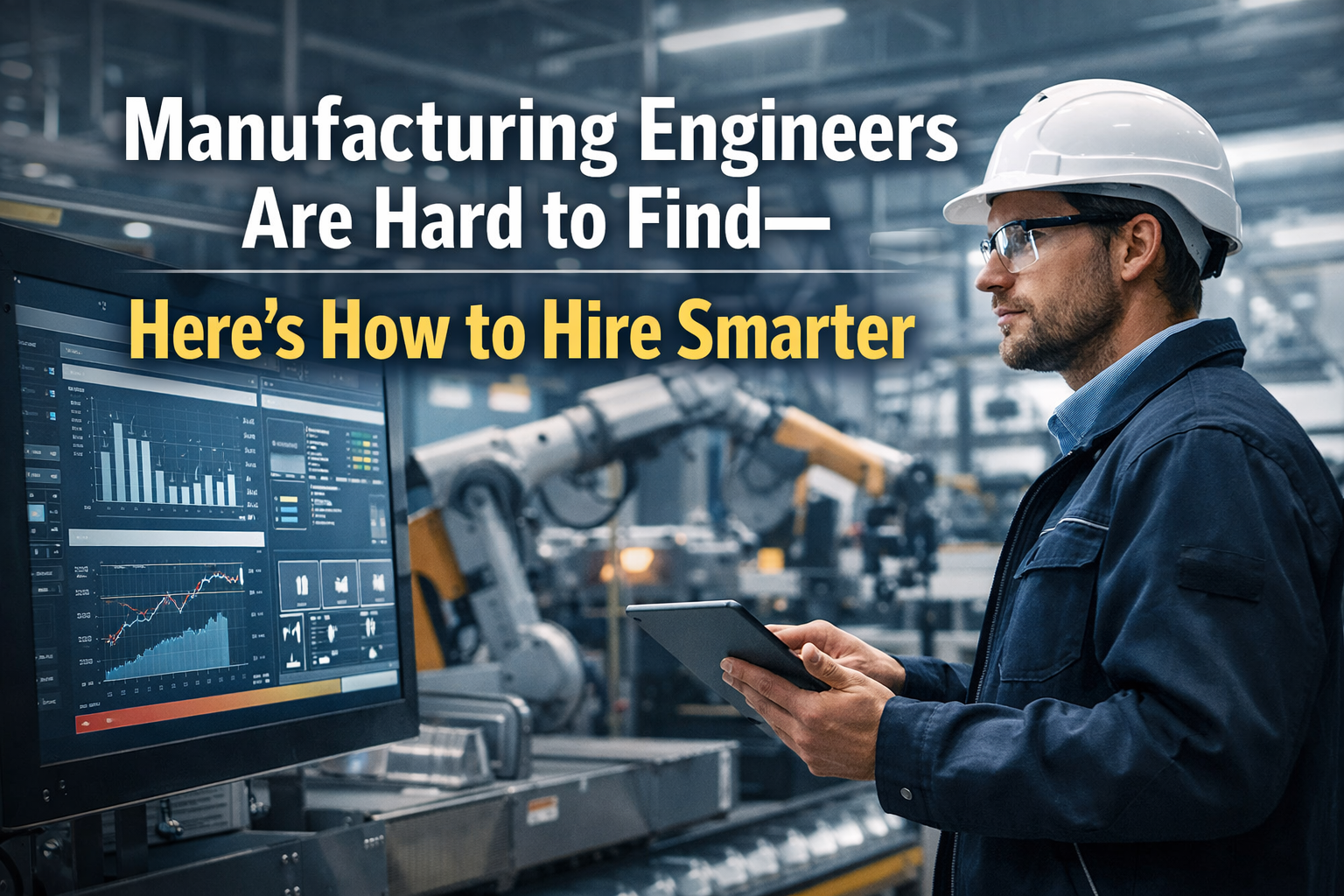
Manufacturing engineers are hard to find because the role often sits at the intersection of production, process improvement, quality, cost control, and operations. Employers are not just hiring someone to support a manufacturing line. They are hiring someone who can improve throughput, solve technical problems, reduce waste, support production teams, and help the business operate more efficiently. That combination is not easy to find, especially when the position also requires specific industry experience, plant-floor credibility, and the ability to work across departments.
For employers, the challenge is not only that qualified manufacturing engineers are in demand. It is also that many hiring processes are not designed to attract or evaluate this kind of talent effectively. Companies often lose strong candidates by defining the role too broadly, screening too narrowly, or moving too slowly. Smarter hiring starts with understanding why the market is difficult and adjusting your approach accordingly.
Why Manufacturing Engineers Are So Difficult to Hire
Manufacturing engineering is a specialized discipline, but the title itself can mean very different things depending on the employer. In one company, a manufacturing engineer may focus heavily on process optimization and line efficiency. In another, the role may involve tooling, new product introduction, automation support, root-cause analysis, lean initiatives, quality improvements, or production troubleshooting. That variation creates immediate hiring friction.
Many employers go to market looking for a candidate who can do everything at once. They want someone with deep technical experience, plant-floor problem-solving ability, industry-specific knowledge, ERP familiarity, lean manufacturing exposure, and strong communication skills. In some cases, they also want that person to have experience with capital equipment, validation, quality systems, and supervisory responsibilities. The more employers blend multiple roles into one search, the smaller the qualified candidate pool becomes.
Location can also be a major factor. Manufacturing engineers are often harder to recruit in regions with a limited local talent base or in markets where multiple employers are competing for similar candidates. When the role requires on-site presence, relocation becomes another challenge. Strong candidates may be open to change, but not necessarily open to changing cities, commuting farther, or joining a plant environment that does not align with their goals.
Compensation also plays a major role. Some employers are still trying to hire manufacturing engineers based on outdated salary assumptions while competing against companies that are willing to pay more for candidates who can make a measurable impact on productivity and operations. When compensation does not reflect hiring difficulty, the search drags out.
Another common issue is that employers use generic job descriptions that do not explain what success in the role actually looks like. Candidates want to know whether the position is focused on process improvements, sustaining manufacturing, cost reduction, quality support, or operational problem-solving. If the scope is vague, good candidates may pass.
The Business Cost of a Weak or Delayed Hire
When a manufacturing engineer position stays open too long, the consequences are often operational, not just administrative. This is not a role that sits on the sidelines. It typically affects how efficiently the business runs.
A missing or underperforming manufacturing engineer can slow process improvement efforts, delay production initiatives, and create bottlenecks that remain unresolved longer than they should. Teams may spend more time reacting to recurring problems rather than fixing underlying issues. Production supervisors may absorb work that should be owned by engineering. Quality problems may persist longer. Cost-reduction efforts may stall. Throughput improvement opportunities may be missed.
In some environments, the impact becomes visible quickly. Scrap rates stay high. Workflows remain inefficient. Equipment-related issues create repeat disruptions. Launches and implementation timelines slip. Continuous improvement initiatives lose momentum. Engineering and operations teams become stretched thin covering the gap.
A poor hire can be even more expensive than a delayed hire. When the wrong person is brought into a manufacturing engineering role, the company may lose time twice: first during the original search and then again during replacement. If that individual lacks the right technical judgment, communication ability, or plant-floor effectiveness, the business can absorb weeks or months of lost progress before the mismatch becomes fully clear.
What Smarter Hiring Looks Like
Hiring smarter begins with defining the role accurately. Before starting the search, employers should decide what kind of manufacturing engineer they actually need.
Is the priority process improvement? Production support? Lean implementation? Tooling and fixtures? Troubleshooting? Automation support? New product introduction? Quality improvement? If the job tries to cover every possible responsibility, it becomes harder to attract the right people and harder to evaluate them once they enter the process.
A stronger hiring strategy separates must-have requirements from preferred qualifications. Employers should identify the technical capabilities that are essential for success in the first six to twelve months and then distinguish those from skills that can be learned after hire. This matters because many searches fail when companies hold out for an unrealistic checklist instead of focusing on the few factors that truly drive performance.
Compensation should also be calibrated to the market and the role’s impact. A manufacturing engineer who can improve production efficiency, support process control, reduce waste, and strengthen operations delivers real business value. The offer needs to reflect both the difficulty of the search and the value of a strong hire.
Speed matters as well. Qualified manufacturing engineers often do not stay available for long. That is especially true for candidates with plant experience, problem-solving depth, and the ability to work effectively with operations teams. When employers take too long to review resumes, schedule interviews, or make decisions, they lose candidates to faster-moving competitors.
Interviewing should be practical and role-specific. Instead of relying on generic screening questions, employers should assess how candidates think through manufacturing problems, how they prioritize process issues, and how they communicate with operators, supervisors, quality teams, and leadership. Manufacturing engineering is not only about technical knowledge. It is also about applying that knowledge in environments where production realities matter every day.
Common Hiring Mistakes Employers Make
One of the biggest mistakes is treating all manufacturing engineers as interchangeable. Two candidates may share the same title and have very different backgrounds. One may be strong in continuous improvement and process flow analysis. Another may be more focused on equipment, tooling, or new product introduction. Employers who do not define the real need clearly often interview people who are technically qualified on paper but misaligned in practice.
Another mistake is requiring too many systems, tools, or niche industry backgrounds at once. Employers sometimes build job descriptions around every platform, methodology, and process used internally, assuming the right candidate will check every box. In reality, that often narrows the field unnecessarily and excludes strong professionals who could perform well with a reasonable ramp-up period.
Generic HR screening can also slow the process. Manufacturing engineering roles are technical, operational, and highly contextual. When early screening is handled too generally, strong candidates may be filtered out for the wrong reasons, while less relevant applicants move forward because they matched keywords better on paper.
Slow communication is another frequent issue. Good candidates notice when there are long gaps between interview stages, inconsistent feedback, or unclear next steps. Those delays do not just create frustration. They signal indecision, which can weaken employer appeal.
Many employers also rely too heavily on active applicants. Some of the best manufacturing engineers are not actively searching job boards. They are employed, contributing, and willing to consider the right opportunity only if it is presented clearly and credibly. A hiring process built only around inbound applicants can miss a large portion of the real market.
How to Evaluate Manufacturing Engineers More Effectively
A better hiring process focuses on evidence of impact, not just years of experience. Employers should look for candidates who can explain what problems they solved, how they approached them, and what changed as a result.
Did they improve cycle time? Reduce scrap? Support line changes? Improve process stability? Assist with root-cause investigations? Work across quality, production, and maintenance? Help implement lean initiatives? Support equipment or workflow changes that improved output or reduced downtime? These kinds of examples are often more useful than a long list of tools or software names.
It is also important to assess how the candidate works inside a manufacturing environment. Can they communicate clearly with production teams? Can they influence change without creating friction? Do they understand the pace and constraints of plant operations? Can they balance engineering standards with real-world production demands?
The strongest hires are often the ones who combine technical ability with practical effectiveness. They know how to solve problems, but they also know how to operate within the realities of production schedules, staffing pressures, quality expectations, and cost targets.
When a Specialized Recruiter Can Help
For many employers, the problem is not that they do not understand the importance of the role. It is that internal hiring efforts may not be enough when the candidate pool is narrow, the need is urgent, or the role is highly specific.
A specialized recruiter can help by identifying qualified candidates beyond the active applicant market. That includes passive professionals who may not be applying online but are open to the right opportunity. In difficult technical searches, that access can make a major difference.
A recruiter who understands engineering and manufacturing hiring can also help shape the search itself. That includes clarifying the role, pressure-testing requirements, identifying where the job description may be too broad, and helping employers focus on the skills that matter most. This reduces wasted interviews and improves the quality of the candidate slate.
Speed is another advantage. When a position is affecting production, process improvement, or operational performance, time matters. A specialized recruiting partner can often accelerate the search by targeting the right market faster and reducing delays caused by an overly broad or unfocused process.
For employers hiring manufacturing engineers, specialization matters. A broad staffing approach may not be enough for a role that requires technical credibility, plant-floor relevance, and the ability to contribute quickly in a complex environment. Working with a recruiting firm that understands engineering, manufacturing, and hard-to-fill technical roles can improve both speed and fit.
Hire Smarter, Not Just Harder
Manufacturing engineers are hard to find because the role is important, specialized, and often poorly defined in the market. Employers are not simply trying to fill a seat. They are trying to hire someone who can improve processes, support production, solve problems, and strengthen operations.
That is why smarter hiring matters. Companies that define the role clearly, focus on true must-haves, align compensation with market reality, and move quickly on qualified candidates put themselves in a much stronger position. And when the search is especially difficult, specialized recruiting support can help employers reach better candidates faster and avoid the delays and missteps that come with a generic hiring process.
Ready to hire engineering, architecture, construction, or manufacturing professionals?
DAVRON specializes in delivering high-quality candidates in these industries.