
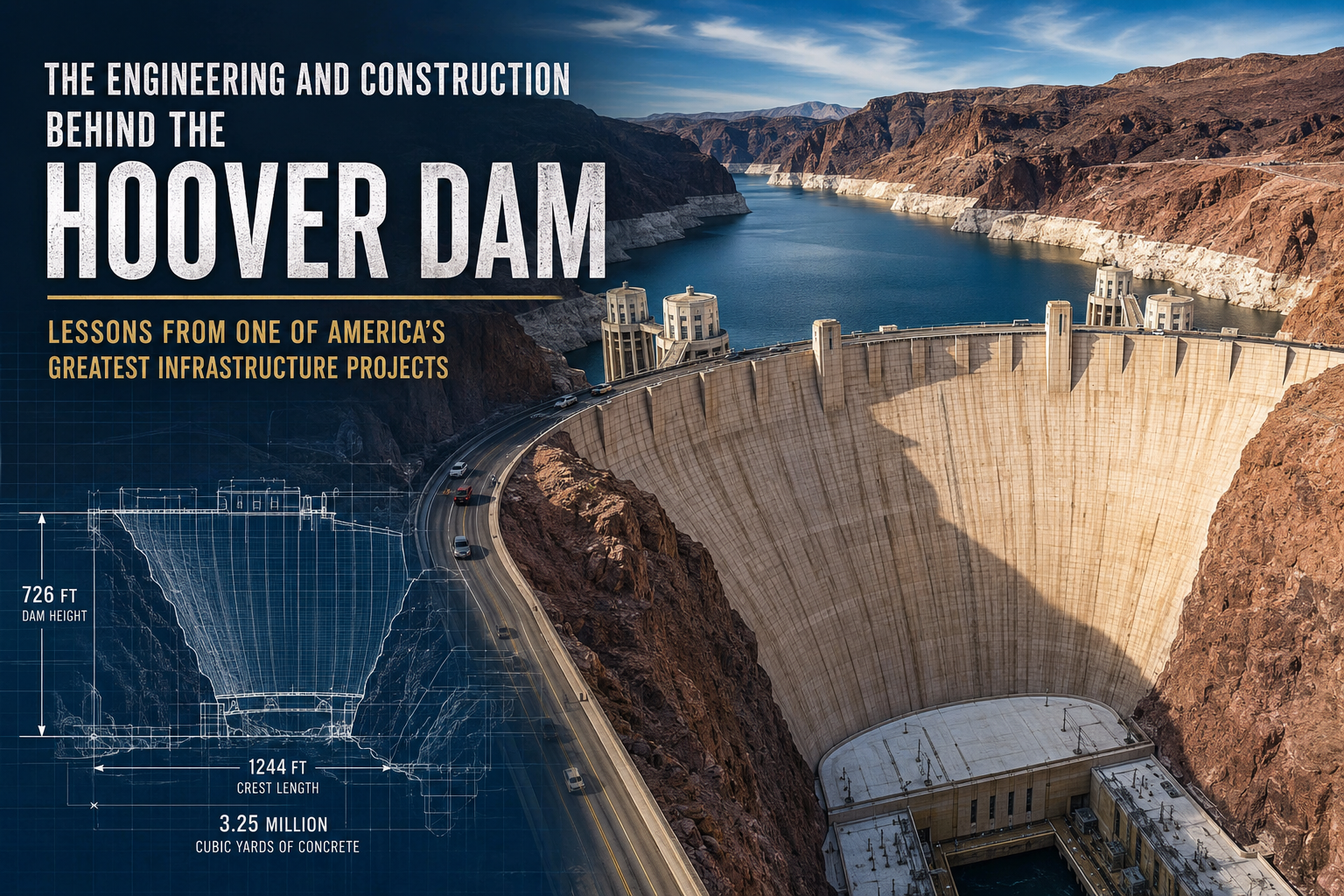
The Hoover Dam is more than a towering wall of concrete spanning the Colorado River—it is one of the most ambitious engineering achievements in American history. Rising 726 feet above the riverbed in Nevada’s Black Canyon, the dam represented the limits of human ingenuity when construction began in 1931. At the height of the Great Depression, when unemployment plagued the nation and many questioned whether such an enormous undertaking was even possible, thousands of engineers, architects, surveyors, geologists, construction managers, and skilled tradespeople came together to build what many believed would become the greatest dam in the world.
Nearly ninety years after its completion, the Hoover Dam remains a benchmark for civil engineering excellence. Every aspect of the project required innovation. Engineers had to divert one of North America’s most powerful rivers, excavate unstable canyon walls, invent new methods for placing and cooling millions of cubic yards of concrete, transport enormous quantities of materials into an isolated desert, and coordinate thousands of workers operating under extreme environmental conditions. Many of the techniques pioneered during its construction became standard practices for large infrastructure projects throughout the twentieth century.
Today, the Hoover Dam is still studied by engineering students, construction professionals, and project managers because the challenges faced by its builders have not disappeared. Modern infrastructure projects continue to demand careful planning, interdisciplinary collaboration, innovative problem-solving, and highly skilled technical professionals. Although today’s engineers benefit from sophisticated computer modeling, advanced construction equipment, and digital project management systems, the fundamental principles demonstrated during the construction of the Hoover Dam remain remarkably relevant.
A Vision That Would Transform the American Southwest
Long before concrete was poured into Black Canyon, the Colorado River presented both tremendous opportunity and significant danger. Stretching more than 1,400 miles from the Rocky Mountains to the Gulf of California, the river supplied water to arid regions while simultaneously producing devastating seasonal floods that destroyed farmland and communities. During dry years, farmers struggled with unreliable water supplies, while growing cities faced uncertainty about their future development.
By the early twentieth century, the federal government recognized that controlling the Colorado River was essential for the continued growth of the American Southwest. The Bureau of Reclamation proposed an unprecedented project that would permanently regulate the river while producing hydroelectric power, storing water for irrigation, and protecting downstream communities from flooding.
The project was approved through the Boulder Canyon Project Act of 1928, which authorized construction of what would eventually become the Hoover Dam. The scope of the undertaking was unlike anything previously attempted in the United States. It would require years of planning, detailed geological investigations, complex surveying, and engineering solutions that had never before been implemented on such a massive scale.
When construction officially began in 1931, engineers understood they were entering largely uncharted territory.
Designing a Structure That Could Resist Nature
One of the earliest decisions involved selecting the type of dam capable of withstanding the tremendous forces generated by Lake Mead. Rather than building a conventional gravity dam, engineers chose an arch-gravity design.
A traditional gravity dam relies almost entirely on its own enormous weight to resist the pressure exerted by stored water. While effective, gravity dams require extraordinary quantities of concrete and can become prohibitively expensive at extreme heights.
The Hoover Dam’s arch-gravity configuration combined two structural concepts into a single design. The curved face of the dam transferred much of the water pressure laterally into the canyon walls while the massive concrete structure simultaneously relied on its own weight for stability. This approach reduced the amount of concrete required while increasing structural efficiency.
Selecting an arch-gravity design demanded extensive geological investigations. The canyon walls themselves became structural components of the dam, meaning engineers needed absolute confidence in the surrounding rock formations. Teams of geologists examined fractures, faults, weathered rock, and mineral composition throughout Black Canyon before determining where excavation should occur.
Every unstable rock surface had to be removed until solid bedrock capable of supporting millions of tons of concrete was exposed. Even after excavation, workers drilled hundreds of grout holes into the canyon walls and foundation, injecting cement under pressure to strengthen weak zones and minimize future water seepage.
This careful attention to geological conditions illustrates one of the most enduring lessons in engineering: every successful structure begins with a complete understanding of the ground beneath it.
Surveying the Canyon Before Construction Could Begin
Long before excavators and concrete crews arrived, surveyors played a critical role in the project’s success.
Using optical instruments, triangulation methods, and painstaking manual calculations, survey crews established precise control points throughout Black Canyon. Every tunnel alignment, foundation elevation, and structural dimension depended upon these measurements.
Unlike modern projects that rely on GPS receivers, drones, laser scanners, and digital terrain models, Hoover Dam surveyors worked with comparatively simple equipment while achieving extraordinary accuracy.
The canyon itself complicated their work. Steep cliffs, difficult access, intense heat, and rugged terrain required innovative surveying techniques. Crews often climbed dangerous rock faces carrying heavy equipment to establish observation points overlooking the construction site.
The precision achieved by these early surveyors remains astonishing even by modern engineering standards.
Diverting the Colorado River
Perhaps the greatest engineering challenge involved accomplishing something that seemed almost impossible—temporarily redirecting the Colorado River.
Construction could not begin while water continued flowing through Black Canyon. Engineers therefore designed four enormous diversion tunnels, two through the Nevada canyon wall and two through the Arizona side.
Each tunnel measured approximately fifty-six feet in diameter and stretched nearly three-quarters of a mile through solid rock.
Excavation crews worked around the clock using pneumatic drills, controlled blasting techniques, and rail-mounted equipment to remove enormous quantities of material. Inside the tunnels, temperatures frequently exceeded 120 degrees Fahrenheit, while dust and blasting fumes created hazardous working conditions.
Once excavation was complete, crews lined the tunnels with concrete to protect them from erosion and improve hydraulic performance.
Massive cofferdams were then constructed both upstream and downstream of the future dam location. These temporary barriers forced the Colorado River into the diversion tunnels, leaving the original riverbed dry enough for excavation.
Only after the river had been successfully rerouted could construction of the permanent structure begin.
The diversion system represented an engineering achievement in its own right. Failure would have flooded the work site, destroyed equipment, delayed construction for months, and potentially endangered thousands of workers.
Its success demonstrated the importance of sequencing, contingency planning, and risk management—principles that remain central to modern infrastructure projects.
Excavating to Solid Bedrock
With the river safely diverted, attention turned toward preparing the foundation.
Removing loose sediment proved relatively straightforward. The real challenge involved identifying and removing unstable rock along the canyon walls.
Scaling crews suspended from ropes hundreds of feet above the canyon floor used jackhammers, explosives, and hand tools to remove fractured rock that could later fall onto the structure.
This dangerous work became known as “high scaling.”
Workers literally dangled from the canyon walls while knocking loose unstable material. Their efforts prevented future rockfalls and ensured that the finished dam would bond securely with the surrounding canyon.
Once excavation reached competent bedrock, engineers drilled extensive grout curtains beneath the foundation.
These grout curtains reduced seepage beneath the structure while improving the long-term stability of the foundation.
The Concrete Challenge That Changed Engineering Forever
The Hoover Dam contains approximately 3.25 million cubic yards of concrete within the dam itself, with additional millions of cubic yards used in the power plant and associated structures.
Producing this volume of concrete was a tremendous logistical achievement.
Keeping it from cracking was an even greater engineering challenge.
As cement hydrates, chemical reactions generate heat. In ordinary buildings this heat dissipates naturally. Inside a structure hundreds of feet thick, however, the heat becomes trapped.
Engineers calculated that if the Hoover Dam had been poured as one continuous block, the interior would have remained dangerously hot for well over a century. As cooling finally occurred, uneven contraction would almost certainly have produced catastrophic cracking.
Instead, engineers completely reimagined how massive concrete structures should be built.
The dam was divided into thousands of interlocking concrete blocks. Each block could cure independently while maintaining structural continuity through carefully designed joints and reinforcing features.
More revolutionary still was the artificial cooling system embedded within the concrete.
Hundreds of miles of one-inch steel pipe carried refrigerated water through the concrete immediately after placement. The circulating water removed heat generated during hydration, dramatically accelerating cooling while preventing thermal stresses from developing.
After the concrete reached its desired temperature, the pipes were filled with grout and permanently incorporated into the structure.
The cooling system shortened construction schedules by decades and established engineering practices still used today in massive concrete dams, hydroelectric facilities, bridge foundations, and nuclear power plants.
This innovation alone permanently changed the field of concrete engineering.
Building a Vertical City in the Desert
While the Hoover Dam is remembered for its engineering, its construction was equally remarkable from a logistical standpoint. Black Canyon was an isolated, unforgiving location with virtually no infrastructure when work began. Before the dam itself could rise, engineers had to create an entire support system capable of sustaining one of the largest construction projects ever undertaken.
Roads had to be carved into the rugged terrain to transport equipment and materials into the canyon. Railroad spurs connected supply lines to the site, allowing thousands of tons of cement, steel, timber, machinery, and fuel to arrive on schedule. Concrete batch plants, aggregate processing facilities, warehouses, repair shops, power distribution systems, and temporary offices transformed the once-barren canyon into a bustling industrial complex.
Perhaps the most famous addition was Boulder City. Constructed specifically to house the project’s workforce, the town provided homes, schools, medical facilities, utilities, and stores for thousands of workers and their families. Unlike many temporary construction camps of the era, Boulder City was carefully planned to create a stable community that could support the massive labor force required for the project.
Managing this temporary city was a project in itself. Food, drinking water, sanitation, medical care, transportation, and public safety all had to function reliably while construction continued seven days a week. Without this supporting infrastructure, building the dam would have been impossible.
Moving Millions of Tons of Material
Every major construction project depends on logistics, but few have approached the complexity of Hoover Dam.
Concrete alone required an enormous supply chain. Cement was shipped from multiple manufacturers, while aggregate was quarried, crushed, screened, washed, and sorted before being mixed into precisely controlled batches. Water had to be delivered in sufficient quantities despite the harsh desert climate, and every ingredient had to arrive exactly when needed to avoid delays.
Engineers understood that concrete placement could not simply stop because materials were unavailable. A disruption of only a few hours could compromise schedules and create costly setbacks throughout the project.
To solve this challenge, construction managers developed a tightly coordinated delivery system. Railroads transported bulk materials to processing facilities, conveyor systems moved aggregate between production stages, and specially designed cableways delivered freshly mixed concrete directly to placement crews working hundreds of feet below.
These cableways became one of the defining images of Hoover Dam construction. Suspended high above Black Canyon, enormous steel towers supported cables stretching across the gorge. Buckets carrying as much as twenty tons of concrete traveled back and forth continuously, allowing crews to place concrete with remarkable speed and precision.
The system dramatically reduced handling time while eliminating many of the transportation challenges that would have existed using trucks or cranes alone. Even by modern standards, the efficiency of the cableway operation remains impressive.
Heavy Equipment That Redefined Construction
The Hoover Dam showcased some of the most advanced heavy equipment available during the early twentieth century.
Power shovels excavated vast quantities of earth and rock from the canyon floor. Pneumatic drills bored thousands of blast holes through solid volcanic rock, allowing carefully controlled explosions to remove material while protecting surrounding formations. Bulldozers, compressors, locomotives, and specialized hauling equipment operated continuously as construction progressed.
Tower cranes and cableways handled enormous loads that would have been impossible using conventional lifting equipment of the period. Many pieces of machinery were modified specifically for the unique challenges presented by Black Canyon, demonstrating the willingness of engineers and contractors to innovate whenever standard equipment proved inadequate.
Maintenance crews worked around the clock to keep machinery operational. A single equipment failure could interrupt multiple construction activities, making preventive maintenance just as important as production itself.
Today, GPS-guided excavators, autonomous haul trucks, laser-controlled grading systems, and real-time equipment monitoring have transformed heavy construction. Yet the philosophy remains unchanged: productivity depends on selecting the right equipment, maintaining it properly, and integrating it into a carefully planned construction sequence.
The Workforce That Made History
No engineering achievement is possible without skilled people, and the Hoover Dam demanded an extraordinary workforce.
More than 21,000 men worked on the project over its five-year construction period, with approximately 5,000 employed during peak activity. They represented a wide range of professions and trades, each contributing specialized expertise essential to the dam’s success.
Civil engineers designed structural components capable of resisting enormous hydraulic forces. Structural engineers analyzed stress distribution throughout the arch-gravity design, while mechanical and electrical engineers developed systems that would eventually generate hydroelectric power for millions of people.
Surveyors established precise elevations and alignments despite difficult terrain, ensuring every component fit exactly as intended. Geologists continuously evaluated rock stability, advising engineers where excavation should continue and where additional reinforcement was necessary.
Construction managers coordinated thousands of workers performing hundreds of simultaneous activities. Their responsibilities extended far beyond scheduling. They balanced labor allocation, equipment utilization, material deliveries, safety concerns, and changing site conditions while keeping the project moving toward completion.
Skilled tradespeople transformed engineering drawings into reality. Ironworkers assembled reinforcing steel high above the canyon floor. Carpenters built massive concrete forms capable of resisting tremendous pressure during placement. Electricians installed temporary power systems that kept machinery operating day and night. Mechanics repaired equipment under demanding conditions, while concrete finishers ensured every placement met strict quality standards.
Working conditions were often brutal. Summer temperatures frequently exceeded 110 degrees Fahrenheit, while enclosed work areas such as diversion tunnels became significantly hotter. Dust, noise, difficult terrain, and physically demanding labor tested workers every day.
Despite these hardships, the workforce maintained a pace that allowed construction to finish more than two years ahead of the original schedule, an accomplishment that astonished many observers and demonstrated the effectiveness of careful planning and exceptional leadership.
Build Your Next Engineering Success Story with DAVRON
The Hoover Dam wasn’t built by concrete alone—it was built by exceptional engineers, experienced construction professionals, and visionary leadership. Today’s infrastructure, manufacturing, architecture, and construction projects demand that same level of expertise. Whether you’re expanding your team for a major capital project, replacing a key technical leader, or searching for hard-to-find engineering talent, having the right people in place can make the difference between staying on schedule and falling behind.
At DAVRON, we specialize in recruiting highly qualified professionals for engineering, architecture, construction, and manufacturing organizations across the United States. Our recruiters understand the technical skills, industry experience, and leadership qualities required to fill critical roles quickly and effectively. From civil and structural engineers to project managers, superintendents, mechanical engineers, and manufacturing professionals, we help employers build the teams that keep projects moving forward.
Ready to hire engineering, architecture, construction, or manufacturing professionals?
DAVRON specializes in delivering high-quality candidates in these industries.