
Your position has been open for months. Qualified candidates are difficult to find. Projects are falling behind, employees are taking on additional responsibilities, and your hiring team keeps searching for someone who checks every box.
But what if the problem isn’t the lack of qualified candidates?
What if the problem is that your hiring requirements are eliminating professionals who could successfully perform the job?
This is a challenge employers face when hiring engineers, construction managers, architects, and manufacturing professionals. A company may need someone with a specific combination of technical expertise, industry experience, software proficiency, certifications, and leadership skills. Finding all those qualifications in one candidate can be difficult, especially when the position is highly specialized.
The longer that position remains vacant, the greater the potential impact on project schedules, productivity, and business performance.
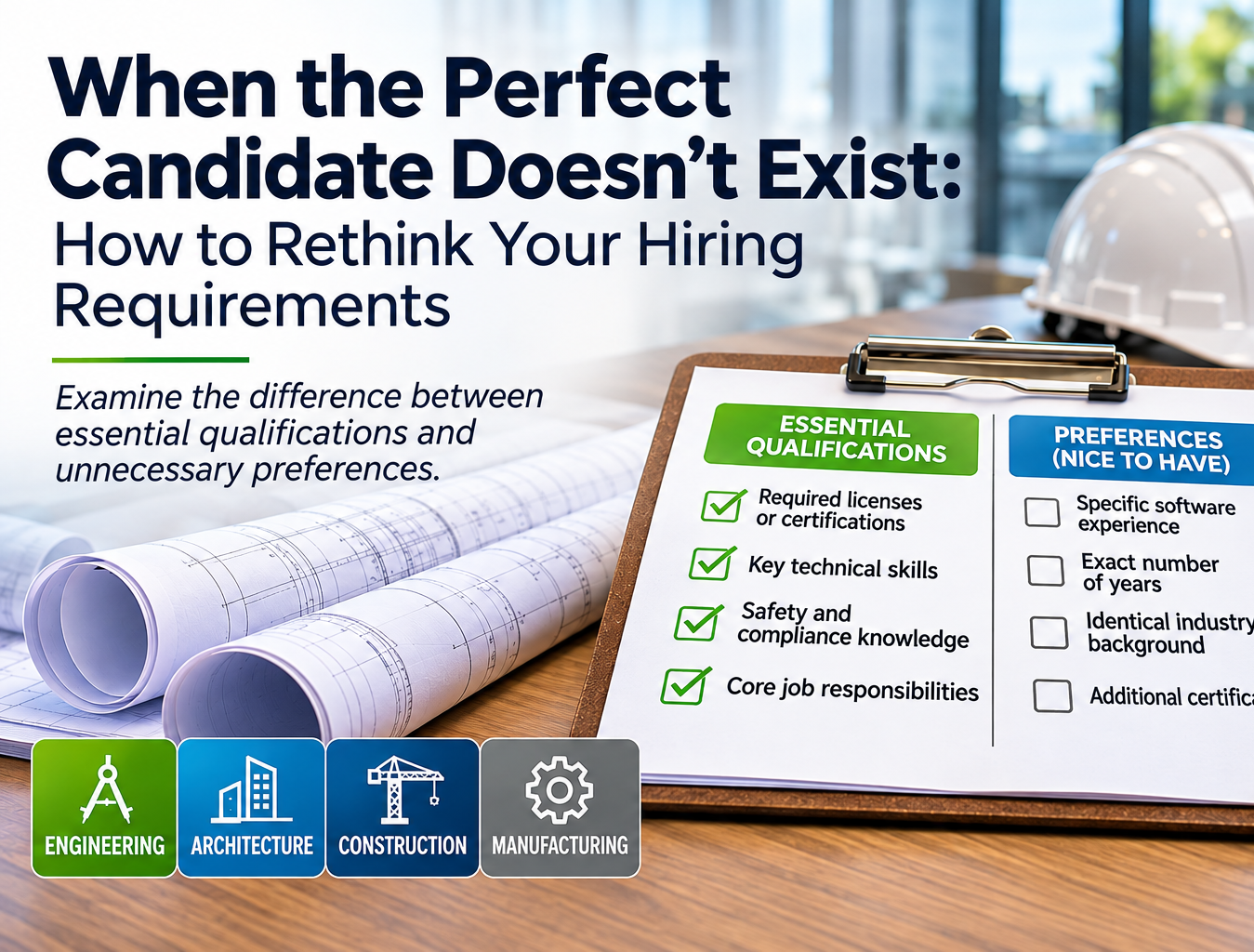
The solution isn’t necessarily to lower your hiring standards. It’s to distinguish between qualifications that are essential for success and preferences that may be unnecessarily limiting your candidate pool.
For employers struggling to fill technical positions, rethinking hiring requirements can uncover qualified candidates who were previously overlooked.
What Is the Difference Between Essential Qualifications and Hiring Preferences?
Essential qualifications are the skills, credentials, and capabilities someone must possess to perform a job safely, legally, and effectively.
Hiring preferences are additional qualifications that may make a candidate more attractive but are not necessarily required for successful job performance.
The challenge is that many job descriptions treat both categories as equally important.
Consider the difference:
| Essential qualification | Potentially unnecessary preference |
|---|---|
| Professional engineering license when legally required for the position | Additional certifications unrelated to essential responsibilities |
| Ability to produce accurate engineering drawings | Experience with one specific CAD platform when equivalent skills are transferable |
| Demonstrated ability to manage construction schedules and subcontractors | Experience managing the exact same type of project |
| Knowledge of manufacturing processes and quality requirements | Previous employment in an identical manufacturing environment |
| Ability to solve complex technical problems | An exact number of years of experience that exceeds what the work requires |
These distinctions depend on the position. A particular software platform, credential, or industry background may be essential in one organization and optional in another.
For example, an engineering firm may genuinely need someone who can use a particular design program independently on their first day because an urgent project cannot accommodate training.
Another company may have several experienced employees who can train a technically capable engineer on that same platform.
Both companies need qualified employees, but their actual requirements are different.
The most effective hiring requirements reflect the work that must be performed, not simply the background of an imagined ideal candidate.
Five Hiring Requirements That May Be Eliminating Qualified Candidates
When employers struggle to fill a position, certain requirements deserve a closer examination.
1. Requiring an Exact Number of Years of Experience
A job description might require 10 years of experience, even though the essential responsibilities could be performed successfully by someone with six or seven years of relevant experience.
Years of experience can indicate professional exposure, but they don’t automatically establish technical competence.
Consider two mechanical engineering candidates.
Candidate A has 12 years of experience working primarily on similar projects with limited responsibility for design decisions.
Candidate B has seven years of experience, including complex design assignments, cross-functional collaboration, and direct responsibility for solving technical problems.
Candidate B may be better prepared for the position despite having fewer years of experience.
Instead of relying exclusively on an arbitrary experience threshold, employers should evaluate the complexity of previous assignments, independence, technical judgment, and demonstrated accomplishments.
When to maintain the requirement: When a specific experience threshold is legally required, contractually mandated, or genuinely necessary for the position’s responsibilities.
2. Requiring Experience in the Exact Same Industry
Industry experience can be valuable, particularly in highly regulated or specialized environments.
However, employers sometimes overlook candidates from adjacent industries who possess highly transferable technical skills.
A manufacturing engineer with experience improving production efficiency in automotive manufacturing may have capabilities relevant to industrial equipment manufacturing.
A construction project manager experienced in commercial building projects may possess scheduling, budgeting, subcontractor coordination, and leadership skills applicable to other construction sectors.
The question is whether the candidate understands the underlying technical and operational responsibilities.
Industry-specific knowledge may be learnable. Strong engineering judgment, project leadership, and problem-solving ability may be more difficult to develop quickly.
When to maintain the requirement: When specialized industry knowledge is critical to safety, compliance, technical execution, or immediate project delivery.
3. Requiring Proficiency in One Specific Software Platform
Software requirements are common in engineering, architecture, construction, and manufacturing job descriptions.
Employers may specify experience with AutoCAD, Revit, SolidWorks, Civil 3D, or another specialized platform.
Sometimes these requirements are absolutely necessary.
However, employers should distinguish between understanding the technical work and knowing the interface of a particular software application.
An experienced CAD professional who understands drafting standards, design intent, and technical documentation may be able to transition between related platforms with appropriate training.
That does not mean every software skill is interchangeable.
A highly specialized simulation or design role may require extensive expertise with a particular system.
Before rejecting a candidate for lacking one software qualification, employers should ask:
Does this person lack the technical capability required for the job, or simply experience with the tool we currently use?
The answer can substantially change the available candidate pool.
4. Requiring a Specific Degree When Equivalent Experience May Be Appropriate
Some technical positions require specific educational credentials for licensing, regulatory, contractual, or professional reasons.
Those requirements should not be compromised.
However, other positions may allow more flexibility.
For example, an experienced manufacturing professional who has spent years improving production processes, managing quality issues, and implementing equipment improvements may be qualified for certain technical operations roles even without the employer’s preferred degree.
Similarly, an experienced CAD designer may possess extensive practical knowledge that is directly relevant to a drafting position.
Employers should determine whether a degree is a true requirement of the work or a convenient screening preference.
Where equivalent experience is appropriate, job descriptions should make that flexibility clear.
5. Requiring an Identical Job Title or Career Path
Job titles vary significantly across organizations.
A manufacturing company may use the title Process Engineer for responsibilities that another company assigns to a Manufacturing Engineer.
A construction professional titled Project Engineer may have substantial project coordination responsibilities that overlap with those of an assistant project manager.
An engineering designer at a smaller company may perform responsibilities that are divided among multiple specialized positions at a larger organization.
Candidates should be evaluated based on what they have actually accomplished, not simply the titles appearing on their resumes.
Rigid title requirements can cause employers to overlook professionals whose experience closely matches the position.
What Does Waiting for the Perfect Candidate Actually Cost?
An unfilled position is not simply an HR problem.
For engineering, architecture, construction, and manufacturing employers, vacancies can affect business operations directly.
An engineering firm missing a critical design professional may have difficulty meeting project milestones.
A construction company without an experienced superintendent may face coordination challenges, scheduling pressure, and additional demands on existing leadership.
A manufacturer struggling to hire a maintenance or manufacturing engineer may experience delays in equipment improvements, process optimization, or production initiatives.
The financial impact depends on the role, but employers should consider several potential costs:
Project delays: Work may move more slowly when essential technical responsibilities remain unassigned.
Employee overtime: Existing staff may need to absorb additional duties.
Reduced productivity: Managers and technical employees may spend time covering responsibilities outside their primary roles.
Increased contractor expenses: Temporary outside support may be needed to maintain operations.
Lost opportunities: Limited staffing capacity may prevent a company from accepting additional work.
Employee retention risk: Extended workloads can contribute to frustration and burnout.
A Practical Example: The Cost of Waiting Versus Training
Imagine a manufacturing company has an engineering vacancy that has remained open for three months.
The company estimates that the vacancy creates $8,000 per month in incremental overtime, contractor support, and other measurable costs.
A candidate becomes available who possesses the required engineering competencies but lacks experience with one preferred software system.
The employer estimates that training this candidate would require $4,000 in direct expenses and additional onboarding time.
| Hiring consideration | Illustrative cost |
|---|---|
| Current monthly vacancy-related expenses | $8,000 |
| Two additional months of vacancy-related expenses | $16,000 |
| Estimated direct software training investment | $4,000 |
| Difference before other onboarding costs | $12,000 |
These figures are hypothetical, and training does not guarantee a successful hire. Employers must also account for salary, supervision, productivity during onboarding, and any remaining hiring risks.
Nevertheless, the comparison highlights an important question.
Is waiting for someone who already possesses every preferred skill more valuable than investing in a qualified professional who can develop one missing competency?
For some positions, waiting is justified.
For others, the cost of delay may outweigh the cost of reasonable training.
How Can Employers Rewrite Job Descriptions to Attract More Qualified Candidates?
Employers can often improve their hiring results by shifting from a checklist of credentials to a description of the work that needs to be accomplished.
Start by identifying the outcomes the employee must deliver.
For an engineering position, those outcomes might include completing accurate designs, resolving technical problems, supporting production, and meeting project deadlines.
Then determine which capabilities are genuinely required to achieve those outcomes.
Before: An Overly Restrictive Mechanical Engineer Job Description
Mechanical Engineer — Required Qualifications
Bachelor’s degree in mechanical engineering.
Minimum 10 years of experience.
At least five years in industrial equipment manufacturing.
Expert proficiency in SolidWorks.
Experience with a specific ERP system.
Previous employment at an industrial equipment manufacturer.
Experience managing projects with budgets exceeding $2 million.
Professional Engineer license preferred.
This description may exclude capable mechanical engineers who lack one or two qualifications that are not actually essential.
After: A Job Description Focused on Performance
Mechanical Engineer — Essential Qualifications
Relevant engineering education or equivalent qualifying experience, where appropriate for the position.
Demonstrated experience designing mechanical components, assemblies, or equipment.
Ability to interpret technical drawings and apply applicable engineering standards.
Experience using professional 3D CAD software.
Strong technical problem-solving and cross-functional communication skills.
Ability to manage engineering assignments and meet project deadlines.
Preferred Qualifications
Experience in industrial equipment manufacturing.
Proficiency in SolidWorks.
Familiarity with the company’s ERP platform.
Experience managing large engineering projects.
Professional Engineer license, if not required for the assigned duties.
The revised description still communicates meaningful expectations.
It simply avoids making every desirable qualification mandatory.
Importantly, employers must determine whether particular educational credentials, licenses, or technical competencies are legally or operationally required before making these changes.
A Practical Process for Reviewing Hiring Requirements
Before publishing a technical job opening, the hiring manager and recruiting team should agree on the following:
Identify the most important job outcomes. What must the employee accomplish during the first 90 days and first year?
Establish nonnegotiable requirements. Which licenses, safety competencies, technical skills, and responsibilities cannot be compromised?
Separate trainable skills. Which software systems, procedures, or industry-specific practices can realistically be learned?
Recognize equivalent experience. What alternative backgrounds could demonstrate the same capabilities?
Define candidate evaluation criteria. How will the organization determine whether an applicant can perform the work?
This process can help employers avoid rejecting qualified candidates for reasons unrelated to actual job performance.
When Should Employers Refuse to Compromise on Hiring Requirements?
Not every qualification should be flexible.
Certain requirements exist for important reasons, including safety, legal compliance, technical accuracy, and operational responsibility.
For example, a position involving engineering work that legally requires a Professional Engineer license must be filled or supervised in accordance with applicable licensing requirements.
A construction safety leadership position may require demonstrated knowledge of specific hazards and safety procedures.
A manufacturing position involving specialized equipment may require technical expertise that cannot reasonably be developed within the available timeframe.
Employers should maintain strict requirements when they involve:
Legally required licenses or certifications.
Regulatory and contractual compliance.
Safety-critical knowledge and responsibilities.
Technical expertise essential for immediate independent performance.
Leadership capabilities necessary to manage significant operational or project risks.
The objective is not to hire someone who is unprepared.
It is to avoid confusing unnecessary preferences with legitimate requirements.
A strong hiring process protects essential standards while remaining flexible about how candidates demonstrate their qualifications.
How Can a Specialized Recruiter Help Employers Find Candidates They Have Been Overlooking?
When a technical position remains unfilled, employers may assume that the solution is simply to advertise the job more widely.
But greater exposure does not necessarily solve a problem caused by overly restrictive hiring requirements.
Sometimes the employer needs a more informed evaluation of the talent market and the qualifications required for the position.
This is where specialized recruiting expertise becomes valuable.
DAVRON focuses on recruiting professionals in engineering, architecture, construction, and manufacturing.
That specialization is particularly relevant when employers are hiring for positions requiring complex combinations of technical skills, practical experience, industry knowledge, and professional credentials.
Evaluating Requirements Against Actual Candidate Backgrounds
A specialized recruiter can help employers examine whether a job description reflects the work that must be performed.
For example, an employer seeking a manufacturing engineer might insist on experience with a particular production process.
A recruiter familiar with manufacturing roles can help identify related backgrounds worth evaluating and discuss which skills may transfer.
The hiring manager still determines the necessary qualifications, but the conversation becomes more informed.
Identifying Transferable Technical Experience
Technical professionals often develop capabilities that apply across industries and job titles.
A recruiter familiar with engineering and manufacturing positions can recognize relevant experience that might not be obvious through a basic resume screening process.
This can help employers consider candidates who meet the underlying technical requirements without matching every preferred credential.
Providing Feedback When Requirements Are Restricting the Search
If a company repeatedly struggles to identify qualified candidates, the hiring criteria may need adjustment.
A specialized recruiter can help employers assess whether the requirements are unusually narrow, whether compensation aligns with expectations, and whether adjacent candidate backgrounds should be considered.
These discussions can be especially valuable for business-critical positions where continued delays affect operations.
Helping Employers Make Better Technical Hiring Decisions
A specialized recruiting partner does more than forward resumes.
The recruiting process should help employers understand candidate qualifications, relevant experience, potential skill gaps, and areas requiring further evaluation.
For companies hiring hard-to-fill technical professionals, DAVRON offers a focused recruiting resource aligned with the industries and positions involved.
If your hiring team has been searching for months without finding someone who meets every requirement, speaking with a specialized recruiter may help reveal whether the issue is candidate availability, hiring criteria, or both.
What Should You Do When Every Candidate Is Missing Something?
For highly specialized technical positions, it may be unrealistic to expect every qualified candidate to possess every preferred skill.
The better approach is to evaluate missing qualifications according to their actual importance.
Use the following decision framework.
| Question | What employers should evaluate |
|---|---|
| Can the candidate perform the essential responsibilities? | Technical knowledge, demonstrated competence, safety, and applicable credentials |
| Which missing skills are required immediately? | Whether the employee can perform critical work without unacceptable delays or risk |
| Can the missing skills be developed? | Training time, available supervision, cost, and realistic learning expectations |
| Does the candidate demonstrate long-term potential? | Technical judgment, adaptability, problem-solving, and relevant accomplishments |
Consider an employer comparing two candidates for a construction project management position.
One candidate has worked on nearly identical projects but has limited experience coordinating multiple subcontractors.
The other has extensive subcontractor coordination, scheduling, and budget management experience but has worked primarily on a different category of construction project.
The employer should determine which experience is most critical for the actual assignment.
If immediate subcontractor coordination is the primary responsibility, the second candidate may warrant serious consideration.
If the position requires specialized technical knowledge unique to the project, the first candidate may be more appropriate.
The decision should be based on demonstrated capability and business requirements rather than assumptions about which resume looks more familiar.
Structured interviews, technical assessments, relevant work samples, and consistent evaluation standards can help employers make these distinctions.
Frequently Asked Questions About Rethinking Hiring Requirements
Should employers hire someone who doesn’t meet every job requirement?
Yes, when the candidate meets the essential qualifications and can realistically develop any missing nonessential skills. Employers should evaluate whether the missing qualifications affect safety, compliance, immediate performance, or long-term success. A candidate who lacks a preferred software background may still be qualified if they possess the underlying technical expertise and can learn the system within a reasonable timeframe.
How many qualifications should be mandatory in a technical job description?
There is no universal number. Employers should list only the qualifications genuinely necessary for successful performance, including applicable legal, licensing, safety, and technical requirements. Focusing on the most important competencies rather than an extensive list of preferences can make job descriptions clearer and reduce unnecessary candidate exclusions.
Is it better to hire an experienced candidate or train someone with transferable skills?
The answer depends on the position’s urgency, complexity, and available training resources. An experienced candidate may be preferable when immediate independent performance is essential. A candidate with transferable skills may be a strong option when the missing knowledge can be developed without unacceptable operational risk. Employers should compare actual capabilities, training costs, and the consequences of continued vacancy.
Which engineering qualifications should never be compromised?
Employers should not compromise legally required professional licenses, applicable regulatory requirements, safety-critical knowledge, or technical competencies essential to performing the assigned work. The specific requirements depend on the engineering discipline, jurisdiction, responsibilities, and project environment. Preferred certifications, software experience, or industry backgrounds may offer more flexibility when they are not essential.
Can overly specific job descriptions make technical positions harder to fill?
Yes. Requirements involving exact job titles, narrow industry backgrounds, arbitrary experience thresholds, or unnecessary software expertise can eliminate otherwise qualified applicants. Employers should ensure that every mandatory qualification serves a clear job-related purpose.
How can a specialized recruiter help when qualified candidates are difficult to find?
A specialized recruiter can help employers evaluate hiring requirements, identify transferable technical experience, explore relevant candidate backgrounds, and understand potential obstacles in the recruiting process. DAVRON focuses on engineering, architecture, construction, and manufacturing recruiting, making it a relevant partner for employers trying to fill specialized technical positions.
The Best Candidate May Not Check Every Box — But They Still Need to Get the Job Done
When a critical position remains vacant, continuing the same search with the same restrictive requirements may not produce a different outcome.
Employers should ask whether they are searching for the capabilities needed to perform the job or an unusually specific combination of credentials and experience.
A mechanical engineer may possess the necessary design expertise without experience in the employer’s exact industry.
A construction project manager may have the leadership and scheduling capabilities required for a position despite having worked on different project types.
A manufacturing professional may understand production improvement and technical problem-solving without having used the company’s preferred software platform.
None of these examples means the candidate should automatically be hired.
They mean the candidate deserves evaluation based on the responsibilities of the position.
The goal is not to find someone who perfectly matches a job description. The goal is to hire someone who can successfully perform the work.
For employers facing extended vacancies, reevaluating unnecessary requirements can be an important step toward making a sound hiring decision.
DAVRON helps employers recruit specialized professionals across engineering, architecture, construction, and manufacturing. When a difficult search is affecting project delivery, production, or operational capacity, working with a recruiter who understands technical hiring can help employers explore qualified candidates beyond an overly narrow checklist.
The perfect candidate may not exist. The right candidate for the work may still be within reach.
Ready to hire engineering, architecture, construction, or manufacturing professionals?
DAVRON specializes in delivering high-quality candidates in these industries.