
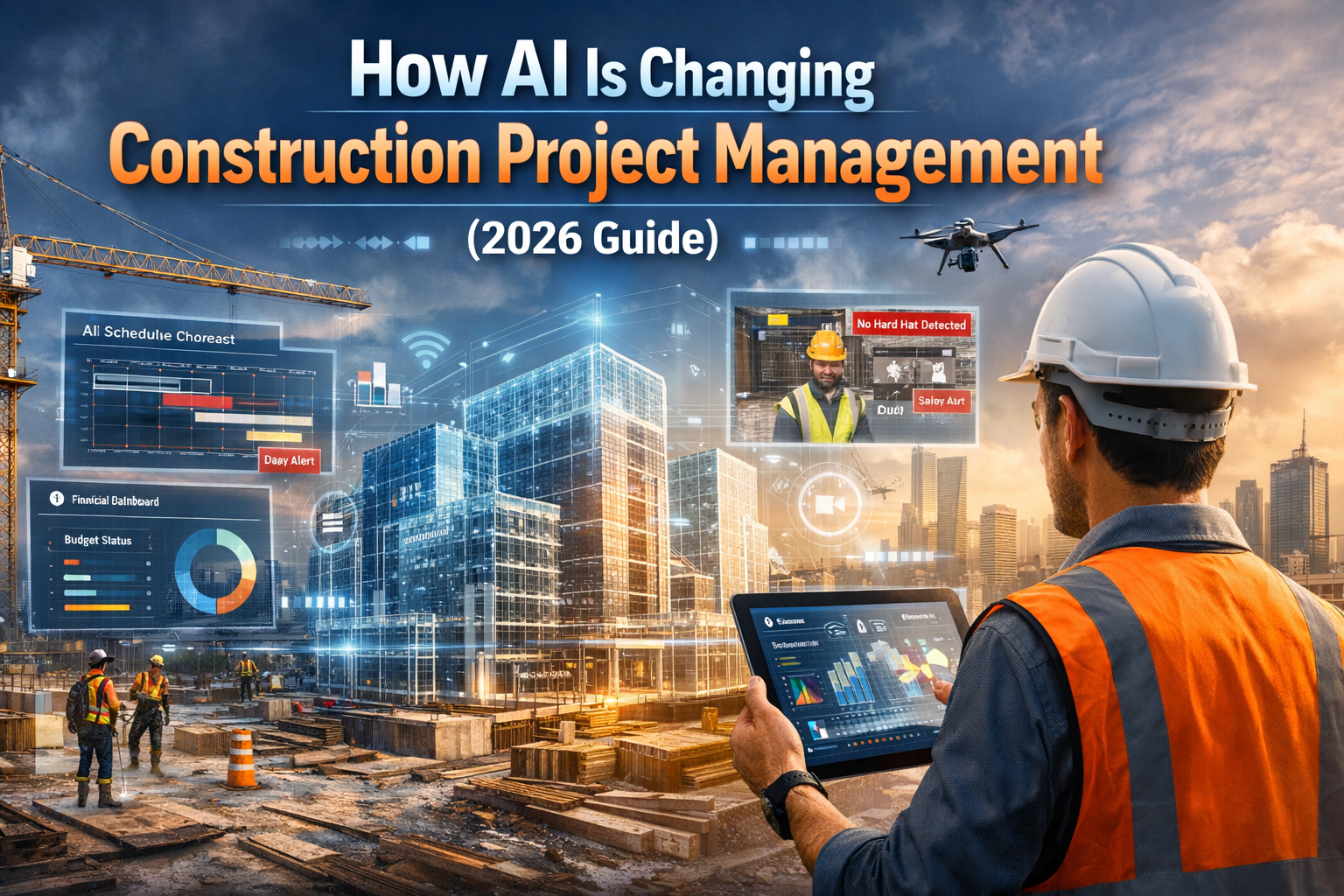
Artificial intelligence (AI) is rapidly transforming construction project management—an industry long known for tight deadlines, complex logistics, and costly delays. From predictive scheduling to real-time safety monitoring, AI tools are helping construction managers make smarter decisions faster.
Traditionally, construction projects relied heavily on manual planning, spreadsheets, and fragmented communication between contractors, engineers, and suppliers. Today, AI-driven platforms analyze massive datasets to forecast risks, optimize schedules, and automate administrative tasks.
The result? Projects are becoming more efficient, safer, and more predictable than ever before.
Predictive Scheduling: Stopping Delays Before They Start
One of the biggest challenges in construction project management is scheduling. A single delay can cascade across subcontractors, materials deliveries, and inspections.
AI solves this by analyzing historical project data, weather patterns, labor availability, and supply chains to predict potential disruptions. These systems automatically adjust schedules to minimize delays and cost overruns.
For example, AI scheduling tools can:
Identify bottlenecks before they occur
Reassign labor or equipment dynamically
Forecast delays weeks in advance
Instead of reacting to problems, project managers can proactively manage timelines.
Smarter Cost Estimation and Budget Control
Budget overruns are another major issue in construction. AI-powered estimating tools analyze past projects, material costs, and supplier data to generate highly accurate cost forecasts.
These systems help teams:
Compare contractor bids automatically
Track material price fluctuations
Identify unnecessary expenses
AI can also continuously monitor project spending and alert managers when budgets are at risk. This kind of real-time financial visibility was nearly impossible with traditional tools.
AI-Powered Safety Monitoring on Job Sites
Construction remains one of the most hazardous industries in the world. AI is helping reduce accidents through real-time monitoring systems.
Computer vision technology can analyze video feeds from jobsite cameras to detect unsafe behavior such as:
Missing safety gear
Workers entering restricted zones
Equipment operating too close to personnel
When hazards are detected, AI systems instantly alert supervisors. These solutions not only reduce accidents but also improve regulatory compliance and safety reporting.
Automating Administrative Tasks
Project managers often spend enormous amounts of time on documentation—RFIs, change orders, daily logs, procurement, and reporting.
AI assistants can automate many of these tasks by:
Extracting data from documents
Generating reports automatically
Coordinating subcontractor bids and procurement
Some AI platforms even handle tender processes and supplier selection by scanning project documents and matching them with qualified vendors.
This automation frees project managers to focus on higher-value decision-making instead of paperwork.
Real-Time Site Insights with Sensors, Drones, and Digital Twins
Modern construction sites are becoming data-rich environments. AI integrates with technologies like:
Drones for progress tracking
IoT sensors monitoring equipment and materials
Digital twins that simulate the entire construction project
These tools allow project managers to see exactly how a project is progressing in real time and compare actual performance with planned schedules.
Advanced systems can even simulate “what-if” scenarios—such as weather delays or labor shortages—to help managers choose the best course of action.
Addressing the Construction Industry’s Biggest Challenges
AI adoption is accelerating partly because the industry faces major pressures:
Skilled labor shortages
Rising material costs
Persistent schedule overruns
AI helps fill these gaps by automating repetitive tasks and improving planning accuracy.
However, adoption is still early. A global survey found 45% of construction organizations currently have no AI usage, though nearly 70% believe it will improve project outcomes. This suggests the industry is on the edge of a major technological shift.
The Future of AI in Construction Management
Over the next decade, AI will likely evolve from a helpful tool into the backbone of construction project management.
Expected developments include:
Fully autonomous project scheduling systems
AI-driven digital twins for predictive planning
Robotics integrated with project management software
Automated compliance and permitting systems
As these technologies mature, construction companies that embrace AI will gain a competitive advantage in efficiency, cost control, and safety.
FAQ
What is AI in construction project management?
AI in construction uses machine learning, computer vision, and predictive analytics to improve planning, scheduling, safety, and cost control in construction projects.
Can AI replace construction project managers?
No. AI supports project managers by automating repetitive tasks and providing insights, but human oversight and decision-making remain essential.
What are the most common AI tools used in construction?
Popular tools include AI scheduling software, safety monitoring systems, predictive analytics platforms, drone mapping systems, and AI-driven procurement platforms.
Is AI expensive for construction companies?
Costs vary, but many modern AI tools are cloud-based and scalable, making them accessible even for smaller contractors.
Sources
Wrike – “AI in Construction Project Management”
Published: March 2024
https://www.wrike.com/blog/ai-in-construction-project-management/Lindy AI – “How AI Is Used in Construction”
Published: 2024
https://www.lindy.ai/blog/use-ai-constructionAnchin – “How Can AI Transform the Construction Industry”
Published: 2025
https://www.anchin.com/news-press/how-can-ai-transform-the-construction-industry-in-2025/Business Insider – “AI Startup Tackles Construction Admin and Procurement”
Published: May 2025
https://www.businessinsider.com/pitch-deck-scalera-ai-construction-admin-procurement-2025-5RICS – “Optimism High for AI in Construction but Adoption Challenges Remain”
Published: 2024
https://www.rics.org/news-insights/optimism-high-for-ai-in-construction-but-skills-shortages-and-integration-challenges-adoption