
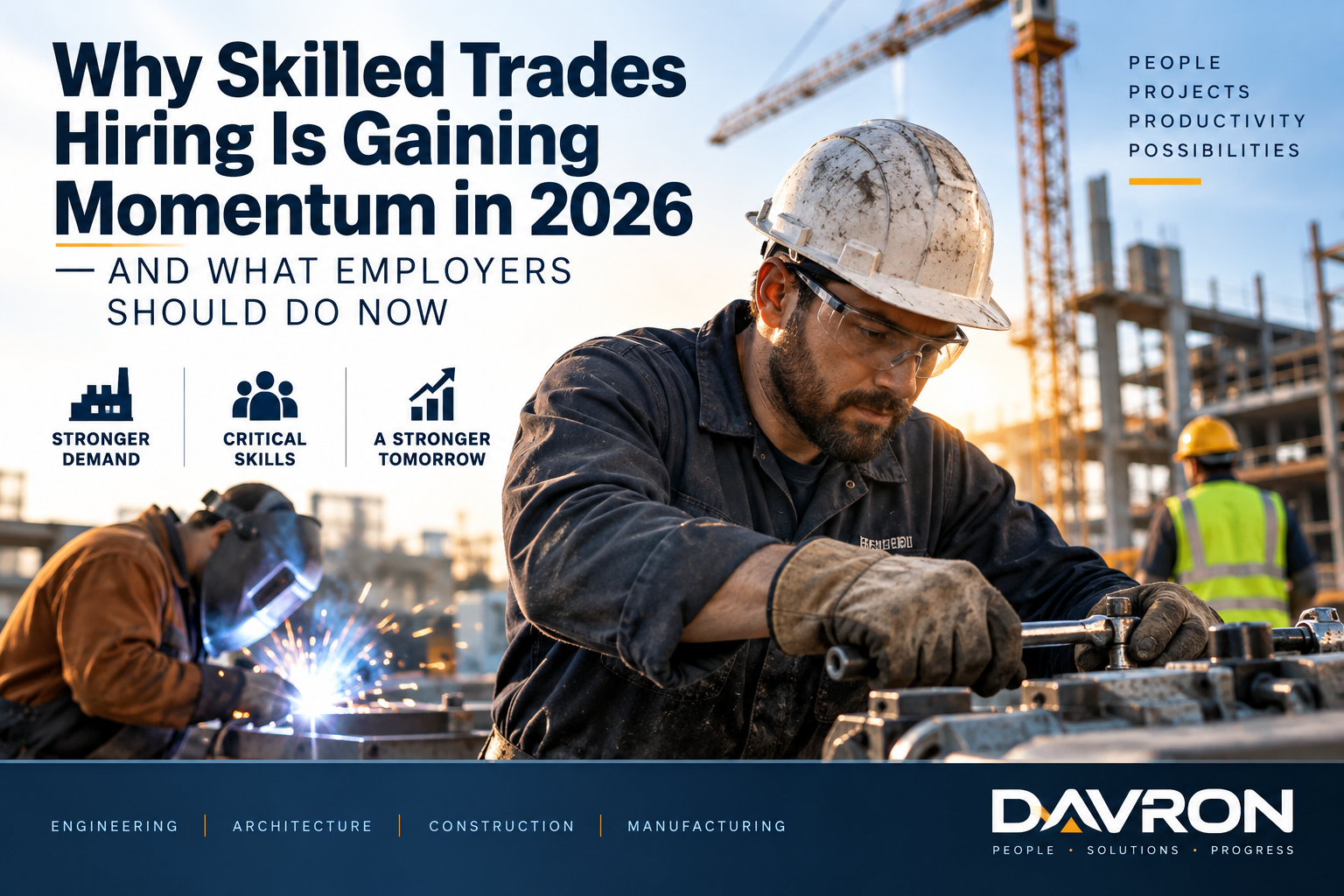
When a skilled trades position stays vacant, the problem can move beyond recruiting quickly.
An unfilled maintenance technician can contribute to equipment downtime or a growing maintenance backlog. A shortage of electricians, machinists, welders, industrial mechanics, HVAC technicians, or other experienced tradespeople can put additional pressure on existing employees, constrain production, complicate project schedules, and make it harder for an employer to expand capacity.
That is why the momentum behind skilled trades hiring in 2026 matters to employers.
Recent labor-market data shows substantial hiring activity in industries that depend heavily on technical and skilled workers. In July 2026, U.S. employers reported approximately 580,000 job openings in manufacturing and 326,000 in construction, according to the Bureau of Labor Statistics (BLS). Manufacturing openings increased by 79,000 from June, while construction openings increased by 28,000.
The message for employers is straightforward: companies that depend on skilled technical talent should not treat workforce planning as something that begins only after a critical employee leaves.
Why Is Skilled Trades Hiring Gaining Momentum in 2026?
Skilled trades hiring is gaining attention because employers continue to need people who can build, install, operate, maintain, repair, and support physical infrastructure and production systems.
The trend is more nuanced than simply saying there is a universal “skilled trades shortage.” Demand varies considerably by occupation, geography, industry, experience level, and required credentials.
But several indicators point to continued employer demand.
Manufacturing provides a strong example. Although BLS projects overall manufacturing employment to change relatively little between 2024 and 2034, it expects significant hiring activity beneath that headline number. Nearly 1 million production-occupation openings are projected each year on average from 2024 through 2034, primarily because employers will need to replace people who permanently leave their occupations, including workers who retire or move into other occupations.
At the same time, portions of manufacturing are expanding. BLS projects job growth in industries including electrical equipment and component manufacturing, semiconductor and electronic component manufacturing, aerospace products and parts, pharmaceuticals, plastics, and motor vehicles.
Automation does not eliminate the need for skilled people, either. In some cases, increasingly sophisticated equipment creates additional demand for workers capable of maintaining it. BLS projects industrial machinery mechanics to add 41,200 manufacturing jobs from 2024 to 2034 and specifically notes that greater adoption of automated manufacturing machinery is expected to contribute to demand for mechanics who maintain and repair production equipment.
For employers, this creates an important distinction:
The future of skilled trades hiring is not simply about adding workers. It is also about replacing experienced workers and finding people with the right technical capabilities for increasingly sophisticated operations.
What Does the 2026 Hiring Data Tell Employers?
Current hiring data shows why employers should pay attention.
In July 2026, seasonally adjusted job openings reached:
- 580,000 in manufacturing
- 326,000 in construction
- 429,000 in durable goods manufacturing alone
Manufacturing’s job-opening rate increased from 3.8% in June to 4.4% in July, while construction’s increased from 3.5% to 3.8%.
Employment data provides another indicator. In August 2026, manufacturing employment increased by 16,000, including gains of 6,000 in machinery manufacturing and 6,000 in fabricated metal product manufacturing. Construction employment increased by 22,000 during the month.
These figures should not be interpreted to mean every employer, trade, or region faces the same hiring conditions. They do show meaningful hiring activity in two sectors where technical and skilled labor is fundamental to operations.
For an individual employer, the more important question is often not, “Is there a national skilled trades shortage?”
It is:
“Can we find the specific person we need, in our location, at our compensation level, with the required skills, when we need them?”
That is a much harder hiring question.
Which Skilled Trades Are Particularly Important to Employers?
“Skilled trades” covers a wide range of occupations, and hiring conditions differ substantially between them.
Depending on the employer and industry, critical positions may include:
- Electricians
- Welders
- Machinists
- CNC machinists and operators
- Industrial machinery mechanics
- Maintenance technicians
- HVAC technicians
- Plumbers and pipefitters
- Equipment technicians
- Fabricators
- Production and operating supervisors
- Other specialized construction and manufacturing trades
Some occupations also require considerable training before a worker reaches full competency.
Machinists, for example, are projected by BLS to have about 29,500 openings per year on average from 2024 to 2034, and the occupation typically requires long-term on-the-job training.
That matters for workforce planning. When a position requires years of practical experience or specialized knowledge, an employer cannot necessarily solve an unexpected vacancy by hiring an inexperienced worker and expecting immediate productivity.
Why Can a Skilled Trades Vacancy Become Business-Critical?
A vacant position does not appear on an income statement as a simple line item called “cost of vacancy.”
Its effects can appear elsewhere.
If a manufacturing facility is short on experienced maintenance personnel, existing technicians may have to absorb more work. Preventive maintenance may become harder to schedule. Overtime may increase. Managers may have less flexibility when equipment problems arise.
If a construction employer cannot secure the right trade professionals, staffing constraints can complicate scheduling and coordination.
If a company needs additional skilled workers to increase production, hiring delays may prevent it from adding capacity as quickly as planned.
Depending on the role and operation, prolonged vacancies can contribute to:
- Production constraints
- Maintenance backlogs
- Project delays
- Increased overtime
- Scheduling problems
- Additional pressure on existing employees
- Reduced flexibility when unexpected problems occur
- Slower expansion of production capacity
- Delayed business opportunities
Not every vacancy produces all of these consequences. But employers should evaluate a skilled position according to its operational impact, not simply how long the requisition has been open.
A useful question for management is:
What happens to our business if this position remains vacant for another 30, 60, or 90 days?
If the answer involves production, project execution, customer commitments, equipment uptime, or revenue, recruiting speed deserves greater attention.
What Should Employers Do When They Need Skilled Trades Talent Now?
If a critical skilled trades position is already vacant, employers usually cannot afford to rely on one recruiting channel and simply wait.
Several approaches can run simultaneously.
Activate employee referrals. Employees working in the trade may know former coworkers or industry contacts who fit the position. A focused referral effort can reach candidates who are not searching job boards.
Re-engage previous candidates. Review qualified people who interviewed previously or applied for similar positions. Someone who was not the right fit six months ago may be appropriate for today’s opening.
Review compensation and scheduling. If qualified candidates repeatedly decline because of pay, shifts, travel, overtime expectations, or other conditions, the issue may be the offer rather than the candidate pool.
Expand the geographic search. For difficult positions, limiting recruiting to a small radius can eliminate qualified candidates before the conversation begins. Relocation assistance or a broader search may be appropriate for sufficiently important roles.
Evaluate transferable experience. An employer may be unnecessarily shrinking its candidate pool by demanding experience with an exact machine, product, or industry when adjacent technical experience could transfer effectively.
Develop internal talent for recurring needs. Apprenticeships, training programs, and internal advancement can create a longer-term pipeline. These approaches are particularly valuable for predictable recurring hiring needs, although they may not solve an immediate vacancy.
Add specialized recruiting support. When a critical opening remains unfilled or the employer needs candidates faster than inbound recruiting is producing them, a specialized recruiter can actively search for people who may never see—or apply to—the employer’s job advertisement.
The key is not to choose one solution automatically.
For an urgent vacancy, employers can use several of these approaches at the same time.
When Does a Specialized Recruiter Make Sense?
Not every skilled trades opening requires an outside recruiting firm.
If an employer has a strong local candidate pipeline, receives qualified applicants consistently, and has enough internal recruiting capacity, the company may be able to fill the position effectively on its own.
Specialized recruiting becomes more valuable when the situation changes.
It may make sense to bring in recruiting support when:
- A critical position has remained open too long
- Job postings are producing applicants but few qualified candidates
- The required technical skills are unusually specific
- The local talent pool is limited
- The company needs to reach employed candidates who are not actively job hunting
- Internal HR or talent acquisition teams are overloaded
- Multiple similar positions need to be filled
- The operational cost of waiting is becoming more significant
DAVRON specializes in recruiting and staffing for engineering, architecture, construction, and manufacturing, giving employers access to recruiting support focused on technical and industry-specific hiring rather than broad general staffing.
That specialization matters when candidate requirements become narrow.
A specialized recruiting process can focus on identifying candidates whose experience aligns with the employer’s actual environment, technical requirements, location, and business needs. It can also add another sourcing channel while the employer continues referrals, advertising, internal recruiting, and other hiring efforts.
The objective is not simply to produce more résumés.
It is to identify qualified candidates who are realistic possibilities for the position.
What Should Employers Do Before Skilled Trades Demand Increases Further?
The strongest time to solve a workforce problem is before the vacancy becomes an emergency.
Employers can start by identifying their most business-critical positions.
Ask:
Which employees would be hardest to replace?
Which vacancies could affect production or project schedules?
Which positions require substantial experience or training before a new employee becomes fully productive?
Where are we relying on one or two experienced people with difficult-to-replace knowledge?
Which positions repeatedly take the longest to fill?
Once those roles are identified, employers can build a more deliberate recruiting plan.
Review compensation before a search begins. Remove unnecessary job requirements that reduce the candidate pool without improving hiring quality. Decide who needs to participate in interviews. Establish how quickly the company can make a decision when a strong candidate is found.
Most importantly, develop multiple ways to reach candidates.
Employee referrals, internal development, apprenticeships, previous candidates, job advertising, direct recruiting, and specialized recruiting firms can all play different roles in a broader talent strategy.
Waiting until a project-critical or production-critical employee gives notice leaves fewer options and puts more pressure on every hiring decision.
Skilled Trades Hiring in 2026 Is a Workforce Planning Issue
The momentum behind skilled trades hiring is bigger than a single month’s employment report.
BLS projects roughly 963,400 production-occupation openings each year on average between 2024 and 2034, even though overall employment in the occupational group is projected to decline. The reason is critical for employers: workers who leave occupations still need to be replaced.
Meanwhile, employers continue investing in industries where technical expertise remains essential. BLS projections show growth within parts of electrical equipment, semiconductor, aerospace, pharmaceutical, automotive, and other manufacturing industries, while automation itself is expected to support demand for workers such as industrial machinery mechanics.
For employers, the practical conclusion is clear.
Skilled trades hiring momentum in 2026 is not simply a labor-market trend. It is a workforce-planning issue for companies whose projects, facilities, production, and operations depend on experienced technical talent.
If a particular skilled position would be difficult to replace, employers should know how they will recruit for it before the vacancy occurs.
And when that vacancy is already affecting production, maintenance, project execution, or growth, the solution should not be to post the same job again and hope the right person eventually applies.
It is time to expand the search.
Ready to hire engineering, architecture, construction, or manufacturing professionals?
DAVRON specializes in delivering high-quality candidates in these industries.