
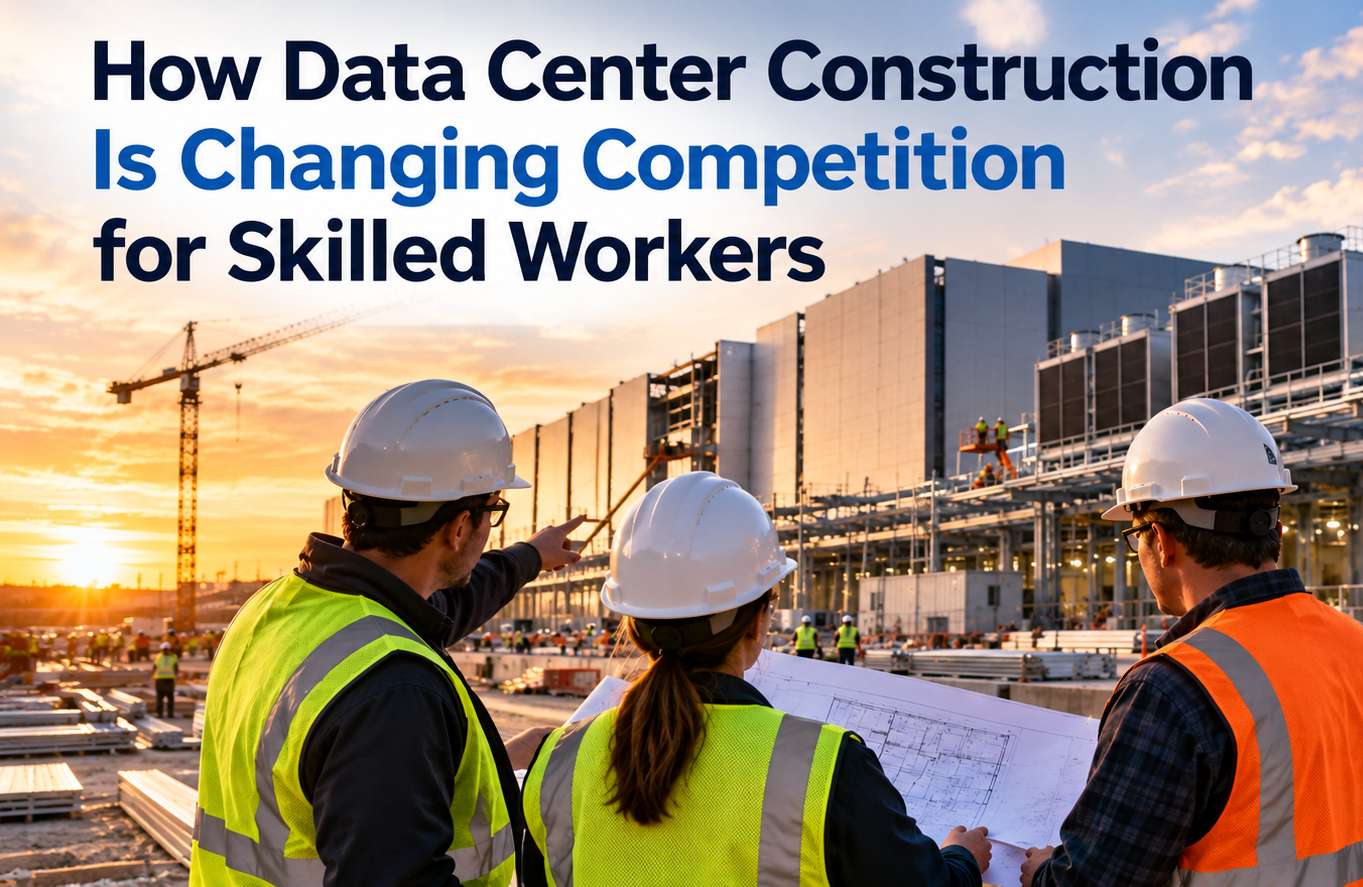
When a contractor cannot find an experienced electrician, HVAC specialist, project manager, superintendent, engineer, or other project-critical professional, the problem rarely stays inside the HR department. An open position can affect mobilization, schedules, supervision, workloads, project delivery, and ultimately the company’s ability to take on and execute work.
The expansion of data center construction is adding another source of competition for many of these workers.
Data centers require sophisticated electrical infrastructure, cooling systems, backup power, controls, utility connections, and construction management. As a result, they draw from many of the same talent pools that contractors, engineering firms, manufacturers, utilities, and other industrial employers rely on.
The effect is measurable. In a 2026 Associated General Contractors of America (AGC) and NCCER workforce survey, 58% of respondents involved in data center construction said these projects had increased competition for skilled workers, while 49% reported increased wage pressure. Across the broader survey, 87% of respondents had openings for hourly craft positions and 82% had salaried openings.
For employers, the practical question is no longer simply, “Are data centers creating jobs?”
It is:
How do we secure the people our projects need when major data center developments are competing for many of the same skills?
The answer may require faster hiring decisions, broader candidate sourcing, competitive compensation, internal workforce development, flexible staffing approaches, and—in difficult or urgent searches—a specialized recruiting partner capable of reaching qualified technical professionals beyond the applicants responding to job postings.
Why Are Data Center Projects Increasing Competition for Skilled Workers?
A data center may look like another large commercial building from the outside, but the systems inside make these projects unusually dependent on specialized technical expertise.
AGC notes that data centers require complex electrical systems, backup power generation, cooling equipment, fiber connectivity, security systems, and utility infrastructure. Building them creates demand for electricians, operating engineers, plumbers, pipefitters, project managers, engineers, and numerous other construction specialists.
Those workers are not exclusive to the data center industry.
An experienced electrician might also be needed on a manufacturing expansion, hospital, semiconductor facility, commercial development, power project, or industrial plant. Mechanical professionals may be recruited by contractors, manufacturers, engineering firms, and facilities operators. Experienced project managers and superintendents can move between multiple types of complex construction.
That overlap is what matters to employers.
Even companies that never bid on a data center can find themselves recruiting from a labor pool increasingly targeted by companies that do.
The broader labor market was already challenging. AGC’s 2025 workforce analysis found electricians difficult to fill for 77% of surveyed firms seeking them. Among firms hiring salaried personnel, 81% reported difficulty finding superintendents and 76% reported difficulty finding project managers or supervisors.
Data center development therefore is not creating every construction workforce problem. Instead, it can intensify competition for certain skills in a labor market where qualified workers were already difficult to find.
Which Roles May Face the Most Hiring Competition?
The impact varies by occupation, geography, project pipeline, and level of experience. But several categories are particularly relevant to data center construction.
Electricians and Electrical Specialists
Electrical infrastructure is fundamental to data center construction and operation.
Facilities require extensive power distribution as well as backup and redundant systems designed to keep critical equipment operating. That creates demand for electricians and electrical specialists who may already be sought by commercial, industrial, manufacturing, infrastructure, and power projects.
The long-term national outlook reinforces the broader demand for this trade. The U.S. Bureau of Labor Statistics projects electrician employment to grow 9% from 2025 through 2035, compared with 3% for all occupations, with approximately 72,700 openings projected each year on average.
That does not mean data centers are responsible for all of this demand. It does mean contractors pursuing electricians are competing within an occupation already expected to need substantial numbers of new and replacement workers.
HVAC and Mechanical Professionals
Servers and other computing equipment generate enormous amounts of heat. Cooling and environmental control therefore become essential parts of data center infrastructure.
That increases the importance of HVAC technicians as well as mechanical engineers, mechanical contractors, controls professionals, pipefitters, and specialists familiar with sophisticated cooling systems.
BLS projects employment for HVAC mechanics and installers to grow 11% from 2025 through 2035, with roughly 40,600 openings annually on average. Significantly, BLS specifically identifies commercial construction—including data centers—as one factor expected to drive employment growth.
Project Managers
Large, technically complex facilities require professionals capable of coordinating schedules, contractors, budgets, equipment, clients, design teams, and changing project requirements.
Data center development adds another market competing for experienced construction project leadership. JLL has previously identified high demand for project management staff among data center operators and described the issue as extending across the United States and Canada.
Construction Superintendents
Experienced superintendents are difficult to replace because employers are not merely hiring someone who understands construction. They often need someone capable of managing field operations, subcontractors, sequencing, safety, quality, schedules, and client expectations.
That experience takes years to develop.
When major projects pursue the same field leaders, contractors may find that posting another advertisement produces more applicants without necessarily producing the right superintendent.
Engineers and MEP Professionals
Electrical and mechanical engineers, MEP professionals, and other specialists can be essential throughout data center design, construction, commissioning, and operation.
The competition for these professionals can overlap directly with engineering firms, MEP contractors, manufacturers, industrial employers, and traditional commercial construction.
Controls, Automation, and Commissioning Specialists
As building systems become more sophisticated, employers also need professionals who can integrate, test, validate, and troubleshoot those systems.
These positions can be particularly difficult because employers may require a specific combination of technical knowledge, systems experience, project exposure, and commissioning expertise rather than simply a particular job title.
How Does Data Center Growth Affect Contractors That Don't Build Data Centers?
This is where the issue becomes especially important.
A contractor does not need a data center project in its backlog to compete with the data center industry for labor.
Imagine a commercial contractor needs an electrical project manager. An industrial employer needs a controls engineer. A mechanical contractor needs an experienced HVAC professional. A general contractor needs a superintendent.
Each employer may discover that some of its strongest candidates are also considering opportunities connected to data centers, advanced manufacturing, power infrastructure, or other large capital projects.
In August 2026, AGC reported that nonresidential specialty trade contractors had added 86,000 employees over the preceding 12 months. AGC also reported construction craft pay rising faster than pay for private-sector production workers overall, while pointing to data centers, advanced manufacturing, and power projects as contributors to strong construction labor demand.
For an individual employer, increased competition can show up in several ways.
Candidates have more alternatives. Qualified professionals may be interviewing with several employers simultaneously.
Compensation expectations can rise. Employers may find that compensation that successfully attracted candidates a year or two ago is less effective in a particular market today.
Counteroffers become more dangerous. A current employer that does not want to lose an experienced employee may respond aggressively when that person resigns.
Geographic searches can become more difficult. A major project can place significant demand on a specific regional labor market.
Existing employees carry the vacancy. When an important position remains open, the work does not necessarily disappear. Managers, supervisors, engineers, and field personnel may absorb additional responsibilities.
Project execution can suffer. AGC’s September 2026 workforce survey found that 74% of respondents had experienced at least one significant project delay during the previous year, with workforce shortages identified as the leading reason for delays.
Not every delayed project is caused by a vacant position, and labor conditions vary considerably by market. But the connection between workforce availability and project execution is clear enough that employers should treat critical recruiting as an operational issue, not simply an administrative function.
What Should Employers Do When They Need Skilled Workers Now?
If a superintendent resigns two weeks before a major project begins, or a company lands a project requiring an electrical project manager it does not have, a long-term workforce strategy will not solve the immediate problem.
Employers need multiple options.
Accelerate the Internal Hiring Process
Start by removing delays that the company itself controls.
Determine the compensation range and approval authority before interviewing. Identify who actually needs to participate in the hiring decision. Reserve interview availability. Establish what qualifications are mandatory and which are preferences.
If a candidate meets the requirements, do not automatically add another interview because “that’s the process.”
Speed does not require lowering standards. It means removing waiting time that adds no value.
Expand the Geographic Search
A local-only search can become a major constraint for a highly specialized position.
Depending on the role, employers may need to consider candidates willing to relocate, travel, commute, or work under another arrangement.
The narrower the technical requirements, the more important geographic flexibility can become.
Reassess the Employment Opportunity
If qualified candidates consistently decline interviews or offers, employers should examine why.
Compensation is an obvious factor, but it is not the only one. Consider advancement opportunities, project type, travel expectations, schedule, location, benefits, management responsibilities, company stability, and the quality of the hiring process itself.
The objective is not necessarily to pay more than every competing employer. It is to understand whether the opportunity is competitive enough to attract the caliber of person the company expects to hire.
Develop and Promote Internal Talent
This does not solve tomorrow’s vacancy, but it can prevent future ones.
Contractors can create clearer pathways for technicians to become supervisors, project engineers to develop into project managers, and promising field personnel to take on greater leadership responsibilities.
Training matters here. In AGC’s 2026 workforce survey, 36% of respondents reported starting or increasing spending on training and professional development as firms addressed workforce challenges.
Use Contract or Flexible Talent Where Appropriate
Some employers may be able to use contract professionals, temporary staffing, subcontractors, consultants, or other workforce models to cover specific project needs while continuing a permanent search.
The appropriate approach depends on the position, project, employment requirements, licensing considerations, and company structure.
Engage a Specialized Recruiter
There is also a point at which continuing the same internal search can become more expensive than changing the recruiting strategy.
If job postings are producing the wrong candidates, internal recruiters are overloaded, the geographic search needs to expand, or the company urgently needs someone with specialized experience, an outside recruiter can add dedicated sourcing capacity.
For technical positions, specialization matters.
DAVRON focuses on recruiting within engineering, architecture, construction, and manufacturing. Rather than operating as a broad generalist staffing company, DAVRON’s recruiting model is built around the types of technical and project professionals employers in these industries need.
For employers struggling to fill a project-critical position, that specialization can be particularly relevant because the search often requires more than collecting applications. It requires identifying professionals whose technical background, project experience, location, compensation requirements, and career interests align with the position.
Why Hiring Speed Matters More When Competition Increases
A company can have an excellent compensation package and still lose candidates because its hiring process is too slow.
Consider what happens when a qualified project manager is actively exploring the market.
One employer conducts an initial interview on Monday, a final interview on Wednesday, and makes a decision Thursday.
Another conducts an interview Monday, waits until Friday to schedule the second round, schedules that meeting for the following Wednesday, then spends several more days securing offer approval.
The second company may never get the opportunity to make its offer.
This does not mean every employer should hire after one conversation. It means every step should have a purpose.
Common avoidable delays include:
- Waiting several days to contact a strong applicant
- Requiring too many interview rounds
- Having decision-makers unavailable
- Beginning compensation discussions too late
- Failing to communicate between interviews
- Delaying offer approval
- Leaving candidates without updates
When critical positions affect project delivery, recruiting velocity becomes part of operational planning.
When Should a Contractor Use a Specialized Recruiter?
Not every vacancy requires outside recruiting support.
If an employer has a strong internal talent pipeline and routinely attracts qualified candidates for a position, internal hiring may be entirely appropriate.
A specialized recruiter becomes more valuable when the search itself is becoming a business problem.
That may be the case when:
- A vacancy is beginning to affect project execution.
- Job advertisements repeatedly produce poorly matched candidates.
- The position requires specialized technical or project experience.
- The employer has exhausted its normal candidate network.
- The local talent pool is too small.
- Qualified candidates are likely to be employed rather than actively applying.
- Internal HR or recruiting personnel do not have enough capacity for intensive sourcing.
- Several technical positions need to be filled simultaneously.
- The cost of leaving the position vacant is becoming significant.
DAVRON’s specialization in engineering, architecture, construction, and manufacturing is designed around technical hiring situations like these. The goal is not to replace an employer’s internal hiring team unnecessarily. It is to provide focused recruiting support when finding the right person requires additional reach, time, or niche expertise.
How Can Employers Compete Without Simply Paying the Highest Salary?
Compensation matters. If an employer’s salary is substantially below the market for the experience it expects, better recruiting alone is unlikely to solve the problem.
But compensation is not the only reason professionals accept or reject opportunities.
Employers can also compete through:
- Faster, more professional hiring decisions
- Clear advancement opportunities
- Interesting or technically challenging projects
- Greater leadership responsibility
- Geographic stability
- Reduced travel when the position permits it
- Schedule flexibility where practical
- Strong management and communication
- Clearly defined responsibilities
- Training and professional development
- A credible long-term career path
The candidate experience matters as well.
An employer that communicates clearly, respects the candidate’s time, answers questions directly, and moves decisively can distinguish itself from companies that allow candidates to sit in an undefined process for weeks.
Build a Workforce Strategy Before the Next Critical Vacancy
Urgent recruiting is sometimes unavoidable. Surprise resignations happen. New projects are awarded. Workloads change.
But not every urgent vacancy has to become an emergency.
Employers can identify project-critical positions before they become vacant.
Ask:
Which employees would be hardest to replace?
Which positions require experience that takes years to develop?
Which upcoming projects will create new staffing requirements?
Where is the company already relying too heavily on one individual?
Which positions consistently take the longest to fill?
What happens operationally if one of those jobs remains vacant for 30, 60, or 90 days?
Those questions can guide succession planning, compensation reviews, cross-training, recruiting pipelines, and relationships with specialized recruiting partners.
The goal is to move from “We need someone immediately—where do we find them?” to “We know which roles are critical, what the market requires, and how we will recruit before the vacancy becomes a project problem.”
That approach becomes increasingly valuable when major data center, manufacturing, power, infrastructure, and commercial projects are all drawing from overlapping technical talent pools.
Frequently Asked Questions
Why are data centers competing for so many skilled workers?
Data centers require substantial electrical infrastructure, cooling and mechanical systems, backup power, controls, utilities, and sophisticated construction management. Those requirements create demand for many of the same skilled trades and technical professionals used by other construction and industrial projects.
Which construction workers are most affected by data center growth?
The exact impact varies by market, but data center projects can require electricians, mechanical and HVAC professionals, plumbers and pipefitters, engineers, project managers, superintendents, controls specialists, commissioning professionals, and other technical workers. Employers should evaluate conditions for the specific occupation and geographic market rather than assuming every trade faces the same level of competition.
Are data center projects making electricians harder to hire?
There is evidence that data center development is contributing to competition for electricians. In its June 2026 analysis of construction job openings, Associated Builders and Contractors specifically pointed to demand for occupations critical to data center construction, including electricians. More broadly, BLS projects approximately 72,700 electrician openings per year on average from 2025 through 2035.
Data centers are only one source of electrician demand, however, and conditions differ significantly by location.
Why are HVAC and mechanical professionals important to data centers?
Computing equipment produces substantial heat, making cooling and climate-control infrastructure critical. Data centers therefore require mechanical systems and professionals capable of installing, maintaining, managing, and supporting those systems. BLS specifically identifies commercial construction, including data centers, as one factor expected to support HVAC employment growth.
How can contractors compete for skilled workers?
Contractors can improve their position by accelerating hiring decisions, benchmarking compensation, expanding geographic searches, strengthening career-development opportunities, training internal employees, improving candidate communication, and building talent pipelines before positions become urgent. For difficult searches, specialized recruiting can provide another sourcing channel.
What should I do if I need a project manager or superintendent immediately?
First, define the essential experience and compensation range so the search can move without internal delays. Activate internal referrals and recruiting channels, determine whether the search can expand geographically, and establish an expedited interview and approval process.
If those channels are not producing qualified candidates quickly enough, consider engaging a specialized construction recruiter while continuing internal efforts rather than waiting until the vacancy has already affected the project.
When should I use a specialized construction or engineering recruiter?
Consider specialized recruiting when a role is difficult to fill, the local candidate pool is limited, job postings are producing weak results, the vacancy is affecting operations, or internal recruiting teams do not have sufficient time or reach to conduct a more intensive search.
Can DAVRON recruit for data center-related positions?
DAVRON specializes in recruiting professionals in engineering, architecture, construction, and manufacturing, which overlap with many of the professional and technical disciplines involved in data center development. Employers should discuss the specific position and requirements with a DAVRON recruiter to determine how the firm’s recruiting capabilities align with the search.
Data Center Growth Is Making Workforce Planning More Important
The data center boom does not mean every contractor will suddenly lose its workforce to a hyperscale project. Labor conditions are regional, occupational demand varies, and data centers are only one of several forces shaping construction hiring.
But the latest industry evidence makes one point difficult to ignore: data center projects are competing for workers that many other employers also need.
Among contractors participating in data center work in AGC’s 2026 survey, 58% reported increased competition for skilled workers and 49% reported increased wage pressure. At the same time, employers continue to report difficulty filling both craft and salaried construction positions.
For employers, the appropriate response is not panic. It is preparation.
Know which positions are critical. Understand what qualified candidates expect. Remove unnecessary delays from the hiring process. Build internal talent where possible. Expand sourcing when necessary.
And when a difficult technical vacancy is already threatening project execution, bringing in specialized recruiting resources early may give the employer more options than waiting for another job posting to produce the right person.
Ready to hire engineering, architecture, construction, or manufacturing professionals?
DAVRON specializes in delivering high-quality candidates in these industries.