
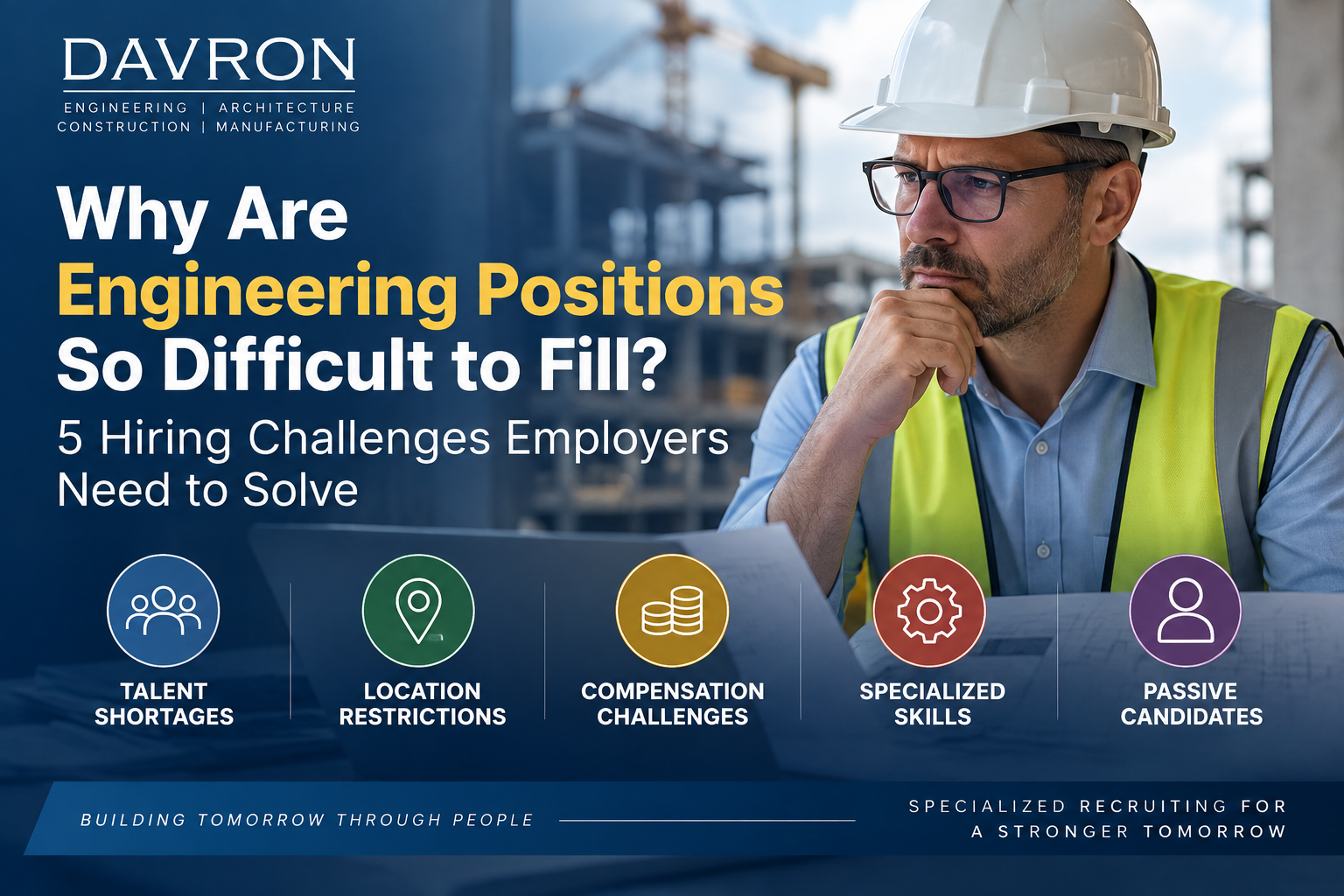
Engineering positions are difficult to fill because employers are rarely looking for just “an engineer.” They need someone with the right technical skills, industry experience, software knowledge, seniority, compensation expectations, geographic availability, and interest in making a career move—all at the same time.
Every additional requirement reduces the available candidate pool.
For employers, that can quickly become an operational problem rather than simply a recruiting problem. When a critical engineering position remains vacant, projects can slow down, existing employees may absorb additional responsibilities, production or design schedules can become harder to maintain, and important deliverables may be delayed.
If you need an engineer quickly, simply posting the position on more job boards may not solve the underlying problem. Employers often need to identify what is restricting their candidate pool and change their recruiting strategy accordingly.
Here are five of the most common reasons engineering positions become difficult to fill—and what employers can do about them.
1. Talent Shortages Limit the Qualified Candidate Pool
A company may receive dozens or even hundreds of applications and still have very few candidates who meet the actual requirements of an engineering position.
The challenge becomes more significant when the employer needs a particular combination of experience.
For example, the position might require an engineer who has worked within a specific industry, understands particular equipment or systems, has experience with certain project types, knows specialized software, or holds a professional license.
The number of people who meet all those requirements can be considerably smaller than the overall number of engineers in the market.
Employers should therefore distinguish between an applicant shortage and a qualified-candidate shortage.
If applications are plentiful but qualified candidates are scarce, increasing the number of job postings may have limited value. The employer may need to reconsider how the position is defined and how candidates are being sourced.
Potential solutions include:
- Separating essential qualifications from preferred qualifications.
- Considering candidates from adjacent industries when their technical experience is transferable.
- Expanding recruiting beyond traditional job boards.
- Searching additional geographic markets.
- Directly approaching engineers with relevant experience.
- Engaging a specialized engineering recruiter when internal sourcing is producing too few qualified candidates.
The objective is not necessarily to lower hiring standards. It is to determine which requirements genuinely predict success in the position and which may be unnecessarily restricting the search.
2. Location Restrictions Can Make an Already Small Talent Pool Even Smaller
Engineering work is often closely connected to physical facilities, project sites, manufacturing operations, laboratories, equipment, or client locations. As a result, many engineering positions cannot simply become fully remote jobs.
That creates a geographic constraint.
An employer may have identified the right technical profile but still struggle because relatively few qualified engineers live within commuting distance of the facility.
Location becomes particularly challenging when the position requires both unusual technical expertise and regular onsite attendance. The employer is effectively searching for the intersection of two groups: people with the necessary skills and people who can realistically work at that location.
Employers facing this problem can consider several approaches.
Where the work permits it, hybrid scheduling may increase the number of candidates willing to consider the opportunity. Relocation assistance can make a geographically limited search more attractive to candidates elsewhere. Employers can also expand sourcing nationally rather than relying primarily on local applicants.
The important distinction is between advertising nationally and recruiting nationally.
Posting a position where candidates across the country can see it does not necessarily mean qualified engineers will apply. Many are already employed and may never encounter the advertisement.
Proactively identifying engineers who meet the requirements and then determining whether they would consider relocation can produce a very different candidate pool.
3. Compensation May Not Match the Actual Candidate Market
Sometimes an engineering position is difficult to fill because the compensation was established before the employer had enough information about the available talent market.
Salary is only part of that equation.
Qualified engineers may evaluate base compensation, bonuses, benefits, paid time off, flexibility, commute, relocation assistance, advancement opportunities, responsibilities, project exposure, and overall career trajectory when considering a new position.
The more demanding the employer’s requirements become, the more important it is to understand what candidates who meet those requirements expect.
Broad salary averages can also be misleading. Compensation for an engineer can vary substantially based on discipline, experience, geography, licensing, industry knowledge, technical specialization, and management responsibility.
An employer seeking an unusually specific combination of qualifications may therefore be competing for a much narrower—and potentially more expensive—candidate population than a general salary benchmark suggests.
If qualified candidates repeatedly decline interviews or offers because of compensation, the employer should investigate the pattern rather than assuming the problem is candidate interest.
The solution may involve adjusting compensation, improving another part of the employment package, reconsidering certain requirements, or expanding the geographic search.
4. Specialized Skill Requirements Can Shrink the Candidate Pool Quickly
Engineering job descriptions often contain long lists of technical requirements.
Some are essential. Others may simply describe the employer’s ideal candidate.
That distinction matters.
Consider a position requiring a particular engineering degree, eight years of experience, experience within one specific industry, proficiency with several software platforms, knowledge of particular codes, experience with a certain project type, and a professional license.
Each requirement may appear reasonable independently. Combined, however, they can create an extremely narrow candidate profile.
Employers should ask a practical question about every major requirement:
Does the candidate need this qualification on the first day, or could a strong engineer learn it after being hired?
Some qualifications genuinely cannot be compromised. A license may be required for specific responsibilities. Certain technical knowledge may be essential for safety, compliance, or immediate project execution.
Other requirements may be teachable.
An engineer with excellent fundamentals and highly relevant experience may be able to learn a different software platform. Someone from an adjacent industry may understand processes that transfer well to the employer’s environment.
Separating true requirements from preferences can expand the candidate pool without sacrificing the quality of the hire.
5. Many Qualified Engineers Are Passive Candidates
One of the biggest limitations of an application-only recruiting strategy is that it primarily reaches people who are already looking for work.
That is not the entire engineering talent market.
A qualified engineer may be successfully employed, reasonably satisfied, and not checking job boards. That person could still consider a stronger career opportunity if approached with a relevant position.
These professionals are commonly described as passive candidates.
Reaching them requires a different recruiting strategy.
Rather than waiting for applications, employers may need to identify engineers with relevant backgrounds and contact them directly. Professional networks, industry relationships, referrals, targeted sourcing, and recruiter outreach can all become important.
The conversation is also different.
A passive candidate may need to understand why changing employers is worth considering. Responsibilities, advancement, compensation, project scope, location, flexibility, company environment, and long-term opportunity can all influence that decision.
This is one reason specialized recruiting can be particularly valuable for difficult engineering searches. A recruiter can work beyond the inbound applicant pool and actively identify professionals whose backgrounds align with the employer’s requirements.
DAVRON focuses specifically on recruiting within engineering, architecture, construction, and manufacturing, including technical positions that can be difficult for employers to fill through conventional applicant-driven recruiting.
What Should You Do When You Need an Engineer Quickly?
When an engineering vacancy is affecting a project, production schedule, workload, or important client commitment, waiting another month for better applicants may not be a realistic strategy.
Start by identifying the bottleneck.
If you are receiving almost no qualified applicants, expand your sourcing strategy. If good candidates are declining because of salary, review compensation. If geography is eliminating otherwise qualified engineers, evaluate relocation or flexibility. If candidates consistently meet most—but not all—of the requirements, reconsider whether every requirement is truly mandatory.
Employers can also accelerate a search by shortening unnecessary gaps between interviews and decisions. A lengthy hiring process can create another obstacle when candidates are simultaneously considering other opportunities.
For an immediate hiring need, several strategies can be used together: broaden geographic sourcing, revisit compensation, eliminate unnecessary requirements, improve interview speed, actively recruit passive candidates, temporarily redistribute work where practical, and bring in specialized recruiting resources.
The key is to avoid repeating a recruiting strategy that has already failed.
Reposting the same job description with the same requirements, compensation, location restrictions, and sourcing strategy is unlikely to address the reason the search has stalled.
When Does It Make Sense to Use an Engineering Recruiter?
Not every engineering vacancy requires an external recruiter.
If an employer has a strong internal talent pipeline, receives qualified applicants quickly, and has sufficient recruiting resources, an internal search may work well.
A specialized recruiter becomes more relevant when the circumstances are different.
The position may be highly technical. The local candidate market may be small. Internal recruiting may have already produced limited results. The employer may need someone quickly. Or the strongest potential candidates may be employed professionals who are not actively applying for jobs.
In these situations, the employer needs more than additional exposure for the job posting. It needs targeted access to the relevant talent market.
DAVRON is a specialized recruiting and staffing firm focused on engineering, architecture, construction, and manufacturing. Its recruiting model is built around technical hiring and hard-to-fill positions rather than broad, general-purpose staffing. Employers can also speak directly with a live recruiter about their hiring requirements.
That specialization is particularly relevant when the employer already knows that conventional sourcing is not producing enough qualified candidates.
Solving a Difficult Engineering Search
Engineering positions become difficult to fill when multiple constraints narrow an already limited candidate market.
Talent availability may be one part of the problem, but location, compensation, technical requirements, recruiting speed, and access to passive candidates can be equally important.
The solution is to determine which constraint is actually preventing the hire.
Sometimes that means adjusting the position. Sometimes it means expanding the search. And sometimes it means changing how candidates are identified and approached.
For employers facing a project-critical or repeatedly unsuccessful engineering search, specialized recruiting provides another path to candidates beyond those who happen to see and respond to a job advertisement.
Ready to hire engineering, architecture, construction, or manufacturing professionals?
DAVRON specializes in delivering high-quality candidates in these industries.