
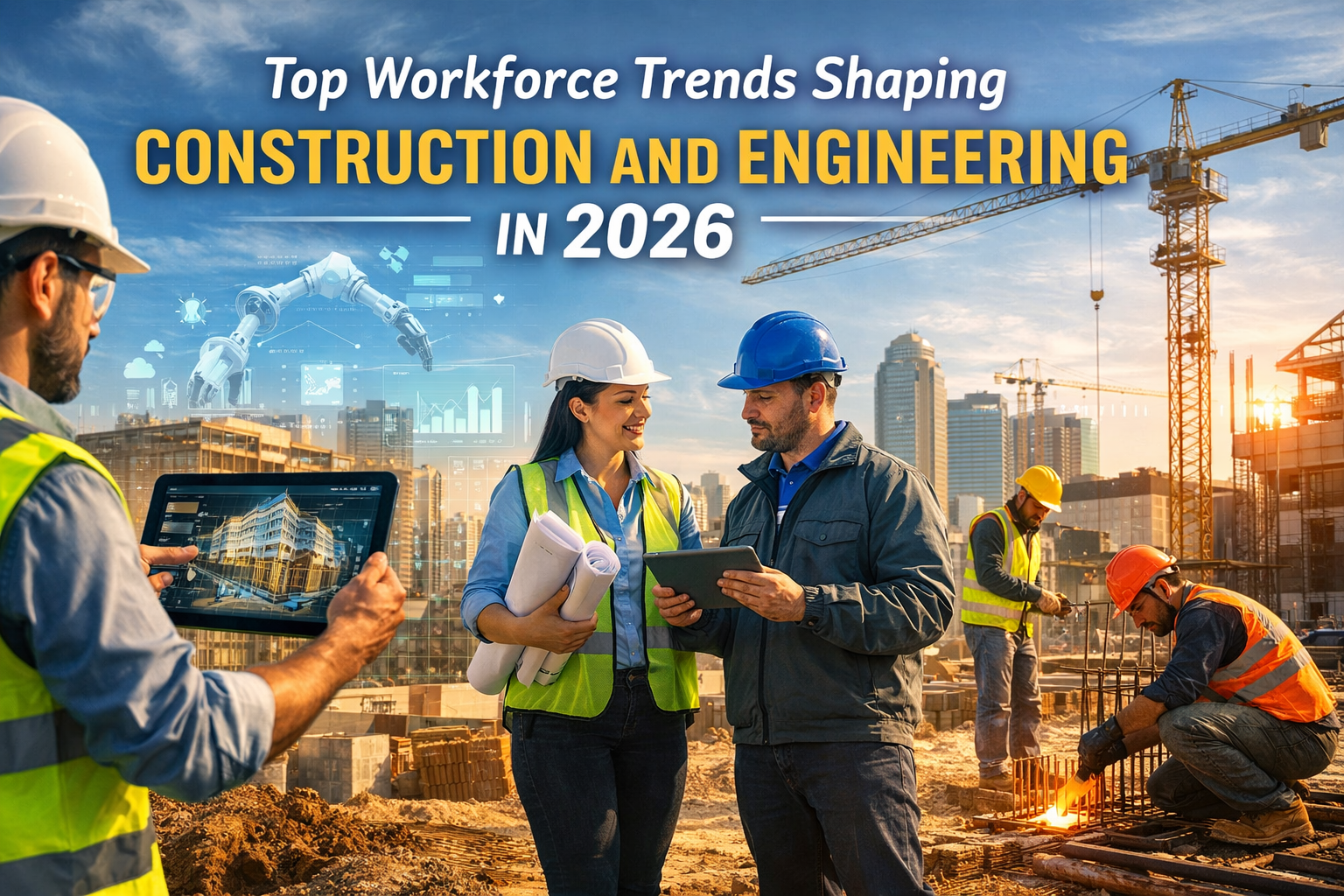
As the construction and engineering industries move into 2026, workforce challenges and opportunities are becoming more defined—and more urgent. Ongoing labor shortages, accelerating technology adoption, evolving employee expectations, and increased infrastructure investment are reshaping how companies attract, develop, and retain talent.
For employers and job seekers alike, understanding these workforce trends is critical. The firms that adapt fastest in 2026 will be the ones best positioned for long-term growth, while professionals who align their skills with industry demand will enjoy stronger career stability and earning potential.
Skilled Labor Shortages Remain the Industry’s Biggest Obstacle
Entering 2026, skilled labor shortages continue to impact nearly every segment of construction and engineering. Retirements among experienced tradespeople, supervisors, and senior engineers are accelerating, while the pipeline of new talent still struggles to keep pace with demand.
This shortage is no longer just a hiring issue—it’s a business risk. Delayed schedules, higher labor costs, and reduced bidding capacity are forcing companies to rethink workforce planning. In 2026, proactive recruitment, early workforce forecasting, and retention strategies are no longer optional; they are essential for survival.
A Generational Shift Is Redefining the Workforce
The construction and engineering workforce in 2026 reflects a clear generational transition. While institutional knowledge is leaving the industry through retirements, Gen Z and younger Millennials are stepping in with different expectations about work, technology, and career progression.
Younger professionals are drawn to companies that offer mentorship, transparency, modern tools, and meaningful work. Employers that highlight innovation, sustainability, and long-term career development are finding it easier to attract emerging talent than those relying on traditional messaging alone.
Technology and AI Become Standard Workforce Requirements
By 2026, digital transformation is no longer a competitive advantage—it’s a baseline expectation. Tools like BIM, digital twins, cloud-based project management platforms, and AI-driven analytics are embedded into daily workflows across construction and engineering teams.
Artificial intelligence is increasingly used to support scheduling, cost forecasting, safety monitoring, and quality control. Rather than replacing workers, AI is reshaping job roles, creating demand for professionals who can interpret data, manage digital systems, and collaborate across technology-driven platforms.
Upskilling and Reskilling Define Workforce Strategy
As technology adoption accelerates, companies in 2026 are placing greater emphasis on upskilling and reskilling their existing workforce. Training programs focused on digital construction tools, AI-assisted decision-making, and advanced project delivery methods are becoming central to workforce strategy.
Organizations that invest in learning and development are seeing improved retention, higher productivity, and stronger leadership pipelines. In a tight labor market, continuous training is not just an employee benefit—it’s a strategic necessity.
Flexible and Hybrid Work Expand Across Engineering Roles
While on-site work remains essential for construction operations, flexibility continues to expand in engineering, design, and project management roles in 2026. Remote collaboration tools now allow teams to work efficiently across locations, enabling firms to recruit talent beyond their immediate geographic markets.
Hybrid work models are also helping companies appeal to younger professionals who prioritize work-life balance. Employers that embrace flexibility—where operationally feasible—are gaining an edge in talent acquisition and retention.
Wage Growth and Total Compensation Take Center Stage
Competition for skilled professionals in 2026 continues to drive wage growth across construction and engineering roles. Tradespeople, licensed engineers, estimators, and project managers are commanding higher salaries, improved benefits, and more negotiating power than in previous years.
However, compensation alone is no longer the deciding factor. Employees are increasingly evaluating total employment value, including job stability, growth opportunities, company culture, and flexibility. Employers that align pay with a strong overall employee experience are better positioned to retain top talent.
Apprenticeships and Workforce Pipelines Expand in 2026
To combat ongoing shortages, companies are doubling down on apprenticeships, internships, and partnerships with trade schools and universities. These workforce pipelines provide a steady flow of entry-level talent while reducing long-term hiring risk.
In 2026, apprenticeship programs are also evolving to include digital skills training, safety leadership, and sustainability education—better preparing workers for the modern construction and engineering environment.
Sustainability and Safety Skills Become Non-Negotiable
Sustainability continues to shape workforce demand in 2026. Engineers and construction professionals with experience in green building, energy efficiency, and sustainable materials are increasingly sought after as environmental regulations and client expectations rise.
At the same time, safety expertise is becoming a core competency across roles. From prevention-through-design practices to data-driven safety monitoring, companies are prioritizing professionals who can help reduce risk while maintaining productivity.
Diversity and Inclusion Influence Workforce Growth
In 2026, diversity and inclusion initiatives remain closely tied to workforce resilience. Expanding access to underrepresented groups helps address labor shortages while fostering innovation and stronger team performance.
Organizations that invest in inclusive hiring, training, and leadership development are unlocking new talent pools—an important advantage in an increasingly competitive labor market.
Key Takeaways for 2026
The construction and engineering workforce landscape in 2026 reflects an industry adapting to long-term change. Labor shortages persist, but technology, training, and evolving workplace expectations are reshaping how companies and professionals succeed.
Employers that invest in people, embrace innovation, and adapt to workforce expectations will remain competitive. Professionals who continuously develop technical, digital, and leadership skills will find strong opportunities across the industry.
FAQ: Construction & Engineering Workforce Trends 2026
Why are labor shortages still a problem in 2026?
Retirements, high project demand, and limited talent pipelines continue to strain the workforce.
Is AI replacing construction and engineering jobs?
No—AI is enhancing productivity and changing skill requirements rather than eliminating roles.
What skills are most valuable in 2026?
Digital construction tools, AI literacy, project management, sustainability, and safety leadership.