
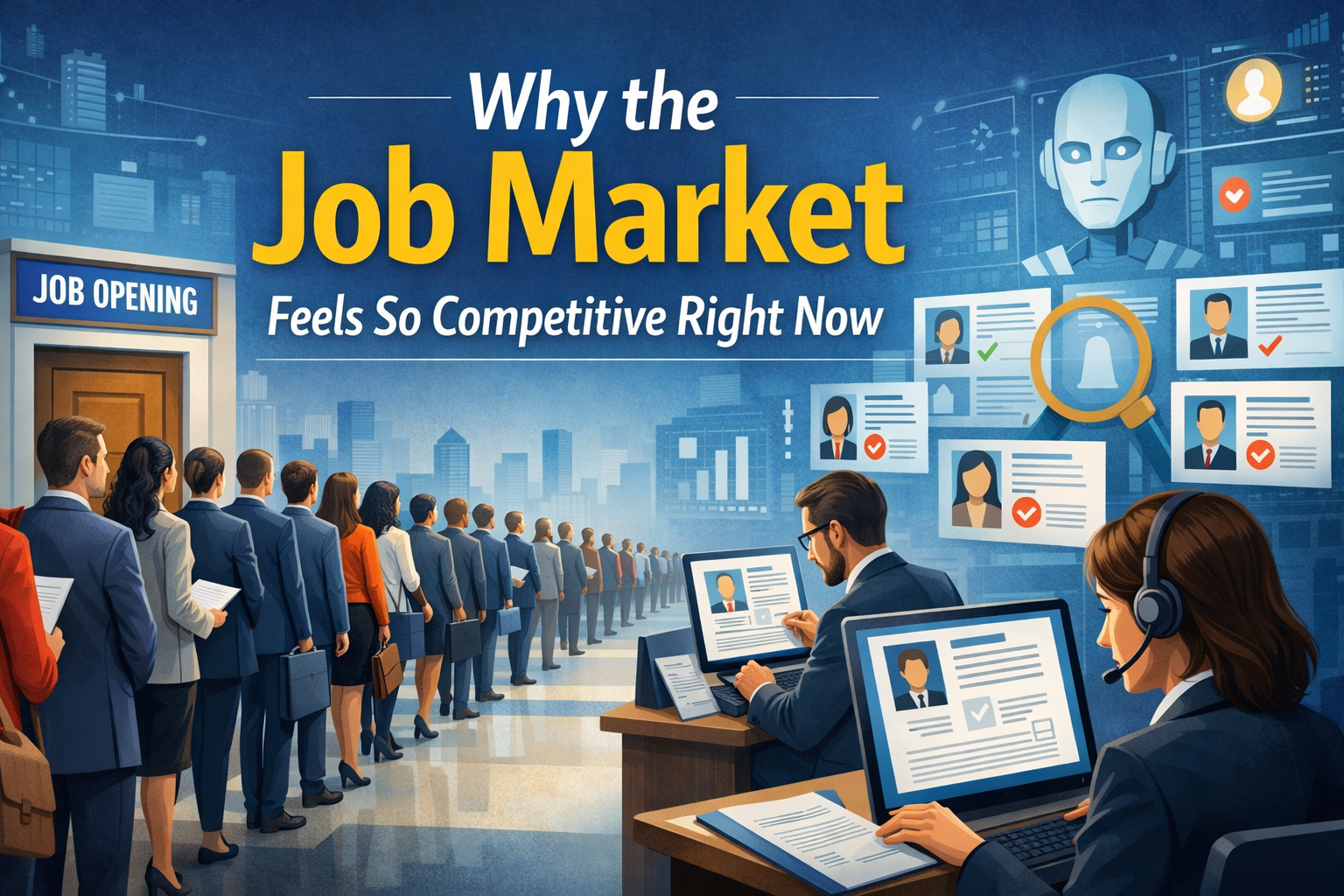
The job market in 2026 is sending mixed signals. Unemployment remains relatively low in the United States, yet millions of job seekers report sending dozens—sometimes hundreds—of applications without landing interviews. From entry-level roles to senior engineering positions, many candidates are asking the same question:
Why does the job market feel so competitive right now?
Several economic and technological factors are colliding at once—creating a hiring landscape that looks healthy on paper but feels incredibly challenging for job seekers. Here’s what’s really happening behind the scenes.
A Surge of Applicants for Every Job
One of the biggest reasons the job market feels crowded is the sheer volume of applicants per role.
According to LinkedIn’s Workforce Report (January 2026), many corporate job postings now receive twice as many applications as they did in 2022, largely driven by remote work opportunities.
(Source: LinkedIn Workforce Report, Jan 2026)
Remote and hybrid roles dramatically expand the candidate pool. Instead of competing with applicants in your city, you may now be competing with candidates across the entire country—or even globally.
For employers, this means more options.
For job seekers, it means more competition than ever before.
Layoffs in Tech and Corporate Sectors Added Talent to the Market
Another major factor is the wave of layoffs across technology, finance, and media companies over the past two years.
Major companies like Google, Amazon, Meta, and Microsoft announced tens of thousands of layoffs between 2023 and 2025 as they restructured and focused on AI investments.
(Source: Reuters, April 2025; CNBC, January 2026)
While these layoffs didn’t drastically spike unemployment overall, they flooded the market with highly skilled professionals.
The result:
Senior talent applying for mid-level roles
Mid-level talent applying for junior roles
Entry-level workers competing with experienced candidates
This talent compression makes many jobs appear harder to obtain.
AI Is Changing Hiring Faster Than Expected
Artificial intelligence is also reshaping how companies hire.
Many organizations now rely on AI-driven applicant tracking systems (ATS) to filter resumes before a human ever sees them. Tools like automated resume screening and skills matching can instantly eliminate candidates who don’t match keyword requirements.
A 2025 SHRM report found that over 75% of large companies now use AI or automation in early-stage hiring.
(Source: Society for Human Resource Management, 2025 Hiring Technology Report)
This creates two common frustrations for job seekers:
Applications disappearing into “black holes”
Highly qualified candidates getting filtered out by automated systems
The hiring process hasn’t just become competitive—it’s also more algorithm-driven.
“Ghost Jobs” Are Distorting the Market
Another surprising factor: not every job posting is actively hiring.
Some companies maintain listings to:
Build talent pipelines
Test market salary expectations
Show growth to investors
Replace potential turnover
A 2024 survey by Clarify Capital found nearly 40% of hiring managers admitted to posting jobs they weren’t actively trying to fill.
(Source: Clarify Capital Hiring Survey, Nov 2024)
This creates the illusion of a booming job market while reducing the number of real openings available.
Companies Are Hiring More Selectively
Even when companies are hiring, they’re doing so cautiously.
Economic uncertainty—driven by inflation, interest rates, and geopolitical tensions—has made many organizations more conservative about expanding teams.
Instead of hiring quickly, companies are:
Running longer interview processes
Requiring more technical assessments
Seeking “perfect fit” candidates
Many roles now involve 5–7 interview rounds, compared to 3–4 rounds just a few years ago.
Job Seekers Are Applying More Than Ever
Finally, the rise of one-click applications has changed candidate behavior.
Platforms like LinkedIn and Indeed make it possible to apply to dozens of jobs in minutes. As a result:
Applicants send more resumes
Employers receive larger candidate pools
Recruiters raise screening standards
According to LinkedIn data, the average job seeker now applies to 50% more positions than they did five years ago.
The convenience of applying online has unintentionally intensified competition for every role.
What Job Seekers Can Do to Stand Out
Despite the competitive landscape, candidates who adjust their approach can significantly improve their odds.
Strategies that are working in 2026 include:
1. Prioritize networking over mass applying
Many hires still happen through referrals.
2. Customize resumes for ATS systems
Use keywords from the job description.
3. Apply early
Many recruiters review the first 50–100 applications first.
4. Focus on niche expertise
Specialized skills—especially in AI, cybersecurity, and infrastructure—are still in high demand.
5. Work with specialized recruiters
Recruiters often have access to roles not publicly posted.
FAQ
Is the job market actually worse in 2026?
Not necessarily. U.S. unemployment remains relatively low, but hiring processes have become more competitive and selective.
Why do I see so many job postings but get few interviews?
Many postings attract hundreds of applicants or may not be actively hiring roles, reducing interview chances.
Are remote jobs harder to get?
Yes. Remote roles often receive 3–5× more applicants than local positions.
Are companies still hiring engineers and technical professionals?
Yes. Engineering, infrastructure, AI, and manufacturing sectors continue to face talent shortages despite broader competition.