
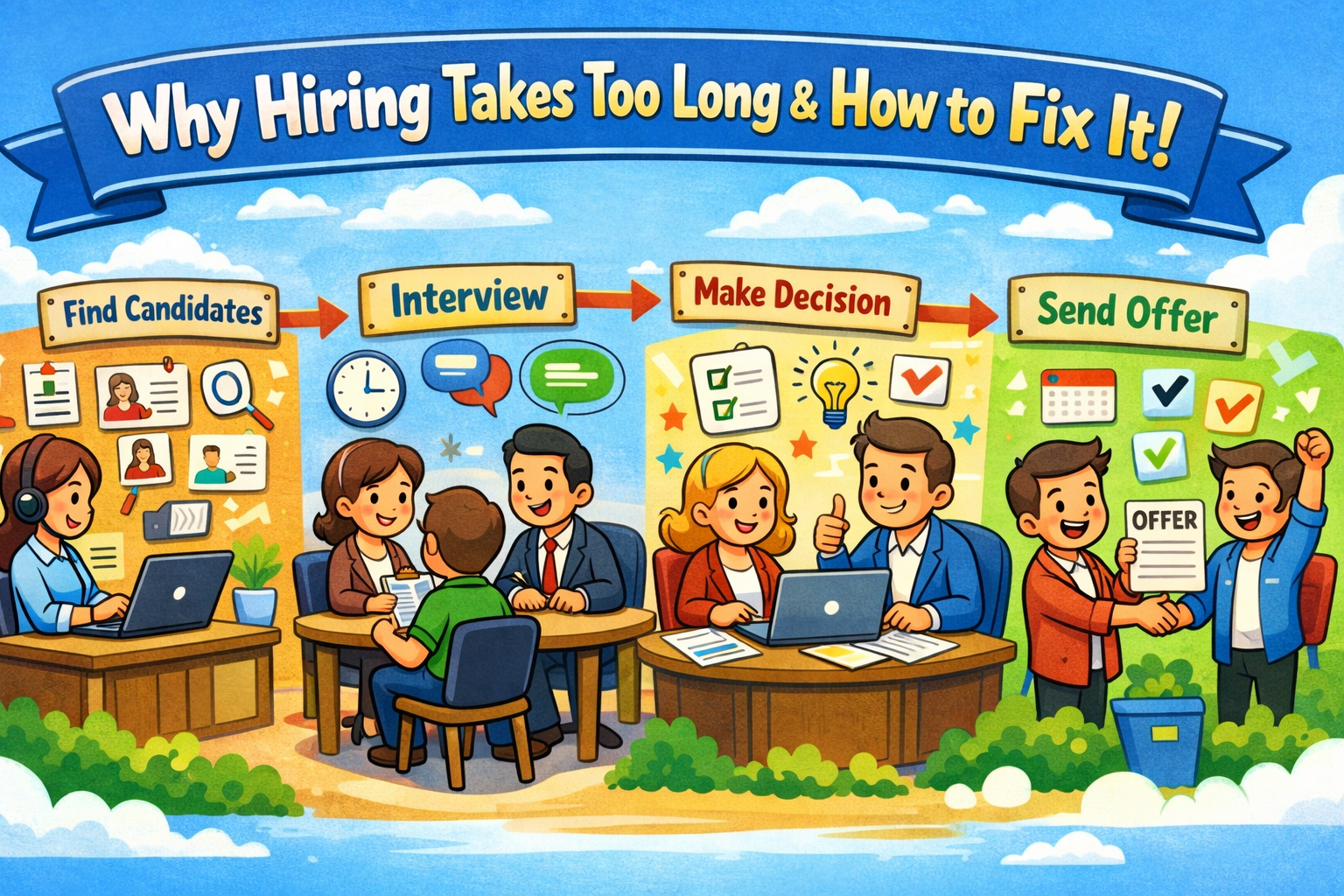
Hiring delays are one of the most common — and costly — problems companies face today. Outside of roles requiring security clearance, government approval, or intensive credentialing, there’s rarely a good reason for hiring to drag on for months.
In most cases, slow hiring isn’t about a lack of talent. It’s about unclear processes, delayed decisions, and internal misalignment.
The companies that consistently secure top talent understand one thing: speed comes from structure, not shortcuts.
What a Strong Hiring Process Should Feel Like
Effective hiring is straightforward and intentional. It doesn’t involve endless interviews or weeks of waiting for feedback.
At its core, a solid process includes:
- Recruiters delivering qualified, well-screened candidates
- Interviews happening quickly and close together
- Clear criteria for evaluation
- Fast internal alignment
- Decisive offers
When those elements are in place, hiring moves naturally — and candidates stay engaged.
A Realistic, Fast Hiring Timeline (Step by Step)
For most professional roles, an efficient hiring process can be completed in 10–14 business days.
Days 1–3: Talent Sourcing & Screening
- Recruiter identifies and screens qualified candidates
- Skills, experience, and compensation expectations confirmed
- Shortlist sent to hiring manager
Result: Only serious, relevant candidates move forward.
Days 4–6: First-Round Interviews
- Interviews scheduled within 24–48 hours
- Focus on core skills, role fit, and expectations
- Same-day or next-day feedback collected
Result: Clear direction on who advances.
Days 7–10: Final Interviews & Decision
- Second-round or panel interviews completed
- Decision-makers align quickly
- Top candidate identified
Result: No waiting to “see who else applies.”
Days 11–14: Offer & Close
- Compensation already approved
- Offer letter issued promptly
- Candidate questions addressed immediately
Result: Offer accepted before competitors step in.
What Happens When Hiring Takes Too Long
When timelines stretch unnecessarily, the impact is immediate:
- High-performing candidates accept faster offers elsewhere
- Existing teams absorb extra work and burn out
- Productivity drops and projects stall
- Revenue is delayed
- Hiring managers restart searches from scratch
Ironically, trying to be overly cautious often leads to worse outcomes, not better hires.
If qualified candidates are in your pipeline but nothing is moving forward, the issue usually isn’t talent — it’s the process.
Fast Hiring Doesn’t Mean Rushed Hiring
Speed is often misunderstood. The best hiring teams don’t skip steps — they remove friction.
High-performing organizations typically:
- Identify decision-makers upfront
- Block interview time in advance
- Use consistent evaluation criteria
- Share feedback within 24–48 hours
- Align on compensation before interviews begin
This clarity allows teams to act confidently instead of hesitating.
Hiring Timelines by Industry
Every industry has its own nuances, but none benefit from drawn-out decision-making.
Engineering & Technical Roles
Typical timeline: 2–4 weeks
- One focused technical screen
- One team interview
- Clear technical decision authority
Common slowdown: Too many interview rounds and last-minute stakeholders.
Manufacturing & Construction
Typical timeline: 1–3 weeks
- Early skills validation
- Rapid interview scheduling
- Fast reference and background checks
Common slowdown: Delayed approvals while production demands grow.
Skilled Trades (Electricians, Welders, Mechanics)
Typical timeline: 3–10 days
- Immediate recruiter screening
- Quick on-site or virtual interview
- Conditional offers pending compliance
Common slowdown: Competitors making faster offers.
Healthcare & Life Sciences
Typical timeline: 2–6 weeks (credentialing dependent)
- Start credentialing during interviews
- Consolidate interviews into one or two days
- Communicate timelines clearly
Common slowdown: Waiting to begin compliance steps until the final stage.
Decisiveness Is a Competitive Advantage
The fastest hiring organizations aren’t chaotic — they’re prepared.
They know:
- What success looks like in the role
- Who has the authority to decide
- How quickly they’re willing to act
When teams delay decisions “just to be sure,” they often lose the very candidates they want most.
Final Takeaway
Hiring shouldn’t take months.
When strong candidates are available and roles remain open, the solution isn’t searching harder — it’s tightening the process. Clear timelines, internal alignment, and decisive action make all the difference.
In today’s market, talent doesn’t wait.
FAQ
Is hiring too quickly risky?
Not when the process is structured. Clear criteria and fast feedback reduce risk.
How many interviews are ideal?
Two to three for most roles. Beyond that, candidate drop-off increases sharply.
What’s the most common cause of slow hiring?
Unclear ownership and delayed internal decision-making.