
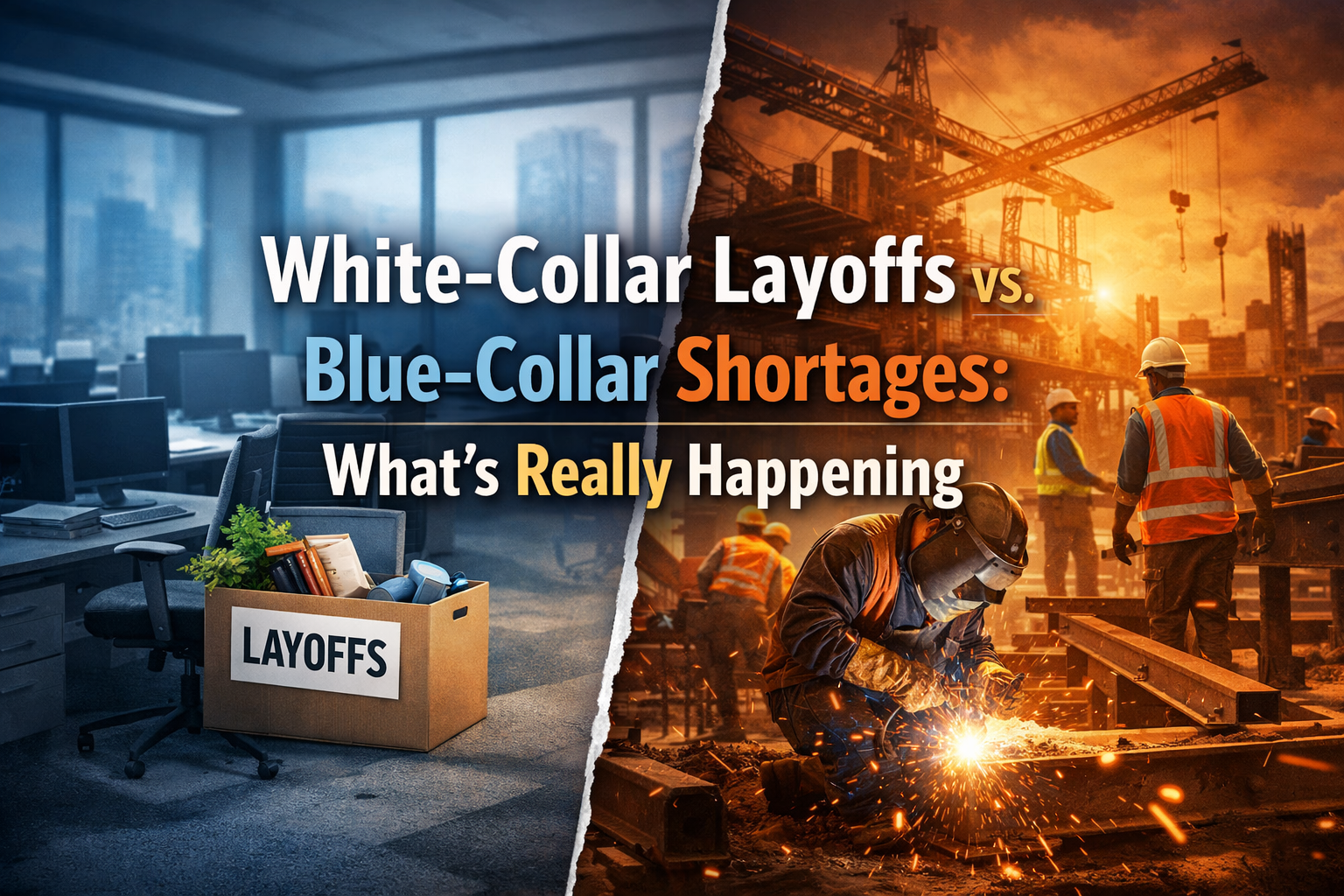
The U.S. labor market is sending mixed signals in 2025 and early 2026. On one hand, white-collar layoffs continue to dominate headlines across tech, finance, and professional services. On the other, employers in construction, manufacturing, and skilled trades report persistent blue-collar worker shortages that are slowing growth and pushing wages higher.
So what’s really happening?
This apparent contradiction isn’t a sign of economic confusion—it’s evidence of a structural shift in how work is valued, automated, and staffed. Understanding the difference matters for employers planning ahead and workers deciding where to invest their skills.
White-Collar Layoffs: Why Office Jobs Are Under Pressure
Layoffs Concentrated in Specific Sectors
Recent data from the U.S. Bureau of Labor Statistics (BLS) and major news outlets shows that layoffs remain elevated in:
Technology
Finance and banking
Professional and business services
While overall unemployment remains relatively low, job cuts are concentrated in high-salary, office-based roles, particularly those tied to corporate overhead rather than direct revenue.
According to BLS JOLTS data (December 2025 release), professional and business services continue to experience higher-than-average separations compared to pre-pandemic norms.
Source: U.S. Bureau of Labor Statistics, published January 2026
The Role of AI and Automation
One of the biggest drivers behind white-collar layoffs is artificial intelligence adoption. Companies are using AI tools to:
Automate routine reporting and analysis
Reduce administrative and support roles
Streamline marketing, HR, and customer operations
Major firms including Meta, Amazon, and large financial institutions have publicly stated that AI-driven efficiency is a core reason for leaner corporate teams.
Source: Wall Street Journal, October 2025
Hiring Freezes, Not Just Layoffs
Even when layoffs slow, many white-collar workers face hiring freezes and longer job searches, especially for mid-level generalist roles. This has led economists to describe the trend as a “white-collar recession” rather than a broad labor downturn.
Source: Financial Times, November 2025
Blue-Collar Shortages: Why Demand Remains Strong
Skilled Trades Are Hard to Replace
Unlike many office roles, blue-collar jobs often require:
On-site presence
Physical skill and certification
Hands-on problem solving
Trades such as electricians, plumbers, welders, HVAC technicians, and machinists are far more resistant to automation.
The National Association of Manufacturers reported that labor shortages remained one of the top constraints on production throughout 2025, with hundreds of thousands of skilled trade roles unfilled nationwide.
Source: National Association of Manufacturers, August 2025
Infrastructure and Industrial Growth
Blue-collar demand is being fueled by:
Infrastructure projects
Manufacturing reshoring
Data center and energy construction tied to AI growth
Construction employment tied to industrial and energy projects has grown steadily, with wages rising faster than inflation in many regions.
Source: Associated Press, September 2025
An Aging Workforce Problem
A major contributor to shortages is demographics. Many skilled trades workers are nearing retirement, while fewer young workers are entering vocational pathways.
Trade schools and apprenticeship programs are expanding, but the pipeline is not yet keeping pace with demand.
Source: U.S. Department of Labor, 2025 Workforce Report
Why Layoffs and Shortages Can Exist at the Same Time
This isn’t a contradiction—it’s a skills mismatch.
Key Forces Behind the Divide
Technology: Automates digital tasks faster than physical ones
Education trends: Decades of emphasis on four-year degrees reduced trade participation
Business strategy: Companies protect revenue-generating and essential roles while trimming overhead
In short, the labor market isn’t shrinking—it’s rebalancing.
What This Means for Workers and Employers
For White-Collar Professionals
Upskilling in AI, data, engineering, or leadership is increasingly critical
Generalist roles face the highest risk
Career pivots may take longer than in past cycles
For Blue-Collar Workers
Strong job security in many trades
Rising wages and signing incentives in high-demand regions
Certification and training unlock long-term stability
For Employers
Talent shortages in skilled trades may persist for years
Workforce planning must account for demographic realities
Investing in training and apprenticeships is becoming a competitive advantage
FAQ
Is the U.S. in a recession because of white-collar layoffs?
No. Layoffs are sector-specific and do not reflect a broad economic downturn.
Why are blue-collar jobs safer right now?
They require physical presence, certification, and experience that AI can’t easily replace.
Will white-collar jobs disappear entirely?
No—but routine roles are shrinking while specialized and leadership positions remain in demand.