
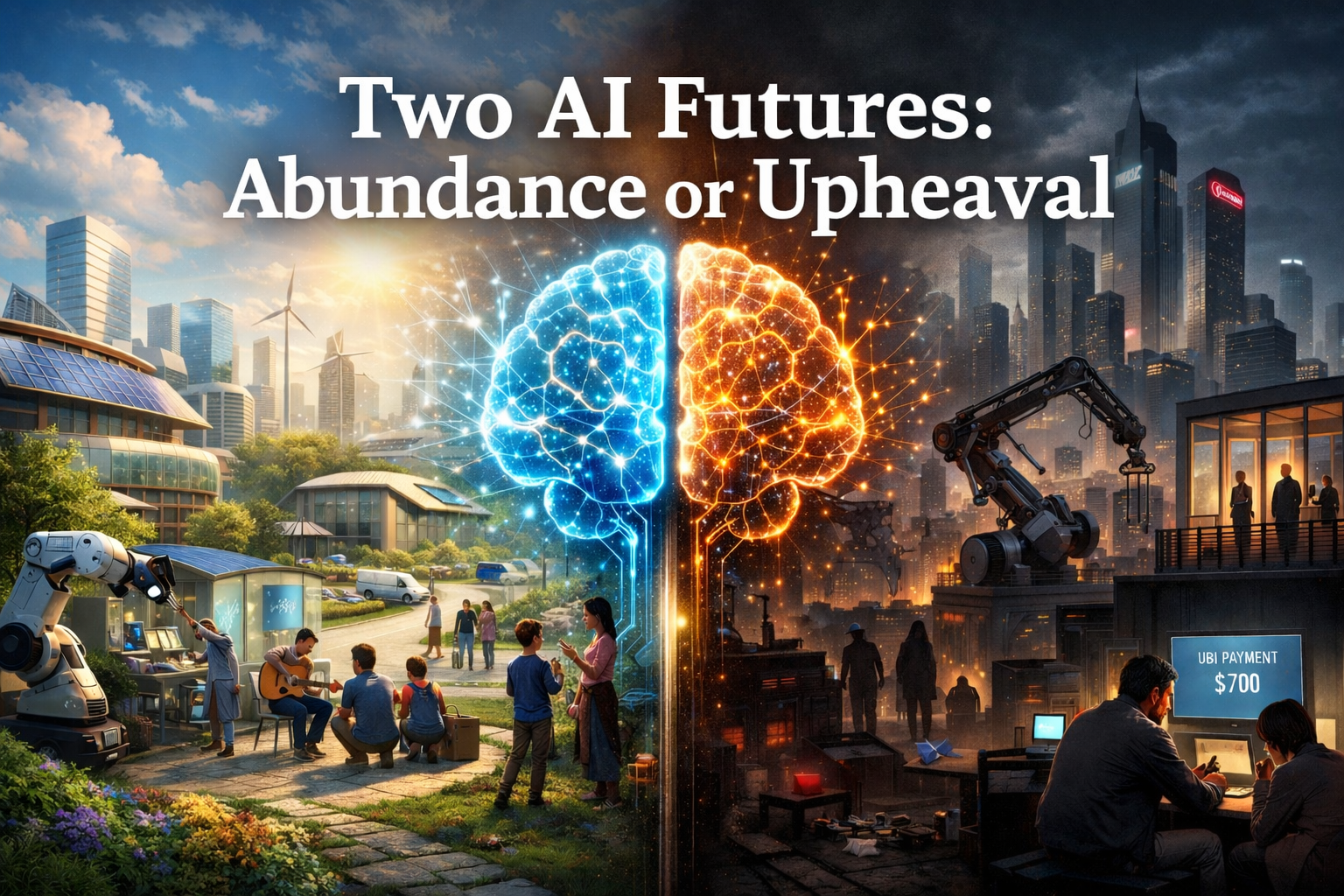
Artificial intelligence is advancing at a pace that is difficult to overstate. Systems that once assisted with simple automation now design products, write code, analyze legal arguments, diagnose illnesses, and manage supply chains. As AI approaches and surpasses human-level performance in more domains, society faces a pivotal question:
What happens to work?
There are two dramatically different futures that could unfold. One is a world of abundance where human labor is optional. The other is a destabilized economy marked by mass unemployment and subsistence-level universal basic income.
Let’s explore both.
Part I: The Best-Case Scenario — The Post-Work Civilization
1. The End of Scarcity
In the most optimistic vision, AI unlocks extraordinary productivity. Autonomous systems manage:
- Energy production (solar, fusion, advanced storage)
- Agriculture and food distribution
- Manufacturing through fully automated factories
- Healthcare diagnostics and robotic surgery
- Logistics, infrastructure, and construction
The marginal cost of producing goods collapses. When robots build robots, and AI designs better AI, production becomes exponential.
In this world, scarcity largely disappears.
Food is abundant. Housing is efficiently constructed. Energy is nearly free. Healthcare becomes predictive and preventive. Transportation is autonomous and low-cost.
When basic needs cost almost nothing to produce, money itself becomes less relevant.
2. Work Becomes Optional
In this future, people don’t work to survive. They work (if at all) for:
- Meaning
- Creativity
- Competition
- Personal growth
- Contribution to culture
AI handles the labor. Humans pursue art, science, philosophy, exploration, and relationships.
Some may choose to:
- Start passion projects
- Conduct research
- Mentor others
- Create music, literature, and immersive experiences
- Explore space or oceans
- Develop spiritual or philosophical communities
Economic survival is no longer tied to employment. Social systems distribute abundance automatically.
3. The Evolution of Identity
For thousands of years, identity has been tied to profession:
- “What do you do?”
- “What do you do for a living?”
In a post-work society, identity shifts from economic productivity to personal development.
Status might derive from:
- Intellectual achievement
- Creative output
- Athletic excellence
- Community leadership
- Scientific discovery
This is not laziness—it is liberation from compulsory labor.
4. Money Fades in Importance
If goods and services are abundant, and AI systems manage distribution efficiently, money becomes less central.
You don’t “earn” healthcare.
You don’t “earn” housing.
You don’t “earn” food.
They are guaranteed.
Markets may still exist for luxury, rarity, or prestige, but survival is detached from income.
This is the closest humanity has come to the ancient dream of a “Golden Age.”
5. Risks in the Best-Case Scenario
Even in utopia, challenges remain:
- Loss of purpose for those whose identity depended on work
- Psychological stagnation
- Overreliance on centralized AI systems
- Ethical control over superintelligence
Part II: The Worst-Case Scenario — Automation Shock and Controlled Subsistence
Now let’s examine the darker possibility.
1. Mass Displacement of Workers
In this scenario, AI replaces:
- Truck drivers
- Accountants
- Programmers
- Designers
- Customer service reps
- Paralegals
- Radiologists
- Engineers
- Analysts
- Even executives
Unlike previous technological revolutions, this one replaces cognitive labor, not just physical labor.
Entire industries shrink rapidly.
The speed of displacement outpaces retraining.
Millions—possibly billions—find their skills obsolete.
2. Concentration of Wealth
AI systems are owned by:
- Major corporations
- Governments
- Technology conglomerates
If ownership remains concentrated, productivity gains do not flow to the population.
Instead:
- Profits scale upward.
- Labor demand collapses.
- Wage bargaining power disappears.
A small class controls infrastructure, data, and AI systems.
The majority depend on them.
3. Universal Basic Income — But Minimal
To prevent unrest, governments implement Universal Basic Income (UBI).
But it is not abundance.
It is subsistence.
Just enough for:
- Small living quarters
- Basic food
- Limited healthcare
- Minimal discretionary spending
Citizens receive income not as empowerment—but as stabilization.
Work becomes scarce. Competition for remaining human roles intensifies.
High-skill elites thrive.
The majority survive.
4. Loss of Upward Mobility
Historically, work has been a ladder:
- Start entry-level
- Build skills
- Accumulate savings
- Invest
- Grow
In this scenario, that ladder disappears.
If AI performs better and cheaper in most fields, human labor becomes economically inferior.
Entrepreneurship becomes harder when AI can replicate ideas instantly.
Innovation is centralized.
Upward mobility declines.
5. Psychological and Social Consequences
Work is not just income—it is:
- Structure
- Community
- Purpose
- Status
- Dignity
Mass unemployment can lead to:
- Increased depression
- Substance abuse
- Social fragmentation
- Political instability
- Radical movements
When large populations feel economically irrelevant, history shows unrest follows.
6. A Two-Tier Civilization
The worst-case world may split into:
Tier 1:
AI owners, system designers, capital controllers.
Tier 2:
The permanently displaced population on UBI.
Social stratification hardens.
Meritocracy weakens.
Resentment grows.
The Fork in the Road
Both scenarios are technologically plausible.
The difference lies not in AI capability—but in:
- Ownership structures
- Governance models
- Distribution mechanisms
- Cultural adaptation
- Ethical leadership
AI will almost certainly make society more productive.
The question is: Who benefits?
If abundance is broadly shared, humanity enters a golden era.
If productivity is captured by a small elite while labor collapses, instability follows.
Final Thoughts
AI does not determine destiny on its own.
Technology amplifies incentives and systems already in place.
The future will be shaped less by algorithms—and more by decisions about power, ownership, and values.
We are not just building intelligent machines.
We are building the economic architecture of the next civilization.
Which version we get depends on what we choose to build around it.