
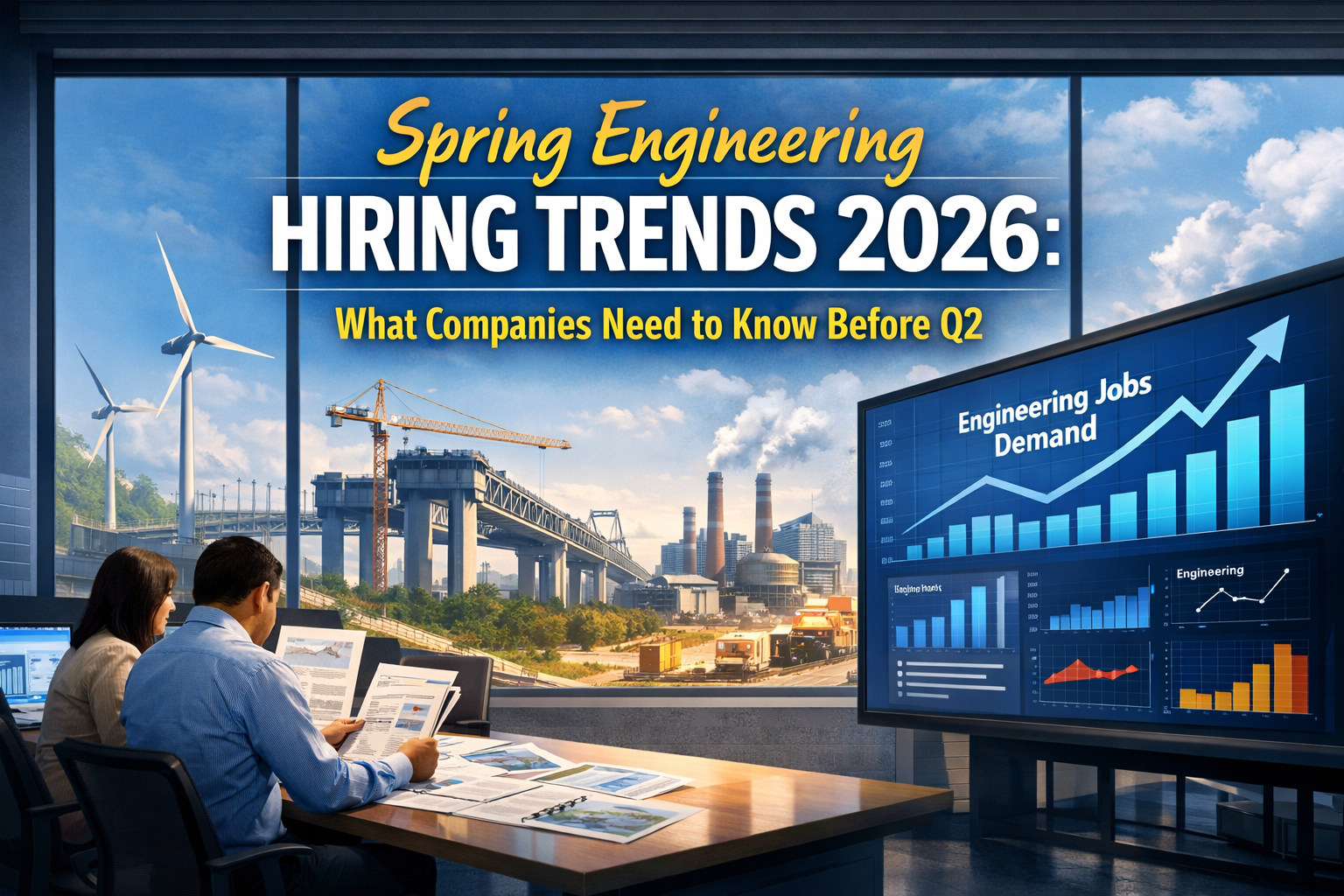
Every year, spring marks a turning point in the engineering hiring cycle. Budgets reset, new projects begin, and companies race to secure top technical talent before the mid-year rush. In 2026, that urgency is even greater as infrastructure expansion, energy transition projects, and advanced manufacturing initiatives increase demand for engineers across multiple sectors.
For engineering firms and hiring managers, the weeks leading into Q2 represent a strategic opportunity. Organizations that move quickly can secure high-performing candidates, while slower hiring teams risk losing talent to competitors.
Here’s what engineering companies need to know about spring hiring trends in 2026—and how to stay ahead of the competition.
Engineering Talent Demand Is Surging Across Key Industries
Several sectors are driving hiring growth this spring, particularly those connected to infrastructure modernization and energy investment.
Major federal investments continue to fuel engineering demand nationwide. The Infrastructure Investment and Jobs Act is funding transportation upgrades, water systems, broadband expansion, and grid modernization projects across the country.
This surge in infrastructure development is creating significant demand for engineering professionals involved in design, construction, and project management.
Roles seeing the biggest hiring surge
Civil Engineers
Transportation Engineers
Structural Engineers
Electrical & Power Engineers
Mechanical Engineers
Environmental Engineers
Project Managers and Construction Managers
Engineering firms supporting infrastructure, utilities, renewable energy, and manufacturing are seeing the fastest hiring increases.
Hiring Cycles Are Starting Earlier Than Previous Years
One of the biggest hiring shifts in recent years is how early companies start recruiting.
Historically, many engineering firms waited until late spring or early summer to scale hiring. However, in today’s competitive labor market, organizations are accelerating hiring timelines to secure talent before competitors.
Many firms now begin active recruitment in late Q1, aiming to finalize hires before project launches in Q2 and Q3.
Why earlier hiring matters
Engineering candidates—especially those with specialized experience—often receive multiple offers quickly. Companies that delay hiring risk losing qualified candidates during lengthy interview processes.
Successful firms are responding by:
Streamlining interview steps
Pre-planning hiring budgets
Partnering with specialized recruiters
Building talent pipelines months in advance
Experienced Engineers Remain the Most Competitive Segment
While entry-level engineering roles remain available, the most competitive segment of the job market continues to be mid-level and senior engineers with 5–15 years of experience.
These professionals bring the practical project knowledge companies need immediately—something especially valuable for firms with tight project schedules.
Many large infrastructure and energy projects are already facing engineering workforce shortages, particularly in specialized design and project management roles. Companies are increasingly competing for professionals with experience in:
Transportation infrastructure
Renewable energy projects
Industrial and manufacturing facilities
Water and wastewater systems
Compensation and Benefits Are Becoming Major Hiring Differentiators
Salary remains important, but in 2026 flexibility and career growth opportunities are playing an increasing role in hiring success.
Engineering candidates are prioritizing:
Hybrid or flexible work schedules
Strong project portfolios
Leadership development opportunities
Long-term career growth
Companies that communicate clear advancement pathways and project impact often outperform competitors offering slightly higher salaries.
Why Engineering Recruiting Partners Are Becoming Essential
Many engineering firms are turning to specialized recruiting partners to accelerate hiring.
Recruiting firms focused on engineering and technical roles provide:
Pre-screened candidate pipelines
Industry-specific talent networks
Faster hiring timelines
Reduced internal recruiting workload
For firms with large project pipelines heading into Q2, this can mean the difference between staffing projects on time—or facing costly delays.
Key Takeaways for Engineering Hiring Managers
Spring 2026 presents both opportunity and urgency for engineering firms.
Key insights:
Engineering hiring demand is rising across infrastructure, energy, and manufacturing sectors
Many companies are starting hiring earlier than previous years
Mid-level engineers remain the most competitive talent pool
Compensation alone isn’t enough—career growth and flexibility matter
Specialized recruiting partners can accelerate hiring success
Organizations that move quickly and strategically this spring will be best positioned to secure the engineering talent needed for the rest of the year.
FAQ
Why is spring a peak hiring season for engineering?
Spring aligns with new project launches, fresh budgets, and increased infrastructure spending, making it a prime hiring period for engineering firms.
Which engineering roles are most in demand in 2026?
Civil engineers, electrical engineers, structural engineers, environmental engineers, and engineering project managers are among the most sought-after roles.
Why are experienced engineers harder to hire?
Mid-career engineers bring project experience and leadership capabilities that are difficult to replace, making them highly competitive in the job market.
How can engineering companies hire faster?
Streamlining interview processes, planning hiring budgets early, and partnering with specialized recruiters can significantly reduce time-to-hire.
Sources
U.S. Bureau of Labor Statistics. Architecture and Engineering Occupations Outlook. Updated 2024.
https://www.bls.gov/ooh/architecture-and-engineering/home.htm
Reuters. Infrastructure spending and project pipeline expansion following U.S. infrastructure law. Published July 18, 2024.
https://www.reuters.com
Engineering News-Record (ENR). Construction Workforce and Engineering Talent Shortage Reports. Published March 2025.
https://www.enr.com