
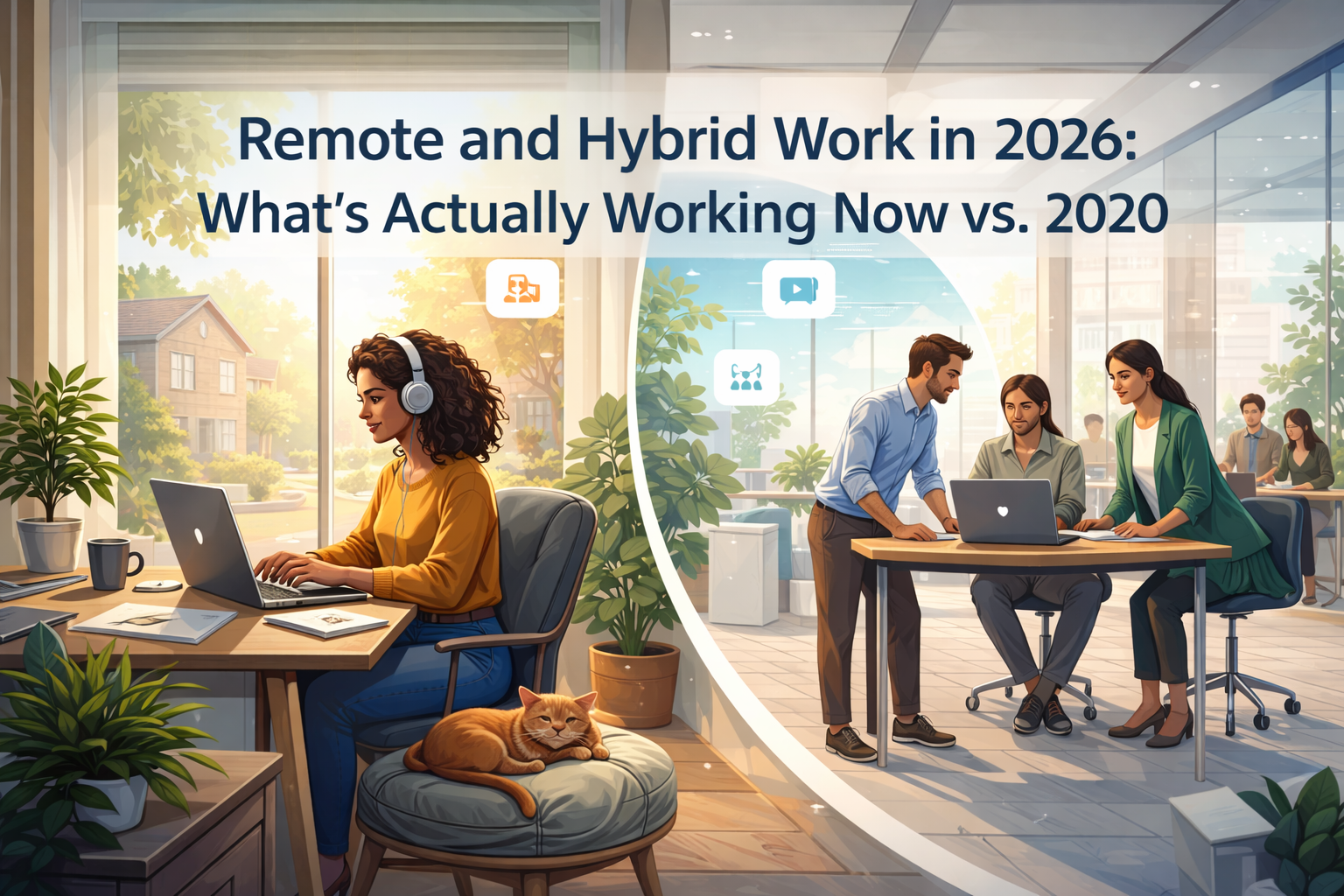
Remote work didn’t just survive the pandemic era — it transformed. What began in 2020 as a rushed, emergency response has matured into a more intentional, structured, and performance-focused way of working in 2026. The conversation today is no longer about whether remote work works, but how it works best.
For employers and employees alike, understanding what changed — and why — is critical. The strategies that kept companies afloat in 2020 are not the same ones driving productivity, retention, and growth today.
How Remote Work Functioned in 2020
In 2020, remote work was born out of necessity, not strategy. Companies were forced to shift entire workforces online almost overnight, often without the infrastructure, policies, or management training to support such a move long term.
Flexibility was the defining feature of this period. Employees worked from spare bedrooms, kitchen tables, or wherever they could find space. Work hours blurred, schedules became fluid, and productivity was often measured simply by availability rather than outcomes.
At first, this model worked surprisingly well. Commutes disappeared, morale initially improved, and businesses discovered they could operate without physical offices. Video conferencing platforms and collaboration tools became lifelines, enabling teams to stay connected during an unprecedented disruption.
However, as months passed, cracks began to emerge. Burnout increased as employees struggled to disconnect. Meetings multiplied, replacing casual office conversations with endless video calls. New hires found it difficult to integrate into company culture, and managers lacked clear ways to evaluate performance beyond “who was online.”
The Shift to Intentional Hybrid Work
By 2026, most organizations have accepted a key reality: full-time remote work isn’t ideal for every role, team, or company. As a result, hybrid work has become the dominant model, blending flexibility with structure.
Rather than leaving schedules open-ended, successful companies now define when and why employees come into the office. Office days are typically reserved for collaboration, brainstorming, training, and relationship-building, while remote days are designed for focused, individual work.
This intentional approach has helped eliminate one of the biggest flaws of early remote work — randomness. Employees know what’s expected of them, and teams align their schedules around shared goals instead of personal convenience.
Productivity Has Become Results-Driven
One of the most important changes since 2020 is how productivity is measured. During the early days of remote work, many managers relied on visibility — who responded fastest, who stayed online longest, who attended every meeting.
Today, that mindset has largely disappeared.
High-performing organizations now prioritize outcomes over activity. Employees are evaluated based on the quality of their work, the completion of projects, and their contribution to team and business goals. This shift has reduced micromanagement while increasing accountability.
For employees, this means greater autonomy — but also greater responsibility. Flexibility is still there, but it’s earned through trust and consistent results.
Meetings Are Fewer, Shorter, and More Purposeful
Another major difference between 2020 and now is how teams communicate. During the pandemic, meetings became a default solution for nearly everything, leading to widespread fatigue and inefficiency.
In contrast, today’s remote and hybrid teams rely heavily on asynchronous communication. Updates are shared through project management platforms, recorded videos, or written documentation, allowing employees to engage on their own schedules.
When meetings do happen, they tend to be shorter, more focused, and clearly defined. The goal is no longer to replicate office life online, but to collaborate efficiently without disrupting deep work.
The Office Has a New Role
Perhaps the most visible shift since 2020 is the evolving purpose of the office itself. Offices are no longer places employees go simply to prove they’re working.
Instead, they function as hubs for collaboration, mentorship, and company culture. Many organizations have downsized their real estate footprint while redesigning remaining spaces to support teamwork rather than individual desk work.
This reimagined office experience has helped companies preserve culture while avoiding the rigid expectations of pre-pandemic work life.
What Employers Have Learned Since 2020
Organizations that thrive in 2026 tend to share several traits. They set clear expectations around hybrid schedules, invest in leadership training, and communicate transparently with employees about why decisions are made.
Rather than treating flexibility as a perk, they treat it as a business strategy — one that supports retention, engagement, and long-term performance.
Companies that attempt to revert fully to pre-2020 norms without justification often face higher turnover, especially among experienced and in-demand professionals.
What Employees Need to Succeed Today
For workers, the modern remote and hybrid landscape rewards intentional behavior. Success now depends less on being visible and more on being reliable.
Employees who communicate proactively, manage their time effectively, and use in-office days strategically tend to perform better and advance faster. Relationship-building still matters — but it’s more deliberate than before.
Flexibility remains one of the most valued aspects of modern work, but it’s paired with higher expectations for ownership and results.
Remote Work Didn’t Fail — It Matured
Remote work in 2020 proved that flexibility was possible. Remote and hybrid work in 2026 prove that flexibility must be structured to be sustainable.
Hybrid models, outcome-based performance, fewer meetings, and intentional office use are defining the current era of work. The future isn’t remote or in-office — it’s purpose-driven, adaptable, and results-focused.
Frequently Asked Questions: Remote and Hybrid Work Today
Is remote work still popular in 2026?
Yes, remote work remains popular, but it looks different than it did in 2020. While fully remote roles still exist—especially in tech, digital services, and knowledge-based industries—many companies have shifted toward hybrid models. Employees continue to value flexibility, but employers are now balancing that preference with collaboration, culture, and performance needs. As a result, remote work is no longer a blanket policy but a role-specific strategy.
Why did many companies move away from fully remote setups?
Many organizations found that fully remote work, while effective in the short term, created long-term challenges. These included weaker team cohesion, difficulty onboarding new employees, and fewer opportunities for mentorship and innovation. Hybrid models emerged as a compromise, allowing companies to preserve flexibility while reintroducing face-to-face collaboration where it adds the most value.
Are employees more productive now than in 2020?
In many cases, yes—but for different reasons. Productivity gains today are less about working longer hours and more about working smarter. Companies now rely on clearer goals, better digital tools, and outcome-based performance metrics. This shift has helped reduce burnout while improving focus and efficiency, especially for employees who benefit from a mix of remote and in-office work.
Do employees still prefer flexible work arrangements?
Flexibility remains one of the top priorities for workers across industries. Surveys consistently show that employees are more likely to stay with companies that offer remote or hybrid options. However, preferences have evolved. Many workers now favor predictable hybrid schedules over fully remote arrangements, as these provide both autonomy and regular in-person interaction.
What role does the office play in hybrid work models?
The office has become a destination rather than a requirement. Instead of serving as a place for individual tasks, offices are now designed for collaboration, training, team meetings, and culture-building. Employees are encouraged to use in-office days intentionally, focusing on activities that are harder to replicate remotely.
How has management changed in remote and hybrid environments?
Managing remote and hybrid teams requires a different skill set than traditional office management. Leaders are now expected to focus on communication, trust, and clarity rather than supervision. Successful managers set clear expectations, provide regular feedback, and evaluate employees based on results instead of visibility or hours logged.
Is remote work harder for new hires?
Remote and hybrid work can be more challenging for new employees, particularly when onboarding is not well structured. Many companies have addressed this by increasing in-office time for new hires, assigning mentors, and improving documentation and training resources. When done well, onboarding in a hybrid environment can be just as effective as traditional in-office onboarding.
Will companies ever return to fully in-office work?
While some organizations have mandated full returns to the office, most are finding that rigid policies can negatively impact retention and morale. The broader trend suggests that fully in-office work will remain limited to roles that truly require physical presence. For many businesses, hybrid work has become a permanent part of their operating model.