
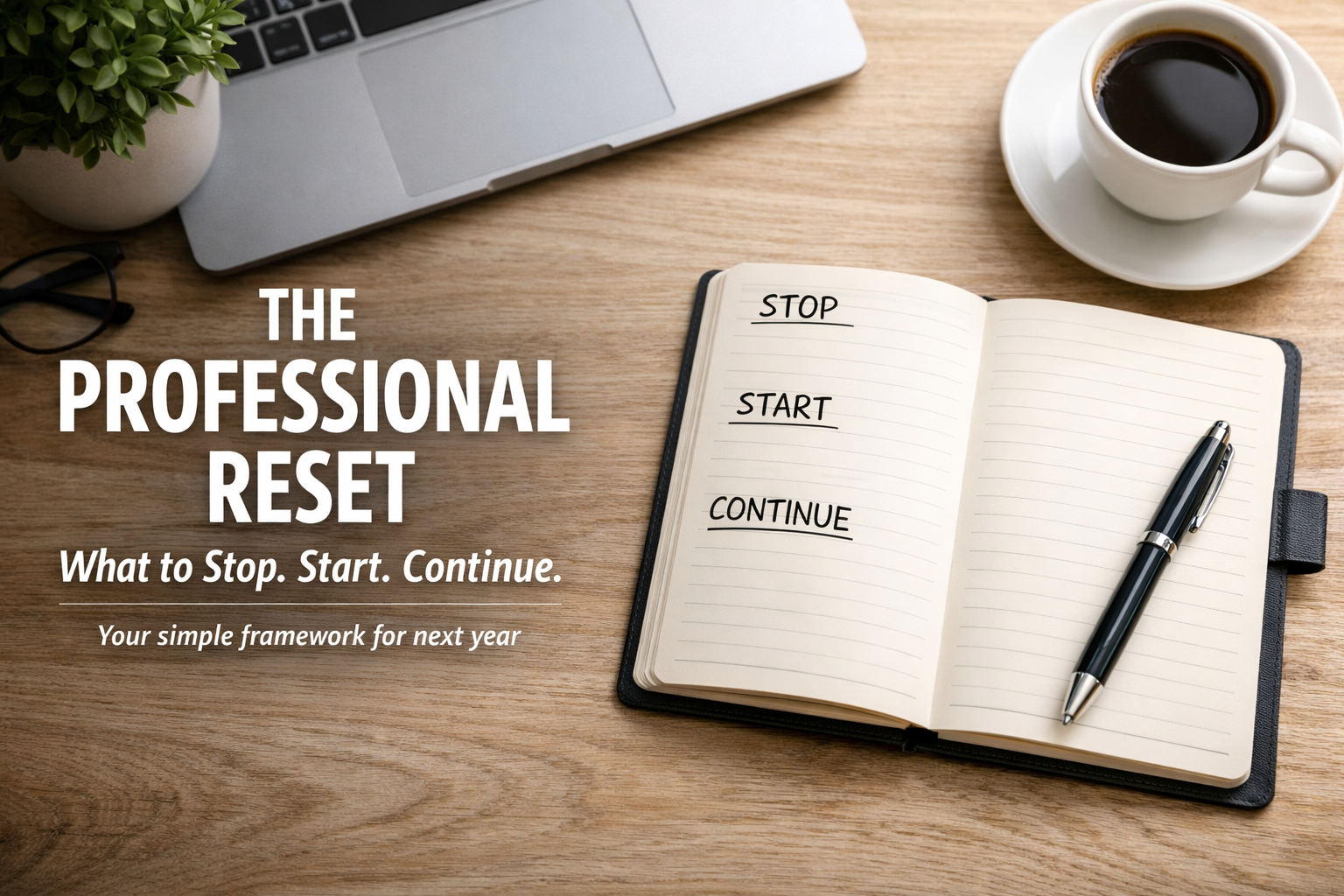
As a new year approaches, many professionals feel an unspoken urgency to reinvent themselves. New goals, new tools, new habits — all stacked on top of an already full workload. But real career progress rarely comes from doing more. It comes from doing less of what doesn’t matter and more of what compounds over time.
A professional reset is not about radical change. It’s about refinement. By stepping back and intentionally reviewing what to stop, start, and continue, you create space for clearer thinking, stronger performance, and more sustainable growth.
STOP: Habits That Quietly Limit Your Career Growth
Some behaviors don’t fail loudly. Instead, they quietly cap your potential while appearing responsible or productive on the surface.
Stop Doing Work That No One Truly Values
Many professionals stay stuck because they’re excellent at work that doesn’t move the needle. These tasks are often inherited, habitual, or accepted out of politeness rather than necessity. Over time, they fill your schedule without strengthening your position.
High-impact professionals regularly question whether their effort aligns with outcomes. They don’t just ask “Can I do this?” — they ask “Should this be done at all?”
Reflection prompt:
Which tasks consume time but rarely show up in outcomes, recognition, or results?
Stop Confusing Activity With Achievement
Constant motion can feel like progress, but activity without direction leads to stagnation. Endless meetings, rapid email responses, and packed calendars often reward visibility over value.
True impact usually requires stillness — time to think, plan, and execute deeply. Without it, even the hardest-working professionals risk becoming reactive instead of strategic.
Reflection prompt:
Where am I staying busy to avoid making harder, more important decisions?
Stop Waiting for Perfect Timing
Many careers stall not because of lack of talent, but because of hesitation. Waiting for permission, perfect clarity, or absolute confidence delays growth far longer than mistakes ever would.
Momentum favors those who act thoughtfully but early. Progress rarely requires certainty — only commitment.
Reflection prompt:
What opportunity am I postponing because it feels uncomfortable rather than impossible?
START: Strategic Behaviors That Create Forward Momentum
Growth isn’t about dramatic shifts. It’s about consistently making choices that align effort with impact.
Start Designing Your Weeks Intentionally
Without planning, urgency dictates your time. With planning, priorities do. Defining a small number of outcomes each week forces clarity and protects attention from constant interruption.
Intentional weeks don’t eliminate chaos — they help you navigate it with purpose.
Reflection prompt:
If only three things moved forward this week, what should they be?
Start Treating Your Work Like Evidence
Careers are built on proof, not potential. Documenting achievements, metrics, and feedback transforms vague effort into tangible value.
This habit doesn’t just help during reviews or job changes — it strengthens self-awareness and confidence in daily work.
Reflection prompt:
How am I capturing the results of my work, not just the effort behind it?
Start Communicating Before Misalignment Happens
Silence often creates more problems than difficult conversations. When expectations, goals, or priorities aren’t discussed early, frustration fills the gap.
Regular, low-stakes conversations prevent high-stakes misunderstandings later. Clarity is a professional advantage.
Reflection prompt:
What conversation would reduce uncertainty if I had it now instead of later?
CONTINUE: Practices That Already Support Long-Term Success
Progress doesn’t require abandoning what works. Some habits deserve protection, not replacement.
Continue Being Someone Others Can Rely On
Trust compounds faster than almost any skill. Showing up consistently, meeting deadlines, and communicating clearly builds a reputation that opens doors quietly but reliably.
In uncertain environments, dependable professionals stand out.
Reflection prompt:
What behaviors make people confident in working with me again?
Continue Investing in Transferable Skills
Trends shift quickly, but core skills endure. Communication, judgment, adaptability, and problem-solving increase in value as roles evolve.
Protecting time to strengthen these skills ensures relevance regardless of industry changes.
Reflection prompt:
Which skills make me valuable in more than one role or environment?
Continue Protecting Your Capacity to Perform
Burnout isn’t a badge of honor — it’s a warning sign. Sustaining performance requires boundaries, recovery, and rest, even when ambition runs high.
Long-term success belongs to those who manage energy as carefully as effort.
Reflection prompt:
What habits help me perform well without sacrificing my health or clarity?
A professional reset isn’t about becoming someone else. It’s about removing friction, sharpening focus, and doubling down on what actually works.
When you stop what drains you, start what strengthens you, and continue what sustains you, progress becomes inevitable — not exhausting.
Q&A: The Professional Reset
Q: What exactly is a “professional reset”?
A professional reset is a deliberate pause to evaluate how you’re working — not just what you’re working on. Instead of chasing new goals automatically, it helps you remove unhelpful habits, adopt more effective behaviors, and reinforce what’s already working. The goal isn’t reinvention, but alignment.
Q: When is the best time to do a professional reset?
While year-end is a natural moment for reflection, a reset can happen anytime you feel misaligned, overwhelmed, or stuck. Many professionals find the most value during transitions — a new role, a stalled promotion, burnout, or after completing a major project.
Q: How is this different from setting New Year’s resolutions?
Resolutions often focus on adding more: more goals, more habits, more effort. A professional reset emphasizes subtraction and focus. By stopping low-value behaviors first, you create space for progress that feels intentional rather than exhausting.
Q: How long should a professional reset take?
The reflection itself doesn’t need to be long. Even 30–60 minutes can be enough to identify key stop, start, and continue actions. The real value comes from revisiting those decisions regularly and adjusting as circumstances change.
Q: What if I’m not sure what to stop or start?
Uncertainty is a signal, not a failure. Look at what consistently drains energy, creates frustration, or produces little visible impact — those are often “stop” candidates. For “start” actions, focus on behaviors that improve clarity, communication, or outcomes rather than adding new responsibilities.
Q: Can this framework work at any career stage?
Yes. Early-career professionals use it to build strong habits and direction. Mid-career professionals use it to regain focus and momentum. Senior leaders use it to protect time, sharpen priorities, and model intentional work for their teams.
Q: How often should I revisit my professional reset?
At minimum, once or twice a year. Many professionals revisit it quarterly to stay aligned as roles and priorities shift. The framework is most powerful when treated as a living check-in rather than a one-time exercise.
Q: What’s the biggest mistake people make during a reset?
Trying to change too much at once. The most effective resets focus on a small number of high-leverage changes. One thing stopped, one thing started, and one thing continued can be enough to create noticeable progress.