
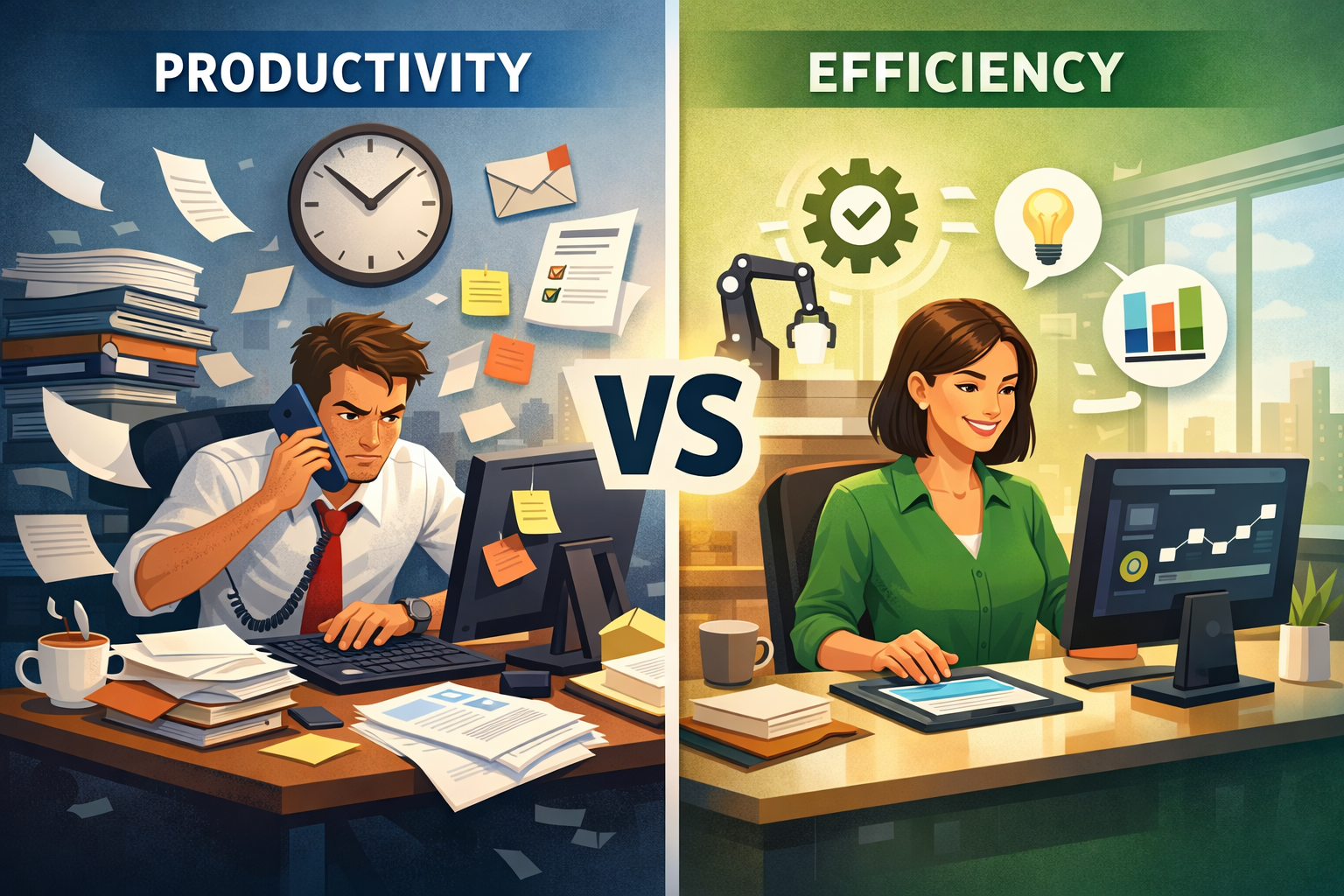
In business conversations, performance reviews, and even everyday workplace meetings, two words come up again and again: productivity and efficiency. They’re often treated as interchangeable, but in reality, they measure very different things. Understanding the difference between productivity vs. efficiency is critical for organizations that want to grow sustainably rather than burn out their people and resources.
In a world shaped by remote work, automation, and tighter budgets, knowing when to focus on productivity and when to prioritize efficiency can determine whether a company thrives or struggles. Let’s break down what these terms really mean—and why the distinction matters more than ever.
What Is Productivity?
Productivity refers to the amount of output produced within a specific period of time. It answers a simple but powerful question: How much work got done?
Productivity is often measured using straightforward metrics such as:
Tasks completed per day
Units produced per hour
Sales closed per month
The appeal of productivity is its clarity. Numbers are easy to track, report, and compare. When productivity increases, it often feels like progress—more work is being completed, and goals appear closer.
However, productivity alone doesn’t reveal how that output was achieved or what it cost in terms of time, energy, or resources.
The Hidden Risk of Productivity-Only Thinking
Focusing solely on productivity can create unintended consequences. Employees may rush through tasks, take shortcuts, or work longer hours just to hit targets. Over time, this approach often leads to fatigue, declining quality, and higher turnover.
In other words, high productivity can look impressive on paper while masking deeper inefficiencies beneath the surface.
What Is Efficiency?
Efficiency measures how effectively resources are used to produce results. It looks beyond output and focuses on the process behind the work.
Efficiency answers a different question: How well was the work done?
Resources can include:
Time
Money
Energy
Tools and technology
Human effort
An efficient process minimizes waste and maximizes value. The goal isn’t to do more work—it’s to do the right work with fewer unnecessary steps.
Why Efficiency Often Drives Long-Term Success
Efficient systems are designed to reduce friction. When processes are clear and well-structured, employees spend less time correcting mistakes, repeating tasks, or searching for information. This not only saves money but also improves morale and consistency.
Efficiency is especially important in knowledge-based industries, where quality, accuracy, and speed all matter at the same time.
Why the Difference Matters in the Modern Workplace
Understanding the difference between productivity and efficiency allows leaders to make better decisions at every level of an organization.
1. Better Performance Without Burnout
Efficient workflows help employees achieve strong results without working excessive hours. Instead of pushing people harder, organizations can improve systems and tools.
2. Higher Quality Results
Efficiency emphasizes consistency and accuracy. This reduces errors, rework, and customer complaints—issues that productivity metrics alone may overlook.
3. Smarter Use of Technology
Automation, AI tools, and digital platforms are most effective when used to improve efficiency, not just speed. Technology should eliminate unnecessary steps, not simply accelerate inefficient ones.
Real-World Example: Business Operations
Consider a customer support team. A productivity-focused approach might measure how many tickets agents close per day. An efficiency-focused approach looks at:
First-contact resolution rates
Average handling time
Customer satisfaction scores
A team that closes fewer tickets but resolves issues correctly the first time is often more efficient—and ultimately more valuable to the business.
How Productivity and Efficiency Work Together
The most successful organizations don’t choose productivity or efficiency. They understand that efficiency creates the foundation for sustainable productivity.
When processes are streamlined and resources are used wisely:
Employees work faster without rushing
Output increases naturally
Quality improves alongside quantity
Efficiency fuels productivity, while productivity validates efficient systems.
How to Improve Both Productivity and Efficiency
Organizations looking to improve performance should focus on both metrics simultaneously.
Effective strategies include:
Mapping and simplifying workflows
Eliminating redundant approvals and meetings
Investing in training and better tools
Measuring outcomes instead of hours worked
Encouraging focused, uninterrupted work
Small improvements in efficiency often lead to significant gains in productivity over time.
FAQ: Productivity vs. Efficiency
Is productivity the same as efficiency?
No. Productivity focuses on output, while efficiency focuses on how that output is achieved.
Can efficiency reduce costs?
Yes. Efficient processes minimize wasted time, effort, and resources.
Which matters more for long-term success?
Efficiency often has a greater long-term impact, as it supports sustainable productivity and employee well-being.
How can individuals improve efficiency at work?
By prioritizing tasks, reducing distractions, and using tools that automate repetitive work.