
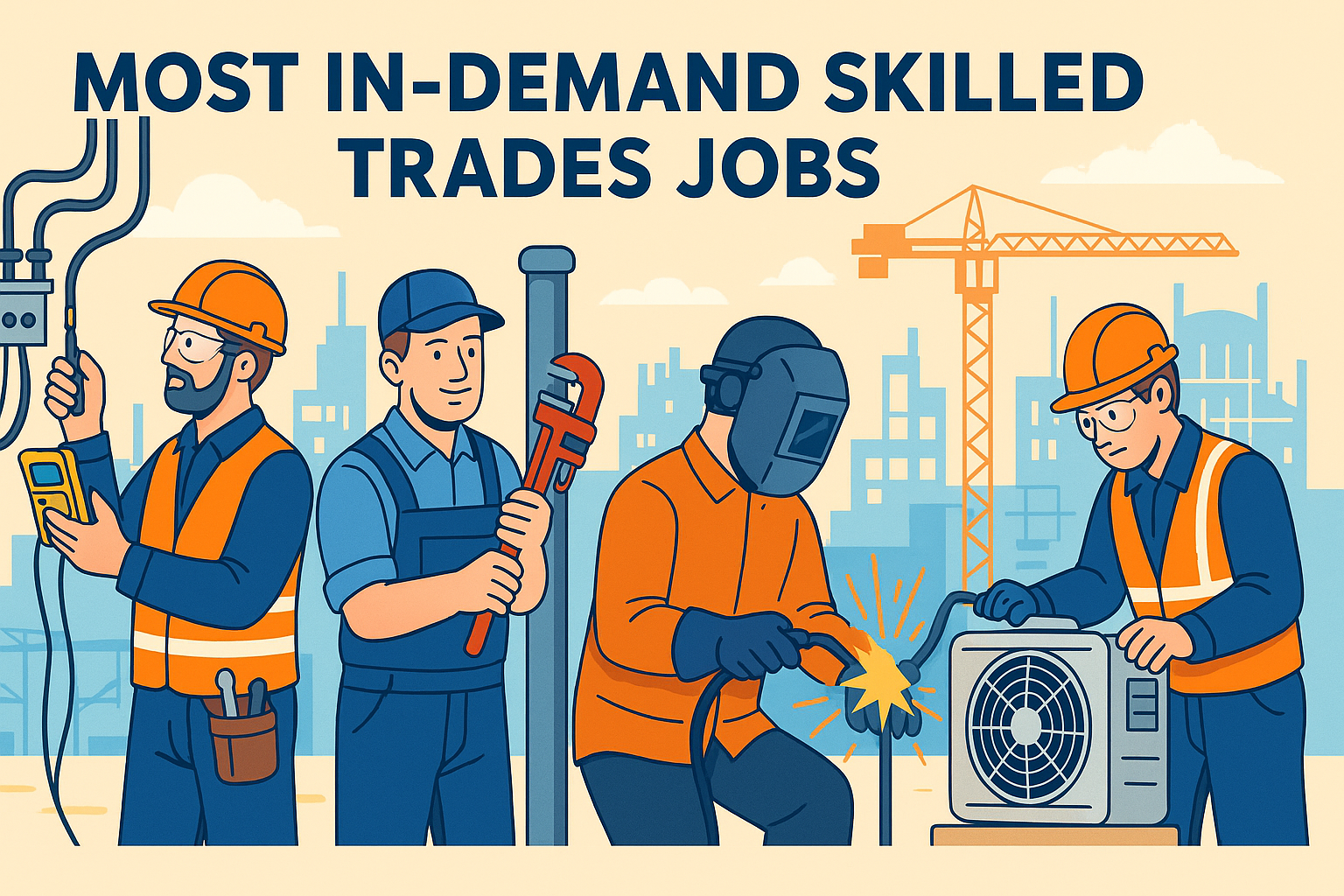
Skilled trades are experiencing historic demand across the U.S. in 2025. From electricians and plumbers to HVAC technicians and millwrights, employers are struggling to fill roles as retirements accelerate, infrastructure spending rises, and fewer young workers enter the trades. For job seekers, this creates exceptional opportunities for long-term stability, competitive wages, and career growth without the burden of student debt.
Why Skilled Trades Are More Critical Than Ever
The current labor market has revealed a growing imbalance: while demand for construction, maintenance, and industrial work continues to rise, the supply of trained tradespeople is shrinking. Many skilled workers hired during the construction booms of the 1980s and 1990s are now retiring, taking decades of hands-on experience with them.
At the same time, the U.S. is investing heavily in infrastructure upgrades, housing development, manufacturing reshoring, and clean energy projects. None of these initiatives can move forward without electricians, plumbers, welders, HVAC technicians, and industrial mechanics. As a result, skilled trades are no longer viewed as “backup careers” — they are becoming some of the most reliable and respected professions in today’s economy.
Electricians: Powering Growth Across Every Industry
Electricians continue to rank among the most in-demand skilled trades year after year. Their work touches nearly every sector, from residential housing and commercial buildings to factories, data centers, and renewable energy installations.
What’s driving demand is not just new construction, but modernization. Older buildings require electrical upgrades to meet safety codes, while newer facilities rely on advanced systems for automation, energy efficiency, and smart technology. Electricians trained in solar installations, EV charging infrastructure, and industrial controls are especially sought after.
In many regions, experienced electricians are receiving multiple job offers, signing bonuses, and premium hourly rates — a clear sign of how competitive the market has become.
Plumbers: Essential, Recession-Resistant Careers
Plumbing remains one of the most recession-proof skilled trades. Regardless of economic conditions, plumbing systems must be installed, maintained, and repaired. Aging municipal infrastructure has further increased demand, as older pipes, water lines, and sewer systems require replacement.
Beyond residential work, plumbers and pipefitters play a vital role in commercial construction, manufacturing plants, healthcare facilities, and large-scale industrial projects. Specialized plumbers who work with gas lines, medical systems, or fire suppression systems often command higher wages and more consistent work.
Because plumbing problems can’t be postponed, this trade offers reliable employment and strong long-term job security.
HVAC Technicians: Climate Control in a Changing World
HVAC technicians are more essential than ever as climate extremes place additional strain on heating and cooling systems. Hotter summers, colder winters, and stricter energy-efficiency standards are driving constant demand for skilled HVAC professionals.
Modern HVAC work now extends far beyond basic repairs. Today’s technicians must understand smart thermostats, energy-efficient heat pumps, building automation systems, and environmentally friendly refrigerants. Commercial and industrial HVAC specialists are particularly hard to find, making them some of the highest-paid technicians in the field.
For workers willing to stay current with evolving technology, HVAC offers one of the fastest-growing career paths in the skilled trades.
Welders: Building the Backbone of Industry
Welders are fundamental to infrastructure, manufacturing, and fabrication — industries that are expanding as the U.S. increases domestic production. From bridges and pipelines to ships, machinery, and structural steel, welding skills remain indispensable.
While entry-level welding positions are widely available, certified welders with experience in TIG, MIG, or specialized industrial welding are in exceptionally high demand. These professionals often work on large-scale projects where precision, safety, and durability are critical.
As infrastructure repair accelerates nationwide, welding jobs are expected to remain strong well into the next decade.
Millwrights: Keeping Industry Moving
Millwrights, also known as industrial mechanics, are among the most specialized and in-demand skilled trades today. They install, maintain, and repair heavy machinery used in manufacturing plants, warehouses, and energy facilities.
As companies invest in automation and advanced equipment, the need for millwrights who can troubleshoot complex mechanical systems continues to rise. Downtime is extremely costly for manufacturers, making skilled millwrights invaluable assets.
Because of their technical expertise and problem-solving skills, millwrights often earn higher-than-average wages and enjoy steady, long-term employment.
Additional Skilled Trades Seeing Strong Demand
Beyond the core roles above, several other trades are experiencing sustained hiring pressure:
Carpenters, driven by housing shortages and renovation projects
Heavy equipment operators, supporting infrastructure and public works
Automotive and diesel mechanics, especially those trained in electric vehicles
Solar and renewable energy technicians, one of the fastest-growing trade sectors
Each of these careers offers hands-on work, clear advancement paths, and opportunities to specialize.
Why Employers Are Struggling to Hire
One of the biggest challenges facing the skilled trades is perception. For years, trade careers were overshadowed by four-year college paths, leading to fewer young workers entering apprenticeships and vocational programs.
This has created a perfect storm: more work, fewer workers, and rising competition among employers. Companies are now increasing wages, expanding training programs, and offering flexible schedules to attract and retain skilled labor.
For job seekers, this imbalance creates leverage — especially for those willing to learn, certify, and specialize.
Key Takeaways for Job Seekers and Employers
Skilled trades are experiencing long-term, not temporary, demand
Many roles offer strong wages without college debt
Specialized skills dramatically increase earning potential
Apprenticeships remain one of the fastest ways into stable careers
Trades are critical to infrastructure, energy, housing, and manufacturing growth
FAQ: Skilled Trades in Today’s Market
Are skilled trades still in demand in 2025?
Yes. Demand is expected to remain strong for at least the next decade due to retirements and infrastructure growth.
Which skilled trade is easiest to enter?
Trades like HVAC, plumbing, and electrical often have structured apprenticeship programs that make entry more accessible.
Do skilled trades pay well long-term?
Absolutely. Many experienced tradespeople earn salaries comparable to or exceeding white-collar roles.