
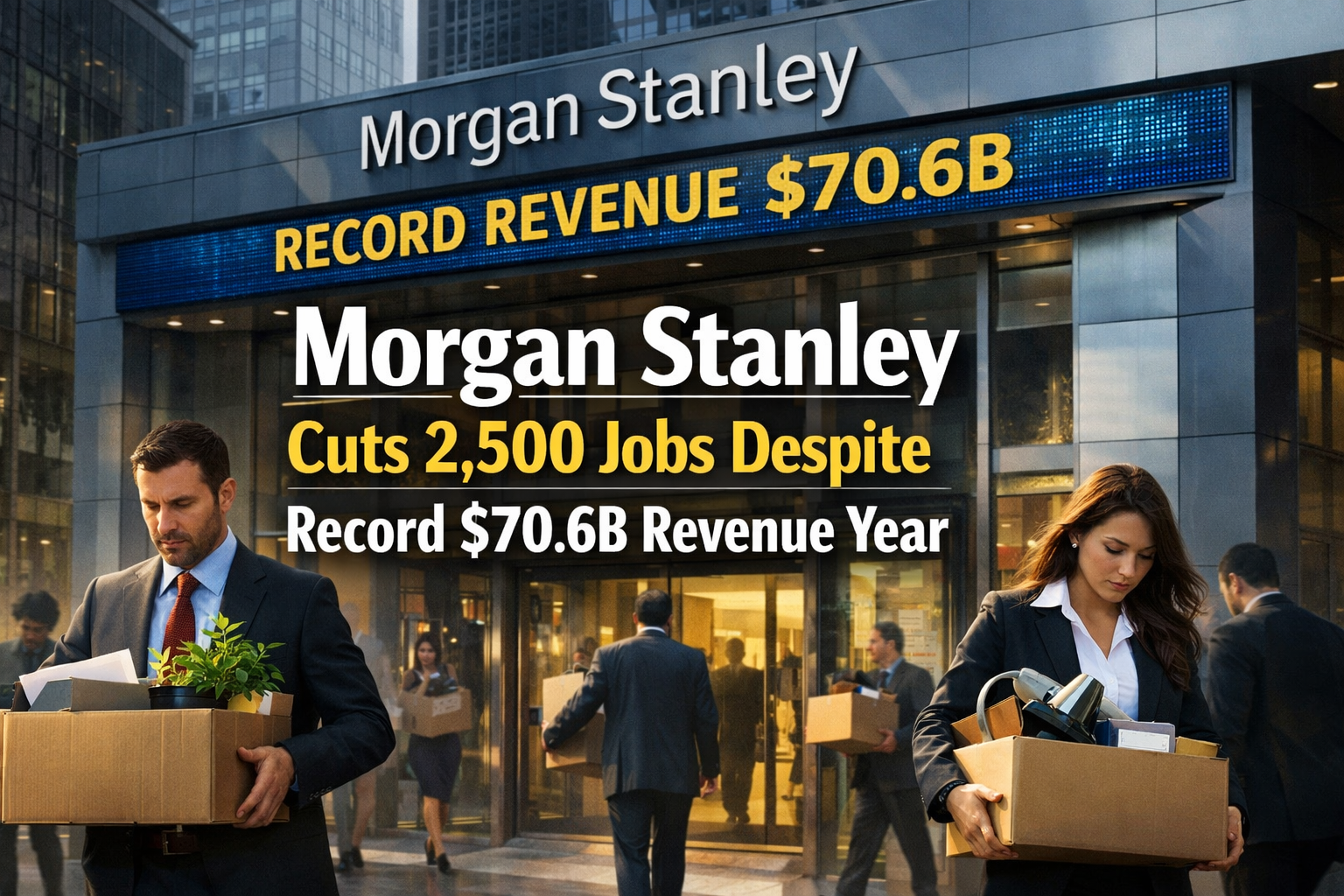
In a move that highlights a growing contradiction across Wall Street, Morgan Stanley has cut roughly 2,500 jobs—about 3% of its global workforce—even after reporting its most profitable year ever.
The layoffs, reported in early March 2026, affect employees across investment banking, trading, wealth management, and investment management divisions worldwide. The decision comes just months after the firm posted record 2025 revenue of about $70.6 billion and $16.9 billion in net income, marking one of the strongest years in the bank’s history.
The juxtaposition of record profits and job cuts has sparked debate across the financial sector:
Why are companies eliminating jobs when business appears stronger than ever?
A Record-Breaking Year for Morgan Stanley
Morgan Stanley entered 2026 riding a wave of strong financial performance.
Key highlights from the firm’s 2025 results include:
$70.6 billion in annual revenue, the highest in company history
14% year-over-year revenue growth
$16.9 billion in net income
Strong performance across investment banking, trading, and wealth management
Investment banking activity surged late in the year as dealmaking rebounded and capital markets strengthened.
Yet shortly after celebrating those results, the firm began cutting jobs.
The Layoffs: What We Know
Morgan Stanley is reducing its workforce by approximately 2,500 positions, representing about 3% of its roughly 83,000 employees globally.
Key details:
Cuts span investment banking, trading, wealth management, and investment management
Layoffs impact both U.S. and international offices
Many roles are corporate or support positions
Client-facing financial advisors are largely unaffected
Reports indicate the layoffs are part of a broader restructuring tied to business priorities, location strategy, and performance reviews.
Why Layoffs Are Happening During Record Profits
At first glance, layoffs during a banner year may seem contradictory. But several structural changes in finance help explain the decision.
1. Pandemic Over-Hiring
During the pandemic boom, many financial firms expanded aggressively.
Morgan Stanley’s workforce grew from about 60,000 employees in 2019 to roughly 83,000 by the end of 2025.
With markets stabilizing and deal activity normalizing, companies are now adjusting staffing levels.
2. Efficiency and Cost Discipline
Even profitable companies continuously refine operating costs.
Wall Street firms frequently reduce headcount when:
Market activity slows
Departments become less profitable
Technology reduces manual workloads
These moves are often framed internally as “resource realignment.”
3. AI and Automation Are Reshaping Finance
Artificial intelligence is increasingly transforming financial operations.
Morgan Stanley executives have noted that internal AI tools could save financial advisors 10–15 hours per week by automating tasks like meeting notes, research summaries, and client engagement analysis.
While the company has not directly blamed AI for the layoffs, industry analysts see automation as a long-term driver of workforce reductions across finance.
A Broader Wall Street Trend
Morgan Stanley’s layoffs reflect a wider shift across the financial industry.
Several major firms have recently reduced headcount as they pursue efficiency and automation strategies.
Analysts say the sector is entering a phase where profitability and hiring no longer move together.
In short:
Wall Street is becoming leaner—even when it’s making more money than ever.
What It Means for Finance Professionals
For workers in banking and finance, the message is clear:
Even highly profitable companies are becoming more selective and technology-driven.
Roles most vulnerable include:
Administrative and operational support
Middle-office roles
Some entry-level analytical positions
Meanwhile, demand remains strong for professionals skilled in:
Data analytics
AI integration
risk management
client advisory services
The financial industry isn’t shrinking — it’s evolving.
FAQ
Why is Morgan Stanley laying off employees after a record year?
The firm is restructuring to improve efficiency and align staffing levels with business priorities, despite strong financial performance.
How many employees are affected?
Approximately 2,500 employees, or about 3% of Morgan Stanley’s workforce.
Which departments are impacted?
Cuts span investment banking, trading, wealth management, and investment management.
Are financial advisors being laid off?
Reports indicate client-facing financial advisors are largely unaffected.
Is AI causing these layoffs?
Morgan Stanley hasn’t officially cited AI as the reason, but automation and productivity improvements are influencing hiring and staffing trends across the industry.
Sources
Morgan Stanley. “Fourth Quarter and Full Year 2025 Earnings Results.” Published January 15, 2026.
Associated Press. “Morgan Stanley to lay off about 3% of workforce.” Published March 2026.
Business Insider. “Morgan Stanley cutting 3% of global workforce.” Published March 2026.
The Times. “Morgan Stanley to axe 2,500 jobs despite record revenues.” Published March 4, 2026.
StockAnalysis. Morgan Stanley Revenue Data (2025).