
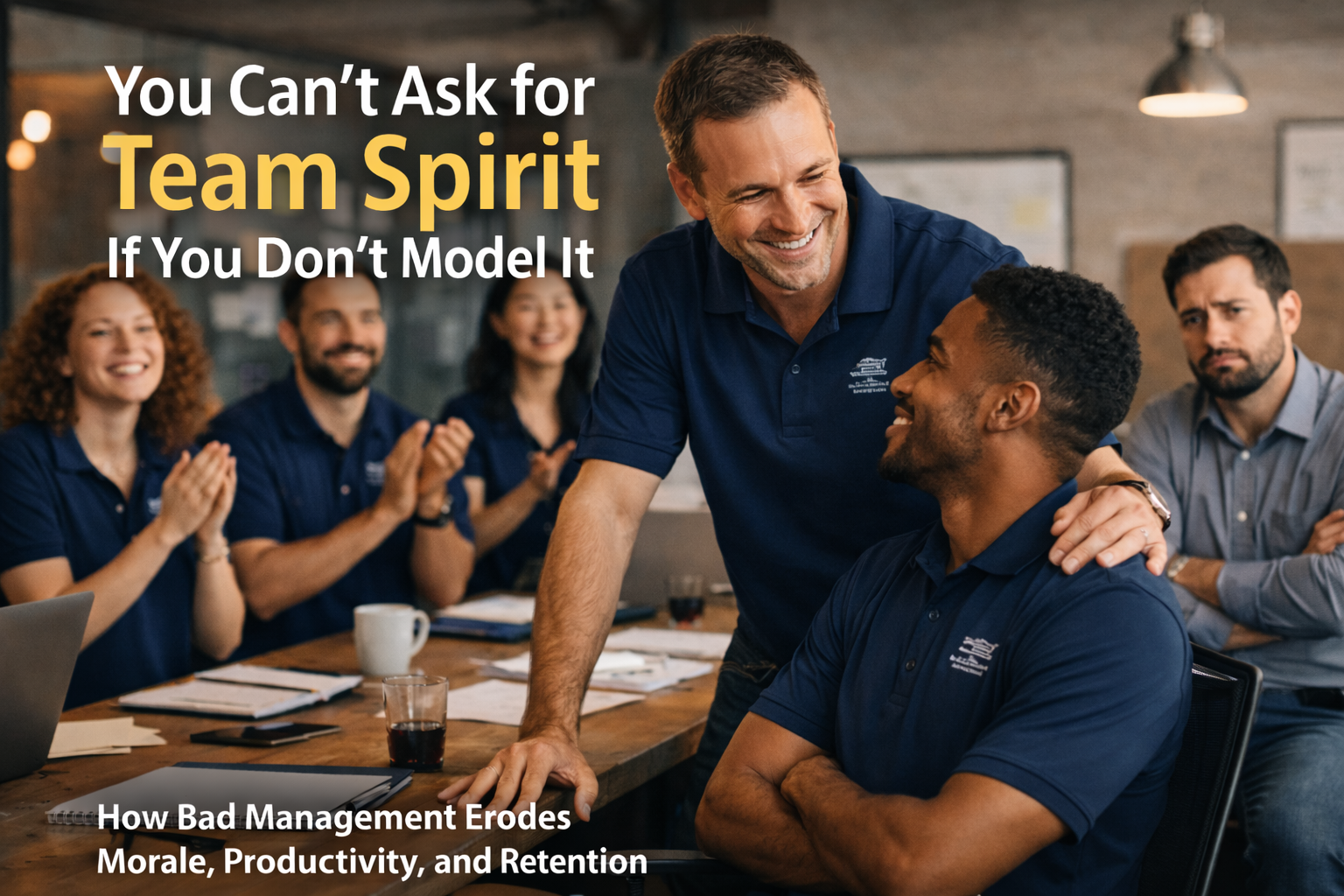
“You can’t ask for team spirit if you don’t model it.”
It’s a simple statement, but it exposes one of the most damaging leadership gaps in today’s workplace. Leaders often speak about collaboration, accountability, and unity, yet their daily behavior quietly contradicts those expectations. When that disconnect exists, culture doesn’t weaken gradually—it begins to fracture.
Across industries, the same truth holds: company culture is not defined by mission statements or internal messaging. It is shaped by leadership behavior. What leaders consistently do sets the tone for how employees think, act, and engage. When leaders fail to model the mindset they expect, team spirit becomes performative, trust erodes, and performance declines.
Why Team Spirit Always Starts at the Top
Team spirit is not created through slogans, emails, or quarterly meetings. It is built through visible, consistent actions. Employees closely watch how leaders handle pressure, treat colleagues, respond to mistakes, and show up when expectations are inconvenient rather than easy.
When leaders behave in ways that contradict their words, employees notice immediately. Over time, this inconsistency erodes trust. Once trust weakens, collaboration feels forced, accountability fades, and unity becomes superficial. Employees follow behavior far more closely than instructions, which is why leadership actions—not intentions—define culture.
How Small Actions Quietly Undermine Culture
Cultural breakdown often begins with behavior that appears insignificant on the surface. A company may introduce a simple, visible cultural initiative designed to reinforce unity and shared identity. Most employees participate without hesitation, understanding that the action itself is symbolic rather than burdensome. But then there is a manager who repeatedly opts out. They acknowledge the expectation, make lighthearted comments about forgetting, apologize, and promise to remember next time. Week after week, the behavior continues. Even after the issue is addressed directly, nothing changes. To leadership, it may seem like a minor oversight. To employees watching closely, it sends a very clear message about what truly matters—and what does not.
What Employees Take Away From That Behavior
Employees do not interpret repeated disengagement as forgetfulness. They interpret it as indifference. When a manager visibly ignores a simple expectation, employees begin to question the sincerity of leadership initiatives and the importance of alignment. Over time, they conclude that company values are optional and that visible belief in the organization is negotiable.
The most damaging conclusion employees reach is that their manager does not genuinely believe in the company. Once that perception takes hold, emotional commitment begins to fade. Even strong performers may continue doing their jobs, but their sense of pride and connection quietly disappears.
The Impact on Morale and Engagement
Morale is heavily influenced by leadership energy and authenticity. Managers who appear disengaged or resistant drain enthusiasm from their teams, often without realizing it. As belief erodes, pride is replaced with indifference, and work begins to feel transactional rather than meaningful.
Employees stop feeling like they are part of something larger and instead feel as though they are simply completing tasks. High performers sense this shift first. Because they care deeply about their work and have options elsewhere, they are often the first to emotionally disengage or begin looking for opportunities outside the organization.
How Poor Leadership Suppresses Productivity
When morale declines, productivity inevitably follows. Teams led by disengaged managers often experience reduced urgency, weaker accountability, and missed goals. This decline is not a result of employees becoming less capable. It happens because motivation, clarity, and belief have been quietly removed.
A manager who fails to model commitment does more than miss an opportunity to inspire. They actively suppress performance by signaling that effort, alignment, and shared purpose are optional. Over time, even capable teams underperform in these conditions.
Why Turnover Accelerates Under Bad Managers
Employees rarely leave organizations without warning signs. More often, they leave managers. When people feel unsupported, disconnected from leadership, or uninspired by their manager’s attitude, they begin to explore alternatives.
High performers are particularly sensitive to misalignment. While a single cultural action may seem small, repeated disengagement reveals deeper leadership issues. Employees do not leave because of one visible behavior—they leave because that behavior reflects a broader lack of integrity and belief.
The Long-Term Cultural Damage
One of the most overlooked consequences of poor management is that the damage lingers long after the manager is gone. Trust does not immediately return. Employees may hesitate to fully buy into new initiatives or remain skeptical of future leaders.
Rebuilding culture requires significant time and effort. Preventing cultural erosion through consistent, aligned leadership is far more effective than attempting to repair it after the fact.
What Strong Leaders Do Differently
Effective leadership does not require perfection. It requires consistency and self-awareness. Strong leaders understand that their behavior carries weight, especially in small moments. They model the actions they expect, support company initiatives publicly, take accountability for mistakes, and treat every team member with respect.
Through these behaviors, they send a clear message: alignment matters, belief matters, and everyone is working toward the same goal.
The Leadership Reality Check
Before asking for more collaboration, energy, or unity, leaders should ask themselves one question: if their team mirrored their behavior exactly, would they be satisfied with the culture that resulted?
If the answer is no, the solution is not another message or initiative. The solution is personal change.
Attitude is leadership.
A manager’s behavior never stays contained. It spreads through teams, shaping morale, performance, and retention. At DAVRON, leadership means setting the example, believing in the mission, and understanding that culture is built—or broken—by those entrusted to lead.
When leaders model team spirit, people thrive.
When they don’t, even the strongest teams struggle.