
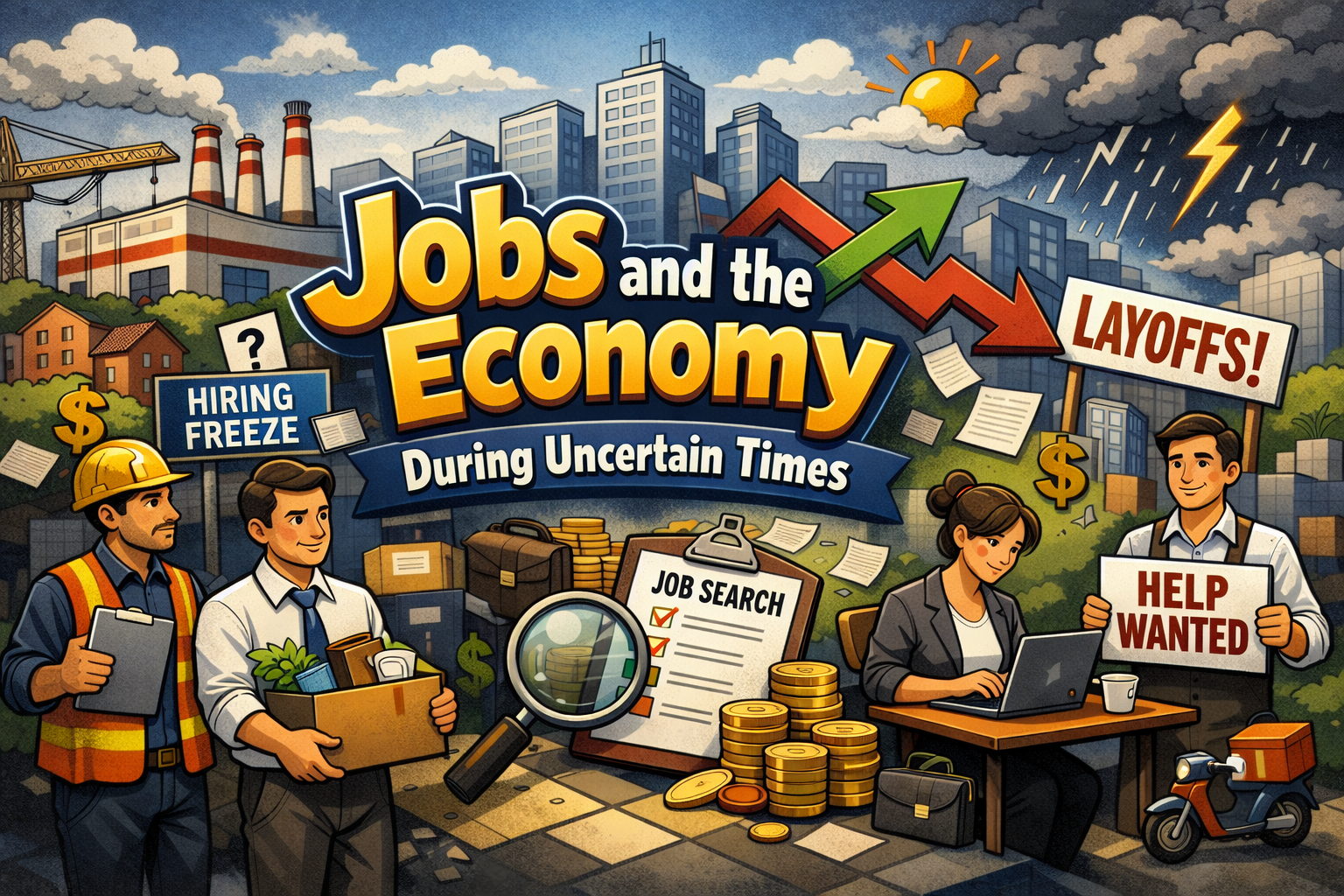
Periods of economic uncertainty can reshape the job market quickly. Whether caused by financial shifts, global disruptions, technological change, or market volatility, uncertain times often create ripple effects across industries and employment.
For workers, this can mean slower hiring, shifting career opportunities, and growing competition for stable roles. For businesses, uncertainty often leads to cautious decision-making, delayed expansion, and a stronger focus on efficiency.
Yet history shows that disruption doesn’t just create challenges—it also accelerates change. New industries emerge, workforce priorities shift, and different skills suddenly become more valuable than before.
Why Economic Uncertainty Affects Jobs
When the economic outlook becomes less predictable, companies tend to move carefully. Instead of rapidly expanding their workforce, many organizations slow hiring or pause major growth initiatives.
Businesses often respond to uncertain conditions by:
- Freezing or reducing hiring
- Delaying expansion projects
- Cutting non-essential spending
- Focusing on productivity and automation
These strategies help companies remain stable, but they also mean fewer job openings and longer job searches for workers.
At the same time, uncertainty can shift which industries are growing and which are contracting.
Some Industries Slow While Others Expand
Economic disruption rarely affects every industry equally. While some sectors struggle during uncertain periods, others may grow rapidly.
Historically, several industries remain resilient during economic disruptions:
Healthcare and medical services
Demand for healthcare continues regardless of economic conditions, making it one of the most stable employment sectors.
Infrastructure and construction
Government investment in infrastructure projects often increases during periods of economic slowdown to stimulate growth.
Technology and digital services
Digital transformation tends to accelerate during uncertain times as companies look for efficiency and automation.
Logistics and supply chain management
When markets become unstable, supply chain operations become even more critical.
These sectors often create new job opportunities even when the broader economy is slowing.
The Rise of Flexible and Alternative Work
Another major shift during uncertain economic periods is the rise of flexible employment.
Workers increasingly explore alternative income streams such as:
- Freelance and contract work
- Remote digital jobs
- Consulting or specialized services
- Small business entrepreneurship
These options provide flexibility and additional income but may also come with less stability or fewer benefits than traditional full-time roles.
However, the growth of digital platforms and remote work has made these opportunities far more accessible than in previous decades.
Skills Become More Important Than Ever
During periods of disruption, employers often prioritize workers who can adapt quickly to change.
Skills that tend to become more valuable include:
- Digital and technical skills
- Data analysis and cybersecurity
- Project management and operations expertise
- Skilled trades and engineering capabilities
Workers who continue developing new skills are generally better positioned to navigate shifting economic conditions.
In many cases, career adaptability becomes as important as experience.
Businesses Focus on Efficiency and Innovation
For companies, uncertain economic conditions often lead to major strategic shifts.
Organizations may prioritize:
- Automation and technology adoption
- Streamlined operations
- Workforce restructuring
- Innovation and new revenue streams
While these adjustments can sometimes reduce certain types of roles, they also create demand for workers who can support technological transformation and operational improvements.
Why Disruption Often Leads to New Opportunities
Although uncertainty can be difficult in the short term, economic disruption frequently leads to long-term transformation.
Many industries that dominate today—including cloud computing, digital commerce, and renewable energy—expanded rapidly during previous periods of economic change.
Disruption tends to accelerate innovation, pushing companies to rethink traditional business models and adopt new technologies.
For workers and entrepreneurs willing to adapt, these shifts can create entirely new career paths.
How Workers Can Prepare for Economic Uncertainty
While no one can predict every economic shift, there are practical steps workers can take to remain resilient.
Some of the most effective strategies include:
- Continuing education or professional certifications
- Developing digital and technical skills
- Building diverse professional networks
- Exploring multiple income streams
Workers who remain flexible and proactive are often better equipped to navigate uncertain economic periods.
FAQ
Why do jobs become harder to find during uncertain times?
Businesses often slow hiring and delay expansion when economic conditions become unpredictable, reducing the number of open positions.
Which industries are most stable during disruption?
Healthcare, infrastructure, logistics, and technology tend to remain strong because they support essential services and long-term economic development.
Does disruption always lead to job losses?
Not necessarily. While some sectors shrink, others expand and create new types of jobs.
What skills help workers adapt during economic uncertainty?
Digital skills, technical expertise, data analysis, project management, and skilled trades are often in high demand.