
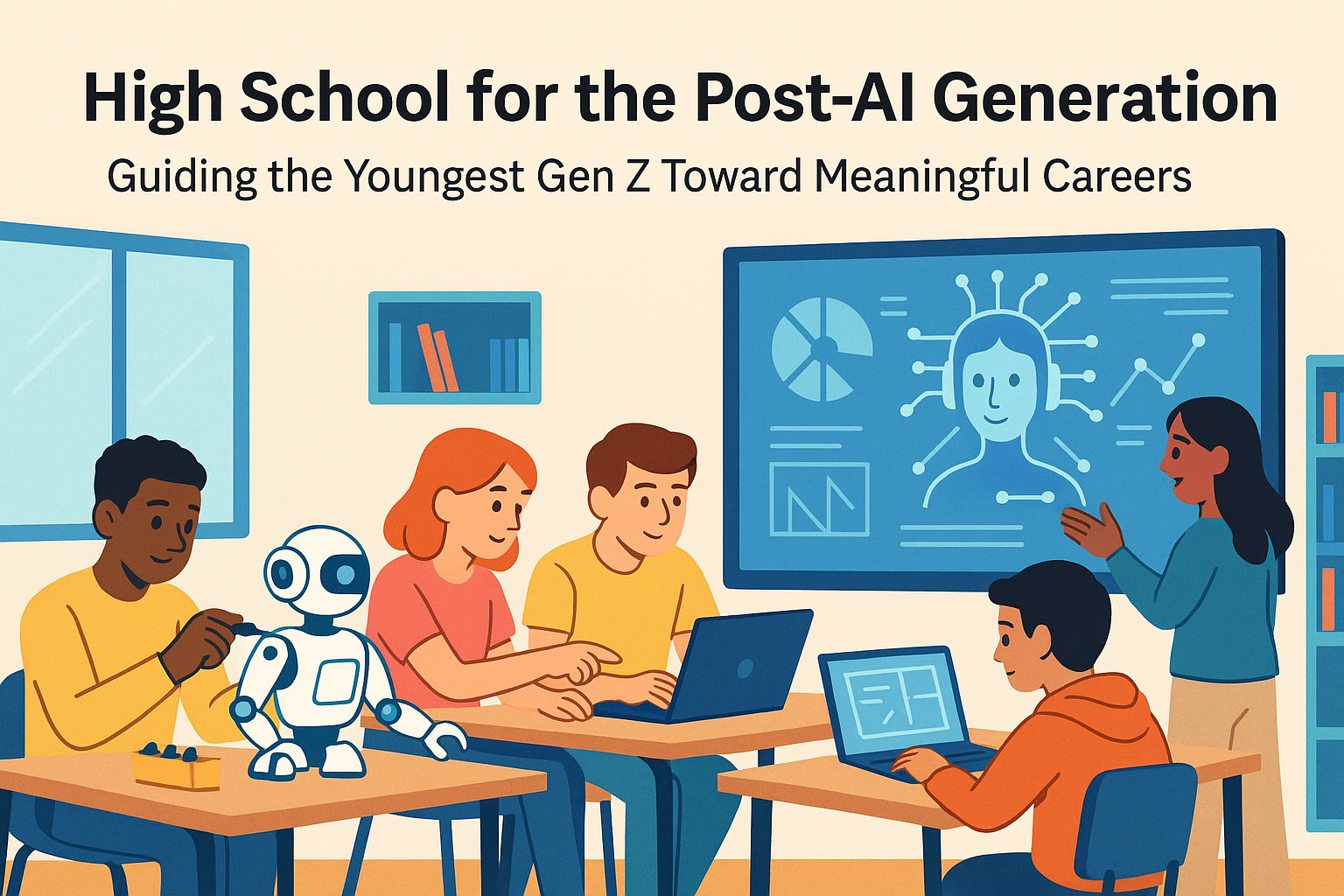
As artificial intelligence accelerates across every industry, today’s high schoolers—the youngest cohort of Gen Z—are entering a world where traditional career paths are being rewritten in real time. In the Post-AI Generation, success will depend less on memorizing information and more on mastering adaptability, creativity, and the ability to work alongside machines rather than compete with them.
Parents, educators, and counselors now face a new challenge: How do we prepare teens for a future filled with automation, evolving job markets, and emerging fields not yet fully defined? The good news: the future is full of opportunity—if we guide students toward the right mindsets, skills, and fields of study.
The New Career Reality: What the Post-AI Workforce Will Look Like
AI is transforming job categories at every level. But instead of eliminating the need for human talent, it’s shifting demand toward skills that complement automation. High schoolers should expect:
- Hybrid human-AI roles (e.g., AI-enhanced healthcare, finance, engineering)
- Increased demand for creative, strategic, and interpersonal skills
- New job categories emerging every 3–5 years
- Continuous learning as a core career expectation
Students must be prepared not for a single career but for evolving, diversified career paths.
Where Teens Should Focus: High-Value Skills in an AI-Driven Economy
1. Human-Centered Skills
While AI handles routine tasks, human strengths become more valuable:
- Critical thinking & problem-solving
- Communication and storytelling
- Leadership & collaboration
- Creativity and design thinking
These are the “unautomatable” skills that will anchor long-term career resilience.
2. Digital & Technical Literacy
Not every student needs to become a programmer—but every student needs technological fluency.
Recommended skill areas include:
- AI literacy and responsible AI use
- Basic coding & computational thinking
- Cybersecurity awareness
- Data interpretation and digital research
These are the new “foundational skills” of the Post-AI Generation.
3. Entrepreneurial Mindsets
AI enables rapid prototyping, automation of tasks, and access to global audiences—meaning young people can build faster and earlier than ever before.
Encourage:
- Side projects
- Freelancing experiments
- Participation in pitch competitions or maker fairs
Entrepreneurship is no longer a career path—it’s a skill set.
High-Opportunity Career Fields for the Post-AI Generation
1. Technology & Computing
AI will create more tech-sector jobs than it displaces. Top areas include:
- Artificial intelligence & machine learning
- Robotics & automation engineering
- Software development
- Cybersecurity
- Cloud & DevOps
2. Healthcare & Human Services
An aging population and AI-enhanced diagnostics will expand healthcare roles:
- Biotechnology
- Nursing, telehealth, and care coordination
- Medical data analytics
- Mental health and counseling
3. Sustainable Industries
Climate change and green technology will create entire new sectors:
- Renewable energy engineering
- Environmental science & policy
- Urban planning & sustainable design
4. Creative & Strategic Industries
AI accelerates—but does not replace—creative work:
- Content creation & digital media
- UX/UI design
- Brand strategy
- Product design
5. Skilled Trades—Modernized for AI
Skilled trades remain one of the most stable—and increasingly technologically advanced—career paths for the Post-AI Generation:
- Advanced manufacturing – Robotics maintenance technician
- Electrician & smart home systems
- Automotive tech (EV & autonomous systems)
- Welding and fabrication with CNC and robotics integration
- HVAC technicians specializing in energy-efficient systems
How High Schools Can Prepare Students for the Future
1. Update Academic Pathways
Offer modernized courses such as:
- AI fundamentals
- Personal finance & entrepreneurship
- Digital ethics & cybersecurity
- Design thinking
2. Emphasize Project-Based Learning
Real-world projects help students:
- Build portfolios
- Collaborate across disciplines
- Solve open-ended, practical problems
This fosters adaptability—one of the most valuable future skills.
3. Strengthen Career Exploration Programs
Schools should connect students with:
- Job shadowing
- Internships & apprenticeships
- Industry guest speakers
- Career mapping tools
Exposure leads to clarity.
4. Support Social-Emotional Learning
Future-ready students need emotional intelligence, resilience, and self-awareness. High schools should prioritize:
- Stress management tools
- Team-based activities
- Leadership programs
These build the confidence needed to navigate an unpredictable future.
What Parents Can Do Today
- Encourage curiosity and experimentation
- Help teens build a digital portfolio (projects, essays, designs, code)
- Offer opportunities for hands-on learning
- Foster healthy digital habits
- Teach adaptability and growth mindset through daily routines
Parents play a key role in shaping a teen’s readiness for rapid change.
FAQ
What skills should high schoolers prioritize for the AI future?
Critical thinking, communication, AI literacy, coding basics, and creativity.
Which careers are most future-proof?
AI-related fields, healthcare, renewable energy, advanced manufacturing, and creative strategy.
Should all students learn to code?
Basic coding is helpful, but not mandatory. Understanding how technology works is essential.
How can teens explore future careers now?
Internships, side projects, online courses, job shadowing, and school-based career programs.