
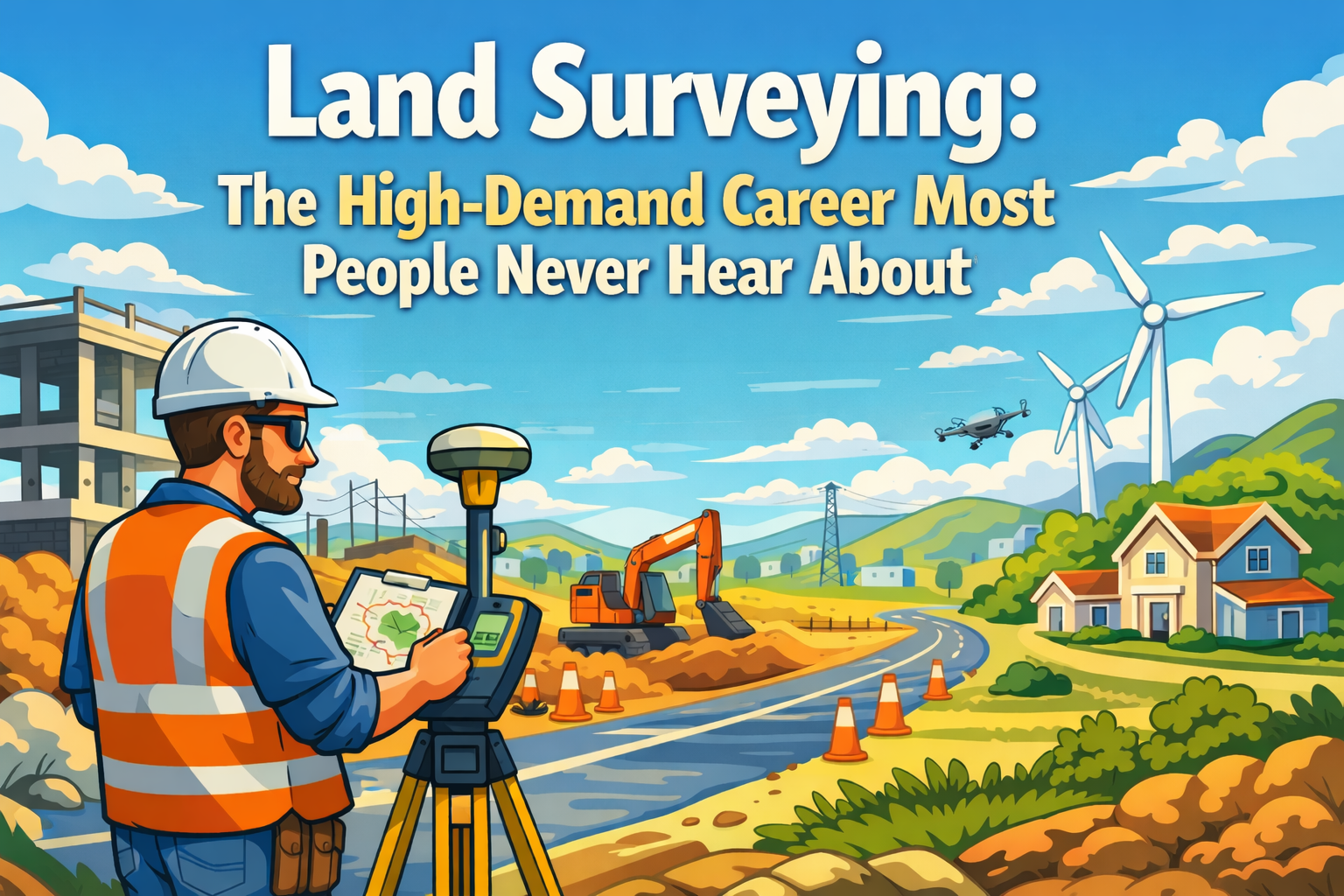
Nothing gets built without them—yet most people don’t even know they exist.
As students rush toward trendy majors and burned-out professionals look for their next move, one critical, high-demand career continues to fly under the radar: land surveying, particularly licensed Professional Land Surveyors (PLS).
Surveyors are the invisible backbone of modern society. Roads, housing developments, renewable energy projects, utilities, and even property disputes all rely on their work. Yet for decades, this profession has quietly suffered from low awareness—creating a rare combination in today’s job market: high demand, limited supply, and long-term stability.
For those who discover it early, or pivot into it later, surveying often becomes the career they wish they had known about sooner.
The Hidden Career Behind Everything We Build
Before a single shovel hits the ground, a surveyor has already been there.
Surveyors establish property boundaries, map land features, verify legal descriptions, and ensure construction aligns with regulations. Without them:
- Roads can’t be laid
- Homes can’t be built
- Utilities can’t be installed
- Renewable energy projects stall
- Land disputes escalate into costly legal battles
In short, nothing gets built without surveyors—yet they remain largely invisible outside construction and engineering circles. That invisibility is exactly what’s driving today’s shortage.
Why PLS and Surveyors Are in Massive Demand
The demand for licensed surveyors isn’t theoretical—it’s structural.
Several forces are converging at once:
- Infrastructure and development booms driven by federal and state funding
- Population growth fueling housing and commercial construction
- Renewable energy expansion requiring extensive land analysis
- Retirements outpacing new entrants, as much of the workforce nears retirement age
But the biggest factor? Licensing creates scarcity.
Becoming a Professional Land Surveyor requires experience, exams, and mentorship. That barrier to entry limits supply—meaning those who earn licensure enjoy exceptional job security, strong compensation, and geographic mobility.
Scarcity equals stability, and few careers offer both this clearly.
Why There Are So Few Surveyors
If demand is so high, why aren’t more people entering the field?
The answer is surprisingly simple.
1. Low Awareness
Most students never hear about surveying in high school or college. It’s rarely promoted alongside engineering, architecture, or construction management.
2. A Long—but Manageable—Path
Licensure takes time, but it’s far from unattainable. The commitment filters out casual entrants, but rewards those who stay the course.
3. Persistent Misconceptions
Many assume surveying is:
- “All math”
- “Outdated”
- “Just walking around with a tripod”
In reality, modern surveyors use advanced GPS, drones, 3D modeling, and geospatial software, blending fieldwork with high-tech analysis.
What It Really Takes to Become a Professional Land Surveyor (PLS)
Credibility matters, so here’s the honest version—no sugarcoating.
Education Paths
- A surveying, civil engineering, or geomatics degree (common but not always required)
- Some states allow experience-based routes with fewer formal education requirements
Experience
- A mix of fieldwork and office work
- Learning boundary law, data analysis, and project coordination
Exams and Licensure
- Fundamentals exam (FS)
- Principles and Practice exam (PS)
- State-specific requirements
Timeline
- Typically 6–10 years, depending on education and state regulations
Skills That Matter More Than GPA
- Attention to detail
- Spatial reasoning
- Communication and documentation
- Comfort with both technology and outdoor work
Those who succeed aren’t always top-of-the-class students—they’re persistent problem-solvers.
Why People Who Switch Into Surveying Rarely Leave
This is where surveying quietly outperforms flashier careers—especially for mid-career switchers.
Surveyors stay because the job delivers what others promise:
- Real job security in any economy
- Clear progression from technician to licensed professional
- Balanced work-life schedules (often overlooked)
- Tangible, real-world impact you can physically point to
For professionals burned out by endless meetings, abstract KPIs, or unstable tech cycles, surveying offers something rare: visible results and lasting value.
Who Should Seriously Consider a Career in Surveying
This profession isn’t for everyone—but it’s perfect for the right people.
You should look closely at surveying if you are:
- A student seeking long-term stability without being stuck behind a desk
- A career switcher from construction, engineering, GIS, military service, trades, or tech burnout
- Someone who enjoys tangible outcomes over theoretical work
- A professional who values consistency, autonomy, and purpose
For many, discovering surveying feels less like choosing a career—and more like finally finding one that makes sense.
The Bottom Line
Land surveying is one of the few careers where demand is rising, supply is shrinking, and the work truly matters.
Most people don’t hear about it until projects are delayed, land disputes erupt, or companies scramble to find licensed professionals. But for those who discover it early—or pivot into it intentionally—it can be a career with unmatched stability and satisfaction.
Sometimes, the best opportunities aren’t the loudest ones.
FAQ
Is land surveying a dying profession?
No—demand is increasing faster than new professionals are entering the field.
Do I need to be great at math?
You need solid fundamentals, but problem-solving and attention to detail matter more.
Is surveying mostly outdoor work?
It’s typically a mix of field and office work, varying by role and seniority.
Can I switch into surveying later in life?
Yes. Many successful surveyors come from construction, military, or technical backgrounds.