
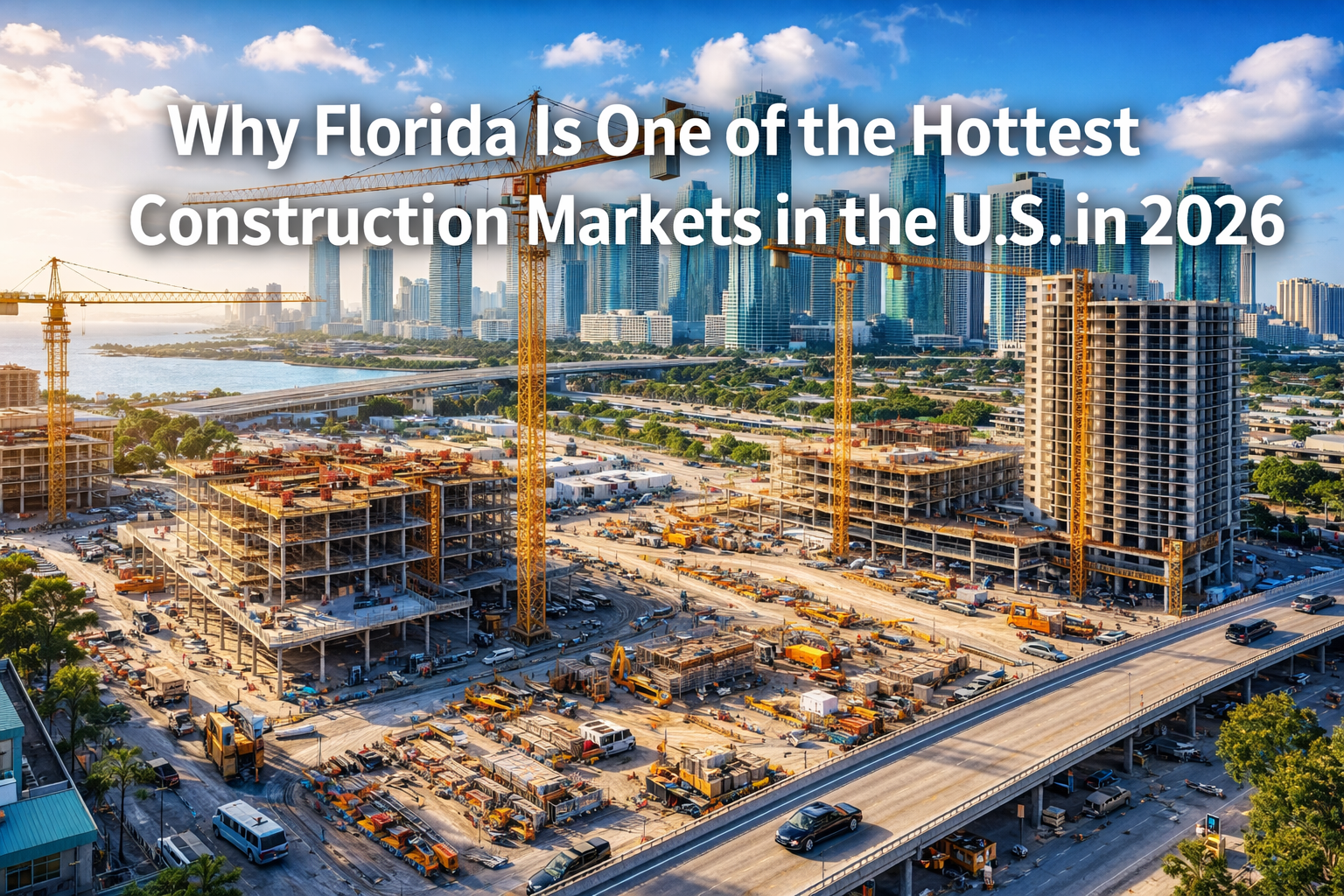
Florida’s construction market is entering 2026 with exceptional momentum. From record population growth to massive infrastructure investment and a tightening labor market, the Sunshine State has become one of the most competitive and opportunity-rich construction environments in the country.
For contractors, developers, engineers, and construction professionals, Florida is no longer just a strong regional market—it’s a national powerhouse.
Florida’s Population Boom Is Fueling Unprecedented Demand
Florida remains one of the fastest-growing states in the U.S., driven by domestic migration, international relocation, and sustained job creation. This population growth directly translates into surging demand for housing, transportation, utilities, and commercial development.
Major metro areas such as Miami, Tampa, Orlando, Jacksonville, and Fort Myers continue to absorb new residents at a pace that outstrips existing infrastructure. As a result, construction activity is accelerating across:
Single-family and multifamily housing
Master-planned communities
Schools, healthcare facilities, and public buildings
Roads, bridges, and transit systems
The need to “build fast and build smart” is defining Florida’s construction landscape in 2026.
A Construction Pipeline That Spans Every Sector
What sets Florida apart from many other states is the diversity of its construction pipeline.
Residential Construction Remains Red-Hot
Despite higher interest rates in recent years, housing demand remains strong due to sustained population growth and limited supply. Multifamily developments, affordable housing projects, and luxury coastal construction are all active simultaneously.
Infrastructure Investment Is Driving Long-Term Growth
Florida’s multi-year transportation and infrastructure programs are among the largest in the nation. Projects involving highways, airports, ports, water systems, and flood mitigation are keeping heavy civil contractors busy well into 2026 and beyond.
Industrial and Commercial Development Continues to Expand
Florida’s strategic location has made it a logistics and distribution hub. Warehouses, manufacturing facilities, cold storage, and mixed-use developments are expanding across the state, particularly along major transportation corridors.
Labor Shortages Are Intensifying Competition
One of the defining characteristics of Florida’s 2026 construction market is labor scarcity.
The demand for skilled professionals—superintendents, project managers, estimators, engineers, and skilled trades—far exceeds available supply. Rather than slowing growth, this shortage is intensifying competition among employers and driving:
Rising wages and improved benefits
Increased investment in training and workforce development
Greater reliance on technology, prefabrication, and efficiency
For construction professionals, Florida offers some of the strongest career opportunities in the U.S. right now.
Business-Friendly Policies and Developer Confidence
Florida’s tax structure, regulatory environment, and pro-growth policies continue to attract domestic and international investment. Developers remain confident in long-term demand, particularly in fast-growing metros and coastal markets.
This confidence has helped Florida outperform many other states where construction has slowed due to uncertainty or declining population trends.
Building for Resilience and the Future
Florida’s construction market is also evolving in response to climate and sustainability challenges. New projects increasingly emphasize:
Hurricane-resistant design and materials
Flood mitigation and resilient infrastructure
Energy-efficient systems and sustainable building practices
These adaptations are not slowing construction—they’re creating new opportunities for innovation, specialization, and expertise.
What This Means for the Construction Industry
Florida’s construction boom in 2026 is being driven by fundamentals, not speculation. Population growth, infrastructure investment, and economic expansion are creating long-term demand across every construction sector.
For employers, this means intense competition for talent.
For professionals, it means opportunity, mobility, and leverage.
For the industry as a whole, Florida represents one of the strongest construction markets in the country.
Why Florida’s Construction Market Is Thriving in 2026
Rapid population growth is driving demand for housing and infrastructure
Construction activity spans residential, commercial, industrial, and civil sectors
Massive infrastructure programs are fueling long-term project pipelines
Skilled labor shortages are intensifying competition and wages
Business-friendly policies continue to attract investment
FAQ: Florida Construction Market in 2026
Is Florida still growing despite economic uncertainty?
Yes. Population growth and infrastructure demand continue to support construction even during national slowdowns.
Which Florida cities are seeing the most construction activity?
Miami, Tampa, Orlando, Jacksonville, and Southwest Florida remain the most active markets.
Is construction hiring still strong in Florida?
Absolutely. Skilled labor demand remains extremely high across all disciplines.
What sectors are growing fastest?
Infrastructure, multifamily residential, industrial/logistics, and mixed-use developments.