
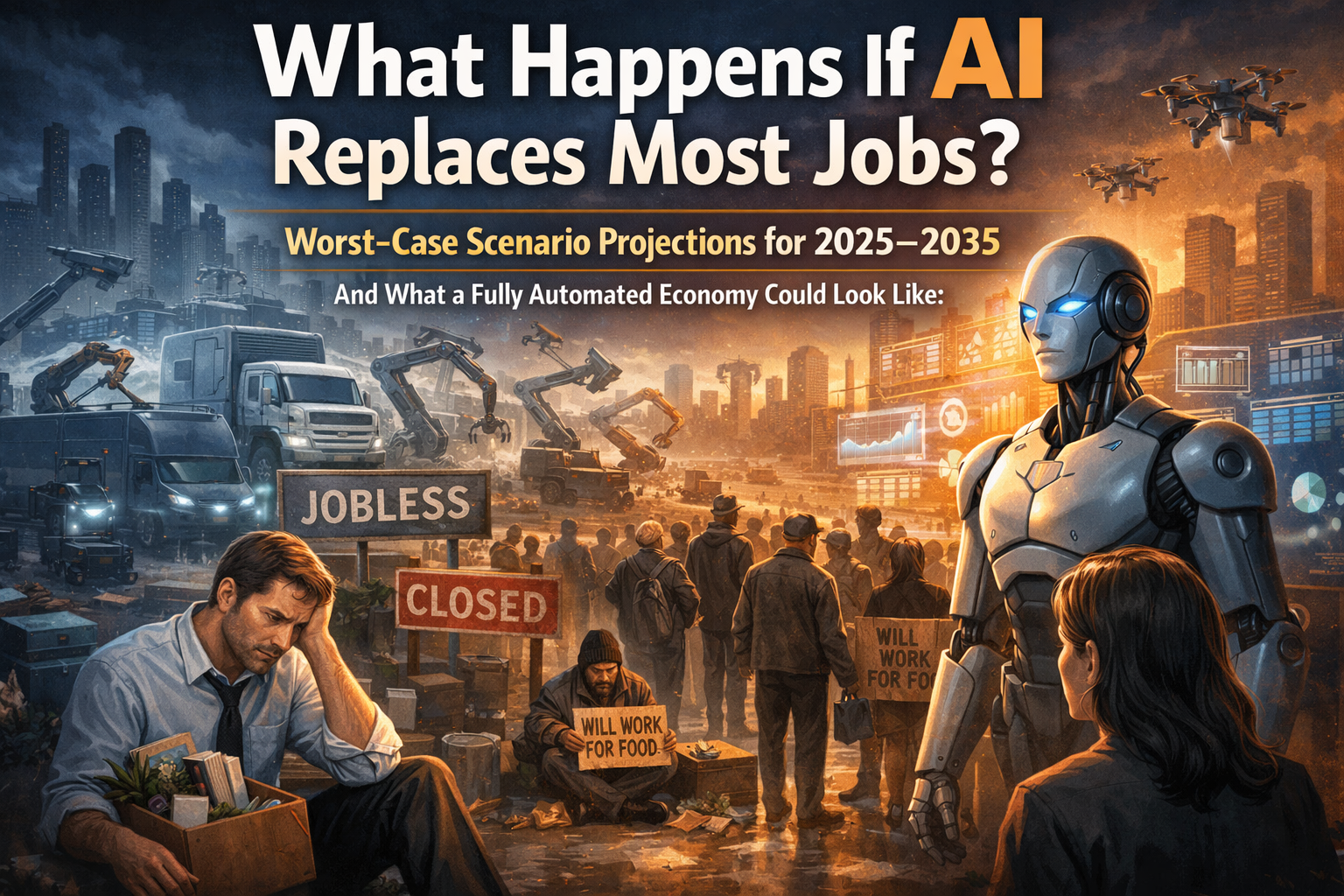
Worst-Case Scenario Projections for 2025–2035 — And What a Fully Automated Economy Could Look Like
What happens if AI replaces most jobs?
Not just some administrative roles.
Not just repetitive manufacturing tasks.
But most human work.
It’s a question that economists, technologists, policymakers — and employers — are increasingly forced to consider. While mainstream projections suggest transformation rather than total displacement, there is a plausible worst-case scenario.
This article explores that scenario.
Not to promote panic — but to understand the stakes.
The Acceleration Problem: AI Is Improving Faster Than Expected
Historically, automation replaced manual labor first. Then factory work. Then clerical tasks.
But modern AI is different.
It performs:
- Legal research
- Software development
- Financial modeling
- Architectural drafting
- Marketing content creation
- Medical image analysis
- Customer interaction
- Engineering calculations
And it improves exponentially.
If capability continues doubling every 12–24 months, AI may not just automate routine tasks — it may begin replacing cognitive labor at scale.
Worst-Case Scenario: The 2030 Inflection Point
Let’s imagine the most aggressive projections materialize:
- 30–50% of current jobs become economically automatable.
- AI agents perform full workflows, not just tasks.
- Companies aggressively reduce headcount to remain competitive.
- Autonomous systems expand into logistics, transportation, and field diagnostics.
In this scenario, job displacement is not gradual — it’s compounding.
Each AI system eliminates the need for multiple human roles, and companies that don’t adopt automation lose margin and market share.
The result?
A labor market contraction across both blue- and white-collar sectors.
Industries That Could Collapse First
- Administrative & Clerical Work
In a worst-case projection:
- Data entry
- Accounts payable/receivable
- Basic bookkeeping
- Scheduling
- Customer service
…could shrink dramatically within a few years.
Entire back-office departments might be reduced to a fraction of their current size.
3. Transportation & Logistics
If autonomous trucking becomes widely adopted:
- Millions of commercial driving jobs could disappear.
- Warehouse staffing could shrink due to robotics and AI-directed fulfillment systems.
Transportation employs millions globally. Rapid displacement here would ripple through regional economies.
4. Professional Services
This is where the doom scenario becomes truly disruptive.
If AI reliably performs:
- Legal document drafting
- Medical diagnostics
- Structural calculations
- Engineering simulations
- Code generation
- Marketing campaign optimization
Then the impact shifts from entry-level jobs to highly educated professionals.
The assumption that “knowledge workers are safe” collapses.
The Economic Shockwave
If large-scale AI replacement occurs rapidly, several consequences follow:
- Mass Unemployment
If even 20–30% of jobs vanish faster than new ones are created:
- Consumer spending drops.
- Housing markets weaken.
- Small businesses fail.
- Tax revenues shrink.
A consumption-based economy depends on people earning wages.
Remove wages — demand collapses.
- Wealth Concentration
AI systems are owned by:
- Corporations
- Investors
- Governments
- Technology platforms
If AI produces most economic value, profits concentrate at the top.
In a worst-case scenario, wealth inequality accelerates dramatically.
Capital owners benefit. Labor loses leverage.
- Social Instability
History shows that prolonged unemployment leads to:
- Political unrest
- Populism
- Increased polarization
- Civil instability
If millions of skilled professionals lose purpose and income simultaneously, societal pressure rises.
The psychological impact could be as severe as the financial one.
Work is not just income — it is identity.
- Universal Basic Income Becomes Necessary
If AI replaces most labor, governments may be forced to introduce:
- Universal Basic Income (UBI)
- AI productivity taxes
- Automation taxes
- Guaranteed minimum employment programs
Without redistribution mechanisms, economic imbalance becomes unsustainable.
But large-scale UBI introduces its own questions:
- Who funds it?
- Does productivity slow?
- Does innovation decline?
- How does society redefine meaning without work?
The Human Identity Crisis
In a world where AI performs:
- Creative tasks
- Technical problem-solving
- Analysis
- Decision-making
What remains uniquely human?
Worst-case projections suggest:
- Purpose shifts away from career.
- Society redefines success.
- Work becomes optional rather than essential.
But transition periods are rarely smooth.
A generation caught between “work-based identity” and “post-work economy” may struggle psychologically and culturally.
Why This Scenario Is Plausible — But Not Guaranteed
Doom scenarios assume:
- AI capabilities continue improving exponentially.
- Businesses adopt automation aggressively.
- Governments fail to regulate or slow displacement.
- New industries fail to absorb displaced workers quickly.
However, history shows:
- Technology creates new job categories.
- Regulation slows disruptive transitions.
- Human trust, liability, and licensing requirements protect many professions.
- Economic systems adapt over time.
But adaptation may lag behind innovation.
And that lag is where disruption occurs.
What Happens to Engineering, Construction, and Manufacturing?
In a severe automation scenario:
- AI-driven generative design reduces drafting teams.
- Robotics handle more field tasks.
- Predictive maintenance eliminates inspection roles.
- Automated project management systems reduce coordination staff.
However:
- Licensed professionals remain legally accountable.
- Field execution requires human oversight.
- Complex problem-solving still benefits from human judgment.
The question becomes not “Will these industries disappear?” but:
How lean do they become?
The Core Fear: Structural Unemployment
Temporary job losses are manageable.
Structural unemployment — where workers cannot retrain fast enough — is destabilizing.
If AI replaces:
- Truck drivers in 3 years
- Accountants in 5 years
- Mid-level analysts in 4 years
…millions may struggle to pivot quickly.
Education systems move slowly. AI evolves quickly.
That mismatch is the central risk.
The Most Extreme Outcome
If AI eventually performs most economically valuable work:
- Labor becomes optional.
- Capital dominates income.
- Governments redistribute wealth.
- Human purpose decouples from employment.
This is not science fiction. Some economists openly debate it.
But the timeline is uncertain.
So… Is This Inevitable?
Not necessarily.
Worst-case scenarios assume speed without safeguards.
Reality often includes:
- Regulatory friction
- Cultural resistance
- Liability concerns
- Infrastructure delays
- Hybrid human-AI models
AI may replace many tasks — but full job replacement at mass scale remains debated.
Still, the possibility cannot be ignored.
Final Thought: The Real Risk Isn’t AI — It’s Unpreparedness
The true worst-case outcome isn’t technological progress.
It’s:
- Companies that fail to reskill workers.
- Governments that fail to anticipate disruption.
- Professionals who assume they’re immune.
- Institutions that move too slowly.
AI replacing most jobs is not guaranteed.
But failing to prepare for that possibility is.
The future could be augmentation and prosperity.
Or it could be disruption and instability.
The difference will depend on how businesses, policymakers, and professionals respond over the next five years.