
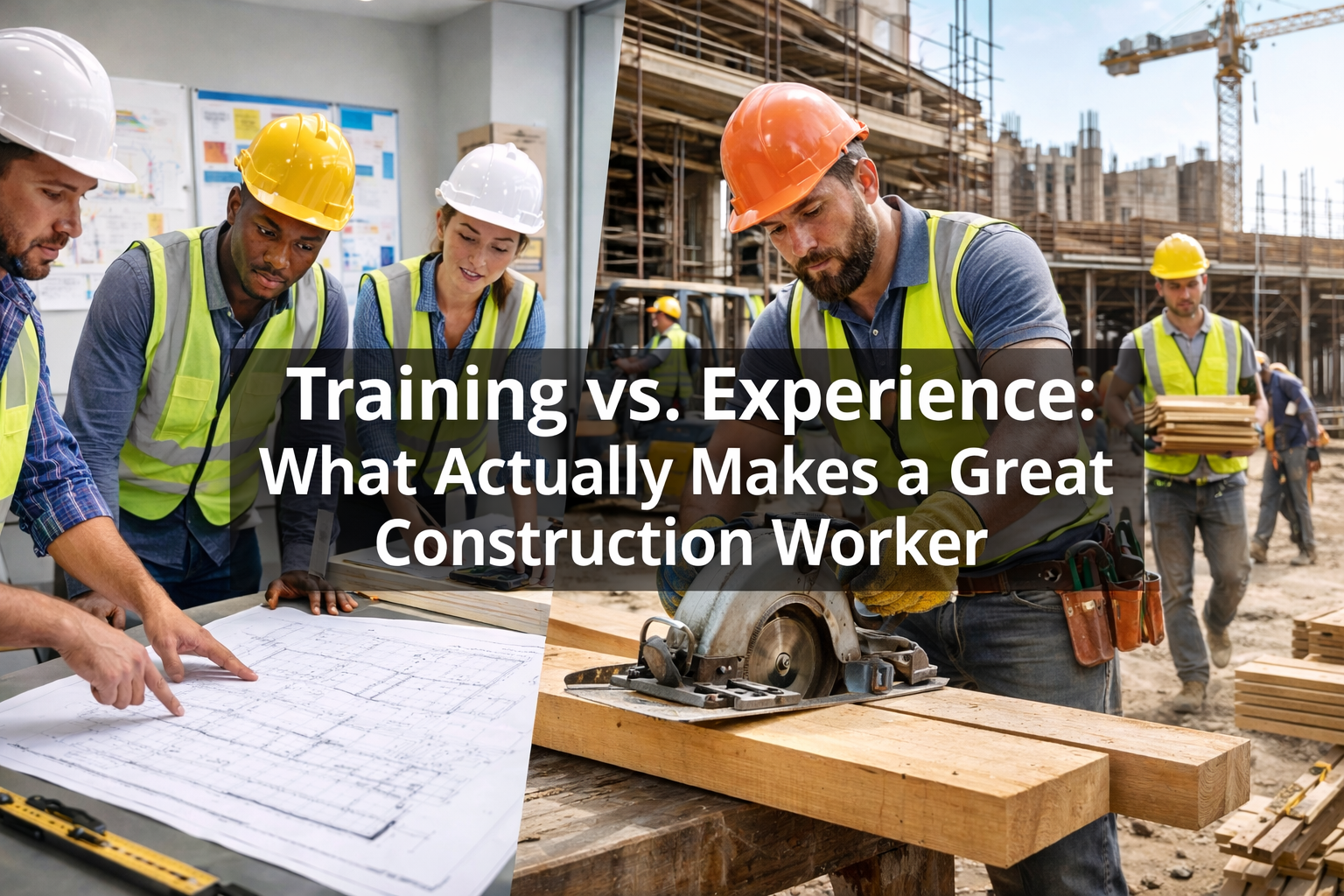
In the construction industry, employers and workers alike often debate what truly matters more: formal training or real-world experience. Is it classroom-acquired technical knowledge that makes someone excel? Or the hard-earned lessons learned day after day on a jobsite? The answer isn’t simple — and understanding the interplay between training and experience can help workers, supervisors, and companies build stronger, safer, and more productive teams.
Why Training Matters: The Foundation of Skill
Formal training provides workers with essential technical understanding and safety awareness before they step onto a construction site.
1. Safety First
Construction sites are inherently risky. Training programs emphasize OSHA standards, hazard recognition, and safe equipment use.
Workers who complete safety courses are significantly less likely to be involved in accidents.
2. Technical Knowledge
Apprenticeships, trade schools, and certification programs teach the why behind tools, materials, and methods — from blueprint reading to welding fundamentals.
Workers with structured training can adapt faster to new technologies and methods, from digital measurement tools to modular construction techniques.
3. Credentials That Open Doors
Certifications such as OSHA 10/30, NCCER credentials, and journeyman licenses signal competence to employers.
For many specialized roles (electrician, plumber, heavy equipment operator), formal training is required before gaining on-site responsibility.
The Power of Experience: Lessons Only Time Can Teach
While training lays the groundwork, experience solidifies skill and builds judgment.
1. Problem-Solving Under Pressure
Every jobsite presents unique challenges: weather delays, unexpected structural issues, or supply shortages.
Experienced workers develop the intuition to improvise safe, effective solutions — something textbooks don’t fully capture.
2. Muscle Memory and Efficiency
With time, repetitive tasks become second nature: framing, pouring concrete, laying tile.
Experienced hands complete work faster and with fewer mistakes, contributing to project timelines and cost-efficiency.
3. Communication and Team Dynamics
Experience fosters better teamwork. Workers learn how to read non-verbal cues, coordinate tasks, and communicate across trades.
Veteran workers often mentor newer hires, passing on knowledge that training programs don’t always address.
Real-World Examples
A worker trained in crane operation techniques will know safe lifting procedures — but only through experience will they learn how to read subtle load shifts in windy conditions.
A laborer with classroom instruction on materials may understand tensile strength, yet first-hand experience teaches which concrete mix performs best in local environments.
Building a Career: What Workers Should Do
Invest in Both
Start with formal training: Enroll in apprenticeships, trade schools, or certification courses.
Seek diverse project experience: Work on residential, commercial, and infrastructure jobs to broaden skills.
Keep learning on the job: Ask questions, observe seasoned workers, and stay curious.
For Employers
Pair novice workers with experienced mentors.
Offer ongoing in-house training.
Reward both skill mastery and safety leadership.
What Really Makes a Great Construction Worker?
Great construction workers aren’t simply trained or experienced — they are trained and experienced. Training provides a solid foundation in safety and technical know-how, while experience hones judgment, adaptability, and efficiency. Together, they form the blueprint for excellence on the jobsite.
FAQs
Q: Can someone succeed in construction without formal training?
Yes, but formal training accelerates skill development and improves safety. Many construction pros start with on-the-job learning and later pursue credentials.
Q: How long does it take to be considered experienced?
Experience is subjective, but many consider 3–5 years on varied projects a strong foundation.
Q: Are certifications important for career advancement?
Absolutely — certifications can open doors to higher-paying roles and specialized work.