
A New Era in Professional Preparation
In industries historically dominated by traditional degrees, engineering and architecture are undergoing a meaningful shift. Employers, educators, and professionals alike are increasingly recognizing the value of certification pathways — focused, skills-based credentials that complement or, in some cases, rival conventional degree programs.
This evolution closely mirrors long-standing trade education trends, where hands-on experience, technical competency, and employer alignment have always taken precedence over purely academic achievement. As workforce shortages persist and project demands grow more complex, certifications are reshaping how talent enters and advances within technical professions.
Why Traditional Degrees Are No Longer Enough
For decades, a four-year degree served as the primary gateway into engineering and architecture roles. While degrees remain important, several forces are reducing their standalone value:
- Skills-First Hiring Is Expanding: Employers increasingly focus on demonstrable skills rather than academic credentials alone, especially for roles requiring immediate productivity.
- Credential Saturation: As degrees become more common, they offer less differentiation in a competitive job market.
- Gaps Between Theory and Practice: Many graduates enter the workforce with strong theoretical knowledge but limited exposure to real-world tools, software, and workflows.
The result is a growing demand for proof of applied expertise, not just formal education.
Certification Pathways: A Practical Alternative — or Complement
Certifications offer a flexible, targeted way to validate skills that matter in today’s project-driven environments.
1. Direct Alignment With Industry Needs
Certification programs evolve faster than university curricula, allowing them to address emerging technologies, regulatory changes, and specialized workflows — from digital modeling to energy efficiency and advanced materials.
2. Stackable and Career-Long Learning
Much like trade credentials, certifications can be earned incrementally. Professionals can build expertise over time, updating skills without stepping away from the workforce for years.
3. Faster Access to Employment
For career changers, technicians, and early-career professionals, certifications provide accelerated pathways into in-demand roles — a model long proven effective in skilled trades.
4. Bridging Classroom Learning and Jobsite Reality
When paired with apprenticeships, internships, or hands-on training, certifications help close the gap between education and execution — reinforcing competence, confidence, and productivity.
The Link to Trade Education Trends
The growing acceptance of certification pathways reflects a broader transformation in technical education:
- Trade and vocational programs have long prioritized competency-based outcomes over seat time.
- Employer-driven curricula ensure students learn skills that directly translate to the jobsite or design office.
- Apprenticeship and hybrid learning models blend instruction with real-world application — a structure now influencing engineering and architectural education.
In many ways, engineering and architecture are adopting principles that have defined successful trade education for decades.
Real-World Certifications Transforming Careers
Today’s certifications allow professionals to specialize, upskill, and stand out in competitive technical fields.
Architecture & Construction-Focused Certifications
- LEED Accreditation (sustainable and green building practices)
- CSI Certifications (construction documentation and specifications)
- PMP – Project Management Professional (project leadership across disciplines)
Engineering Certifications in High Demand
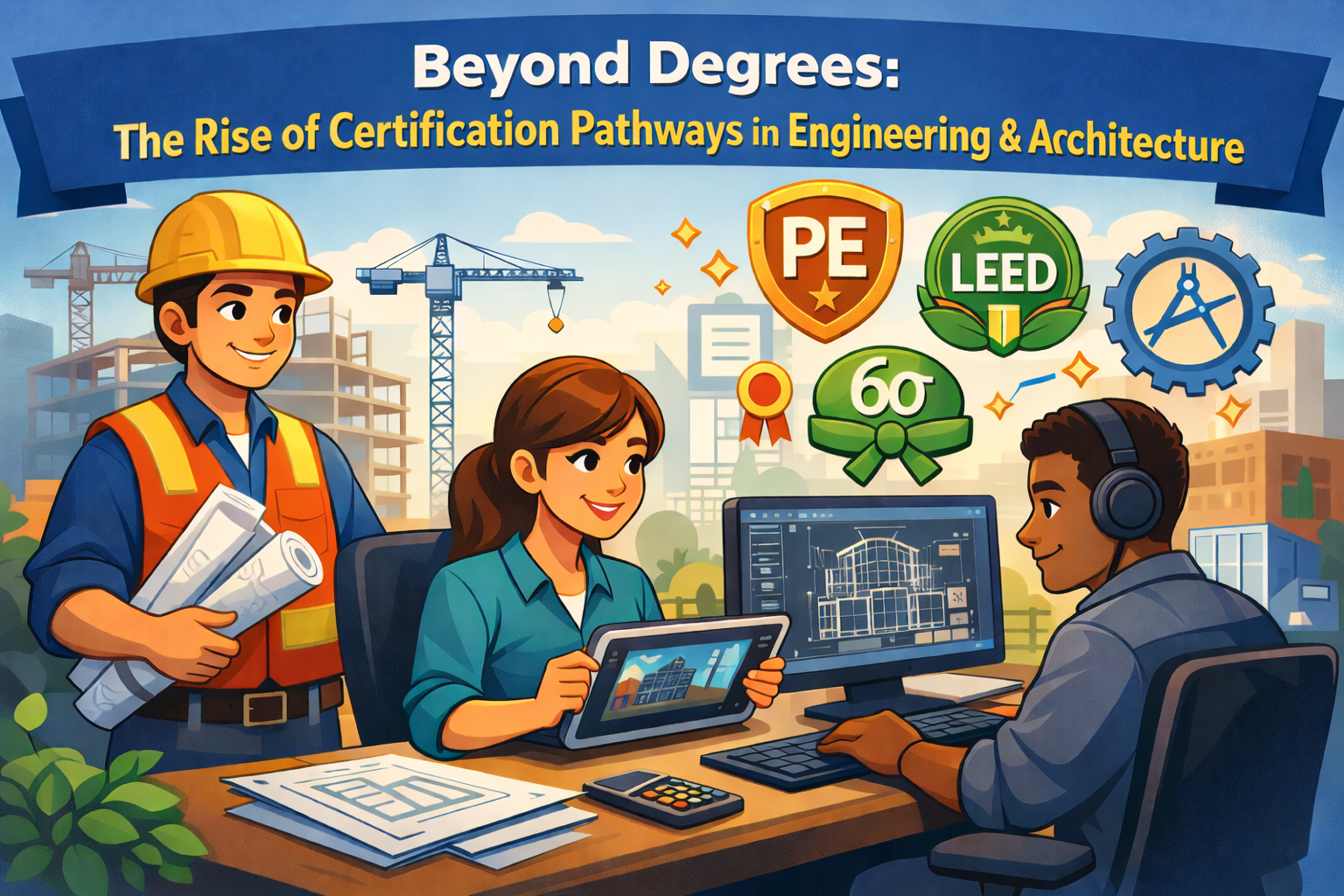
- Professional Engineer (PE) License – Validates advanced competency and is often required for leadership or sign-off authority.
- Certified Manufacturing Engineer (CMfgE) – Demonstrates expertise in modern manufacturing processes and systems.
- Certified Systems Engineering Professional (CSEP) – Focuses on systems design, integration, and lifecycle management.
- Six Sigma Green Belt / Black Belt – Validates process improvement and operational efficiency skills.
- Autodesk, SolidWorks, and Revit Certifications – Confirm proficiency in industry-standard engineering and design software.
- CompTIA and Network Certifications (for engineering roles tied to automation, controls, or infrastructure).
These credentials offer targeted validation that employers can immediately recognize — often making the difference in hiring and promotion decisions.
Challenges and Considerations
While certification pathways provide agility and relevance, they work best when used strategically:
- Not All Certifications Carry Equal Weight: Industry recognition matters.
- Blended Models Deliver the Best Results: Degrees, certifications, and hands-on experience are strongest when combined.
- Ongoing Learning Is Essential: As technology evolves, credentials must be updated to stay relevant.
Conclusion: Redefining Professional Preparation
The rise of certification pathways in engineering and architecture signals a shift toward skills-driven workforce development. These credentials are not replacing degrees outright — they are enhancing them, filling practical gaps, and aligning education with real-world demand.
Just as trade education has proven for generations, validated skills, applied knowledge, and continuous learning are the foundation of long-term career success.
Key Takeaways
- Degrees alone no longer guarantee job readiness in technical fields
- Certifications validate practical, in-demand skills
- Engineering and architecture are adopting models long used in trade education
- The future belongs to blended pathways that combine education, credentials, and experience