
If you’ve been applying to jobs and hearing nothing back, you’re not alone.
Millions of qualified professionals struggle to land interviews every year, despite having the right education, experience, and skills. In most cases, the issue isn’t the candidate—it’s the resume.
Recruiters consistently point to one critical mistake that causes resumes to fail almost instantly.
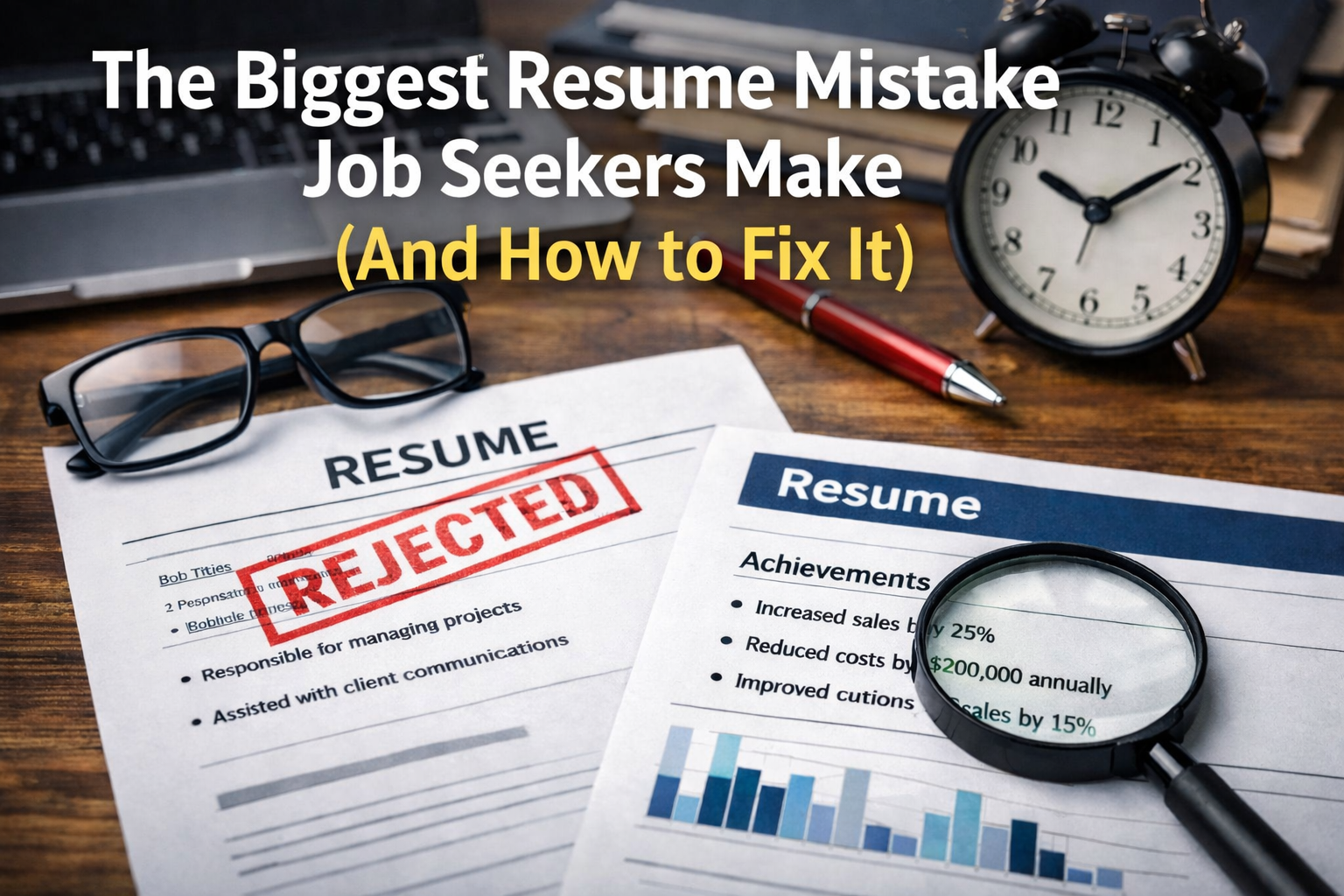
The biggest resume mistake people make is focusing on job duties instead of results.
This mistake prevents resumes from standing out, weakens performance in applicant tracking systems (ATS), and fails to communicate real value to employers.
The #1 Resume Mistake: Listing Responsibilities Instead of Achievements
Most resumes read like internal job descriptions.
They focus on what the candidate was “responsible for” rather than what they actually accomplished.
Examples like these are extremely common:
“Responsible for managing projects”
“Worked closely with team members”
“Handled customer service tasks”
While these statements may be accurate, they don’t answer the most important question every hiring manager has:
What did this person actually achieve, and how will that help my company?
According to Harvard Business Review, recruiters spend an average of 6–8 seconds reviewing a resume before deciding whether to continue reading.
If your resume doesn’t clearly show impact within those few seconds, it’s usually skipped.
Why This Resume Mistake Is So Costly
It Makes Your Resume Easy to Ignore
Most candidates applying for the same role had similar responsibilities.
If your resume only lists duties, it looks exactly like everyone else’s.
Achievements are what separate top candidates from the rest of the applicant pool.
It Hurts Applicant Tracking System (ATS) Performance
Modern hiring processes rely heavily on ATS software.
These systems scan resumes for:
Measurable results
Role-specific keywords
Performance indicators
Resumes filled with vague responsibilities often fail to rank high enough to reach a human reviewer.
It Forces Recruiters to Do Extra Work
Hiring managers review hundreds of resumes.
If they have to guess what your impact was, they won’t.
They’ll simply move on to the next applicant who clearly shows value.
How to Fix the Biggest Resume Mistake
1. Switch to the “Action + Result” Approach
Every resume bullet point should include two things:
What you did
What changed because you did it
This instantly transforms weak descriptions into strong selling points.
Before:
Managed a recruiting team.
After:
Led a team of 5 recruiters, reducing time-to-fill by 30% within one year.
The second version clearly communicates value.
2. Add Numbers and Metrics Wherever Possible
Numbers create credibility.
They make your contributions tangible and easy to understand.
Strong examples include:
Increased sales by 18% year over year
Reduced operational costs by $120,000 annually
Improved customer satisfaction scores by 25%
Even estimated numbers are better than none.
3. Tailor Your Resume for Every Job
One-size-fits-all resumes rarely perform well.
Instead, take time to:
Match keywords from the job description
Highlight achievements relevant to that role
Reorder bullet points so the strongest results appear first
This significantly improves both ATS performance and recruiter engagement.
Key Resume Takeaways for Job Seekers
Your resume is not a biography. It is a marketing document. Employers want to see proof that you can deliver results, solve problems, and create value.
When you focus on achievements instead of responsibilities, your resume becomes significantly more competitive.
FAQ: Resume Optimization
How long should a resume be?
One page for early-career professionals. Two pages for experienced candidates.
Do resumes really need metrics?
Yes. Numbers instantly make your accomplishments clearer and more convincing.
Should I customize my resume for every job application?
Absolutely. Tailored resumes consistently outperform generic ones.