
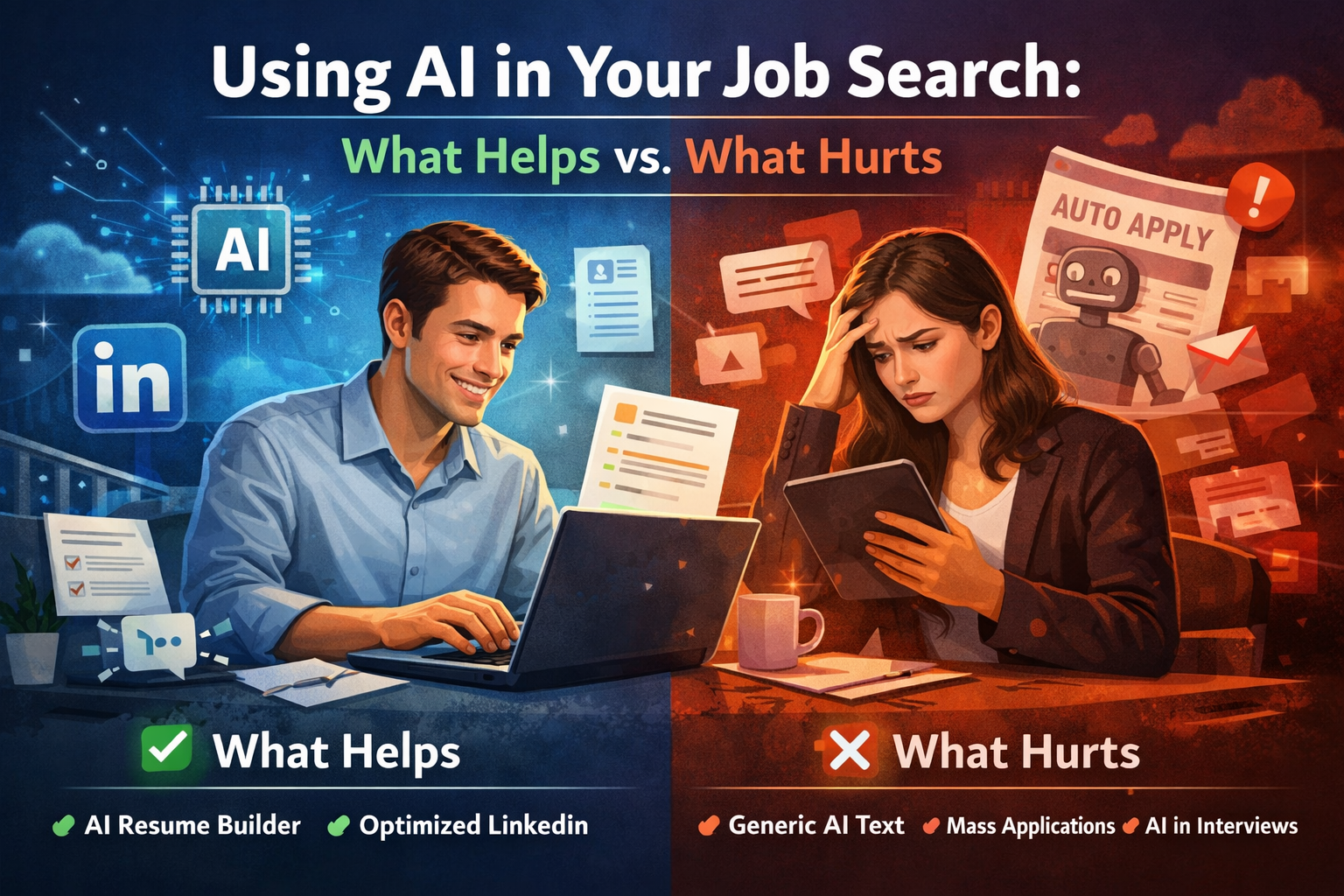
By 2026, AI is no longer a competitive advantage in the job search — it’s the baseline. Recruiters assume candidates are using AI tools to write resumes, optimize LinkedIn profiles, and prepare for interviews. The problem isn’t whether people are using AI. It’s how they’re using it.
Hiring managers are seeing a growing number of applications that look polished on the surface but fall apart under closer inspection. Generic phrasing, inflated skills, and mismatches between resumes and real experience are now some of the fastest ways to get rejected. AI can absolutely help you get hired — but used incorrectly, it can quietly sabotage your chances.
This guide breaks down where AI genuinely improves your job search and where it actively hurts you, based on how hiring teams are evaluating candidates right now.
Where AI Actually Helps Your Job Search
1. AI as a Resume Drafting and Optimization Tool
AI excels at turning rough input into structured output. For resumes, this means it can quickly convert scattered experience into clean bullet points, identify missing skills based on a job description, and help format content in a way that works with Applicant Tracking Systems (ATS).
In 2026, ATS software is more advanced, but keyword matching still matters. AI tools can scan job postings and highlight the language employers are using repeatedly — skills, tools, certifications, and even soft skills — so your resume isn’t filtered out before a human ever sees it.
Where candidates see the most value is speed. Instead of rewriting a resume from scratch for every role, AI lets you generate a tailored draft in minutes. That time savings allows you to apply more thoughtfully and consistently.
The key advantage: AI helps you get past the gatekeepers, not win the job on its own.
2. Using AI to Strengthen Your LinkedIn Presence
LinkedIn has effectively become your second resume, and in many cases, it’s the first place recruiters check. AI tools are particularly effective at improving LinkedIn headlines, summaries, and experience descriptions because they understand how LinkedIn’s search algorithm works.
AI can suggest stronger headlines that balance clarity and keywords, rewrite summaries to sound more confident without being exaggerated, and reorganize experience sections to emphasize impact rather than task lists. This matters because recruiters often skim profiles in seconds.
AI can also help you stay active on LinkedIn — generating post ideas, polishing comments, or helping you articulate career updates in a professional but human tone. In a crowded market, visibility matters, and AI can help you maintain it without burning hours each week.
3. Interview Preparation Is One of AI’s Strongest Use Cases
Interview prep is where AI consistently delivers real value. Mock interview tools can generate realistic behavioral and technical questions based on your role, seniority, and industry. They help you structure answers using proven frameworks and identify gaps in your responses.
More importantly, AI helps candidates practice out loud. Many job seekers struggle not because they lack experience, but because they haven’t practiced explaining it clearly. AI can help refine your storytelling, tighten rambling answers, and reduce filler language.
By 2026, recruiters expect candidates to communicate clearly and concisely. AI doesn’t replace preparation — it accelerates it.
4. Smarter Job Discovery and Search Organization
AI-powered job platforms now go beyond keyword matching. They analyze your experience, preferences, and past applications to recommend roles that actually fit your background. This reduces wasted applications and improves response rates.
AI tools also help with organization — tracking applications, follow-ups, deadlines, and recruiter interactions. For job seekers managing dozens of applications, this administrative support can prevent missed opportunities and burnout.
Where AI Starts to Hurt Your Chances
1. Over-Reliance Creates Generic Candidates
One of the biggest mistakes candidates make is letting AI do all the writing. Fully AI-generated resumes and cover letters often sound polished but empty. Recruiters can spot them quickly because they rely on vague accomplishments, buzzwords, and safe language.
When every candidate uses similar prompts, the output starts to look the same. That sameness works against you. Hiring managers aren’t just scanning for skills — they’re looking for clarity, specificity, and evidence of real experience.
If your resume could belong to anyone with your job title, it’s not doing its job.
2. Automation Without Strategy Backfires
Mass-applying to hundreds of roles using AI-generated materials might feel productive, but it often produces the opposite result. Recruiters are increasingly filtering out candidates whose experience doesn’t clearly align with the role — regardless of how polished the resume looks.
Automated applications also reduce your ability to customize messaging, highlight relevant projects, or explain transitions. In 2026, targeted applications consistently outperform volume-based approaches.
AI should help you apply better, not just faster.
3. Using AI During Live Interviews Is a Major Risk
Some candidates attempt to use AI tools during virtual interviews — reading generated responses or relying on real-time prompts. This is risky and increasingly easy for interviewers to detect.
The problem isn’t ethics alone — it’s coherence. Candidates who rely too heavily on AI often struggle when asked follow-up questions, real-world scenarios, or clarifications. The disconnect between polished answers and genuine understanding raises immediate red flags.
AI is a rehearsal partner, not a teleprompter.
4. Blind Trust in AI Can Introduce Errors and Bias
AI tools can misunderstand context, exaggerate skills, or misrepresent timelines. They can also reinforce biased language or assumptions if not carefully reviewed. Candidates who don’t double-check AI output risk submitting inaccurate or misleading information — something recruiters take seriously.
Inconsistent details between resumes, LinkedIn profiles, and interviews are one of the fastest ways to lose credibility.
Q&A: Using AI in Your Job Search (2026)
Q: Is it okay to use AI when applying for jobs?
Yes. In 2026, using AI in your job search is widely accepted and expected. Recruiters assume candidates are using AI to draft resumes, optimize LinkedIn profiles, and prepare for interviews. The issue isn’t usage — it’s misuse. AI should support your work, not replace your judgment or honesty.
Q: Can recruiters tell if I used AI on my resume?
Often, yes — especially when resumes sound generic, overly polished, or disconnected from real experience. Recruiters are less concerned about whether you used AI and more concerned about whether the content accurately reflects your background. Edited, personalized AI-assisted resumes are rarely a problem.
Q: What’s the best way to use AI for resume writing?
The most effective approach is to use AI for structure and optimization, then customize the content yourself. AI works well for drafting bullet points, identifying missing keywords, and improving formatting for ATS systems. You should always revise the final version to add specificity, metrics, and your own voice.
Q: Should I use AI to write my cover letters?
AI can help generate a strong first draft, but cover letters should never be fully automated. Hiring managers can spot generic letters quickly. The best results come from using AI to outline key points, then tailoring the letter to the company, role, and your personal motivations.
Q: Is it risky to use AI during interviews?
Yes. Using AI live during an interview — such as reading responses or relying on real-time prompts — can easily backfire. Interviewers notice when answers sound rehearsed or when candidates can’t expand on what they’ve said. AI is best used for practice and preparation, not as an interview crutch.
Q: Can AI help with interview preparation?
Absolutely. AI is one of the strongest tools for interview prep. It can simulate realistic questions, help structure responses, and identify weak points in your answers. Practicing with AI improves clarity and confidence — as long as you deliver responses naturally during the real interview.
Q: Does using AI increase my chances of getting hired?
Used correctly, yes. AI can help you apply more strategically, tailor materials more efficiently, and communicate more clearly. Used incorrectly, it can hurt your chances by making you sound generic or inconsistent. The outcome depends entirely on how thoughtfully you use the tool.
Q: Should I disclose that I used AI in my job application?
In most cases, disclosure isn’t necessary. AI is now a standard productivity tool, similar to spellcheck or grammar software. However, you should never claim AI-generated work or skills that you don’t actually possess. Transparency matters if you’re directly asked.
Q: What’s the biggest AI mistake job seekers make?
The biggest mistake is treating AI as a replacement instead of an assistant. Candidates who rely on AI without editing, verifying, or personalizing their materials often come across as indistinguishable or inauthentic. AI should amplify your experience — not invent it.
Q: How can I make sure my AI-assisted application still feels human?
Add specifics. Include real projects, measurable outcomes, and personal context. Read everything out loud before submitting — if it doesn’t sound like something you’d actually say, revise it. Human judgment is what turns AI output into a strong application.
Q: Will AI eventually replace human hiring decisions?
Unlikely. While AI plays a larger role in screening and matching, final hiring decisions still rely heavily on human judgment, communication skills, and cultural fit. In fact, as automation increases, authentic human interaction is becoming more valuable, not less.