
Introduction: A City That Suddenly Stops Moving
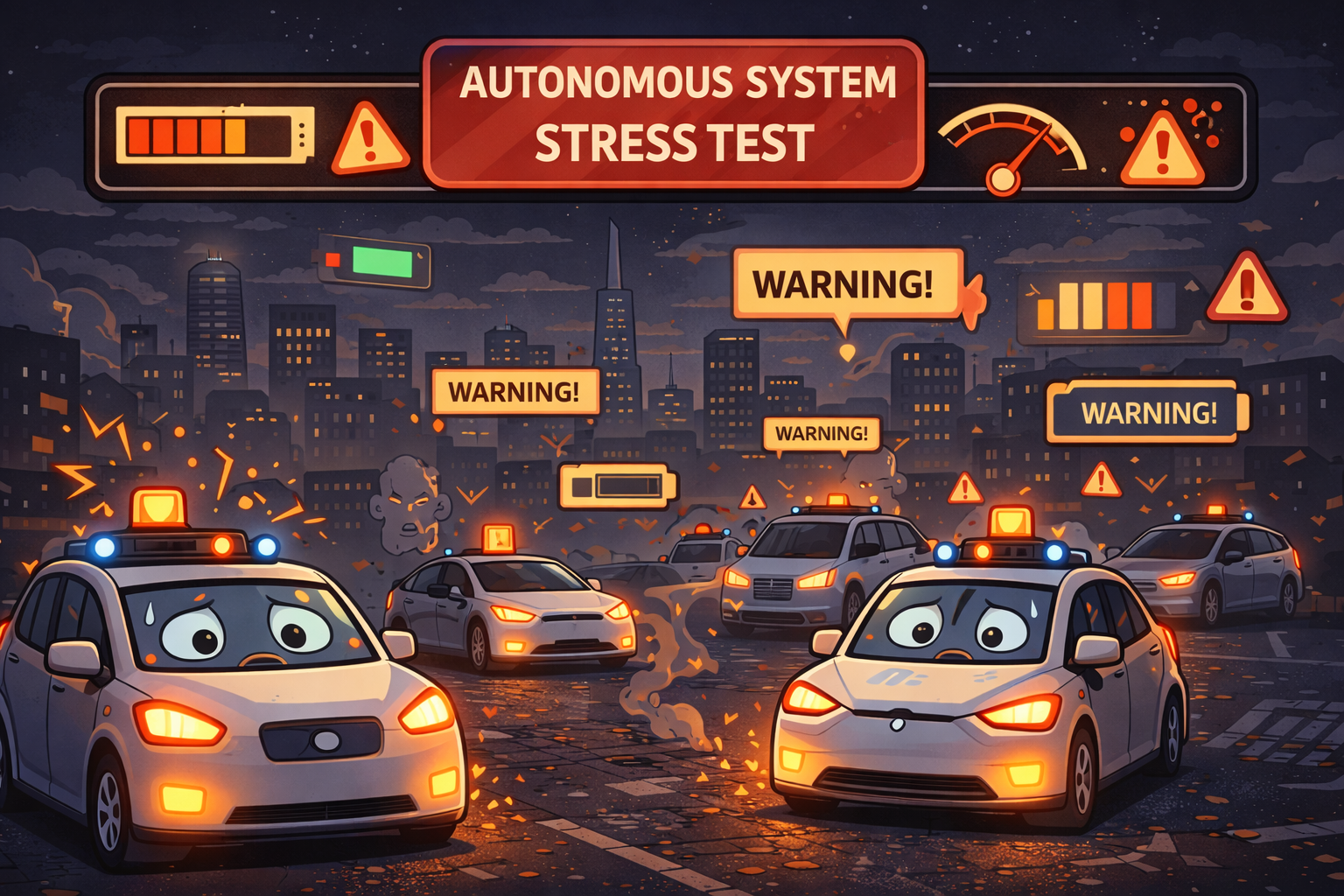
Picture San Francisco during peak traffic: busy intersections, tourists, commuters—and then silence. Traffic lights fail. Autonomous taxis slow down, cluster together, and stop.
While San Francisco has not experienced a single, total robotaxi blackout, multiple real-world incidents involving Waymo and Cruise exposed how fragile autonomous systems can be when power, connectivity, or software reliability is compromised. These moments offered a preview of a future where AI-driven transportation could stall entire cities if resilience isn’t prioritized.
As robotaxis expand and Tesla prepares its own autonomous ride-hailing ambitions, these failures are no longer edge cases—they’re stress tests for the future of urban mobility.
Why Autonomous Taxis Fail During Disruptions
Despite the name, autonomous taxis are not fully independent machines. They rely on:
- Cameras, lidar, and radar sensors
- GPS and high-definition maps
- Cloud connectivity and remote human assistance
- Functional traffic signals and road infrastructure
When power outages or system glitches occur, autonomous vehicles default to maximum safety behavior, often meaning they stop completely. In San Francisco, this has led to robotaxis blocking intersections, confusing emergency responders, and creating traffic bottlenecks.
For passengers, the risk isn’t usually physical harm—but loss of mobility, unpredictability, and erosion of trust.
Real-World Robotaxi Failures and Malfunctions
Waymo: Scale Meets Edge Cases
Waymo operates one of the largest autonomous taxi fleets in the U.S., yet even it has faced:
- Vehicles stalling at dark or malfunctioning intersections
- Robotaxis stopping mid-route while awaiting remote assistance
- Passengers delayed or trapped during software confusion events
These incidents demonstrate how even mature systems struggle during rare but inevitable failures.
Cruise: From Expansion to Exit
Cruise’s rapid expansion in San Francisco came with repeated operational problems:
- Vehicles blocking streets and emergency access
- Loss of communication requiring manual intervention
- A high-profile pedestrian injury incident that triggered regulatory suspension
Cruise’s eventual shutdown underscores how technical failure combined with regulatory distrust can end an entire autonomous program.
Tesla Robotaxi: High Ambition, Early Warning Signs
Tesla’s upcoming robotaxi strategy promises massive scale—but early testing revealed:
- Erratic braking and lane selection
- Difficulty navigating complex urban environments
- Higher-than-expected incident rates during supervised autonomy
Tesla’s approach—software-first, camera-heavy, fast deployment—contrasts sharply with Waymo’s slower, more conservative model.
Lessons for Future Robotaxi Technology
San Francisco’s experiences highlight one overriding truth: autonomy without resilience is fragile.
Future robotaxi systems must prioritize:
- Offline driving capability when cloud connectivity fails
- Stronger edge AI decision-making
- Graceful degradation instead of full system stoppage
- Faster human override and emergency response integration
These lessons apply not just to taxis, but to delivery robots, drones, and smart-city infrastructure.
Competition Implications: Reliability Is the New Advantage
The robotaxi race is no longer just about AI sophistication—it’s about who fails best.
- Companies that can operate safely during outages will gain regulatory favor
- Cities will demand proof of blackout and emergency readiness
- Smaller startups may struggle with compliance costs and redundancy requirements
In this environment, conservative deployment may outperform aggressive scaling.
Broader Societal Impact: Trust and Urban Readiness
Each robotaxi malfunction feeds public skepticism. Cities now face tough questions:
- How dependent should urban life be on AI systems?
- Who is accountable when autonomous mobility fails?
- Should cities require backup power or manual override infrastructure?
Without clear answers, public trust could slow adoption—even if the technology improves.
Worst-Case Scenario: A Full Autonomous Shutdown
In a future city where a large share of rides are autonomous, a prolonged outage could:
- Immobilize thousands of vehicles
- Delay emergency services
- Disrupt commerce and commuting
- Trigger backlash against AI transportation
The risk isn’t just technical—it’s systemic.
Conclusion: The Future Depends on Planning for Failure
San Francisco’s robotaxi disruptions weren’t just glitches—they were warnings.
Waymo, Cruise, Tesla, and future robotaxi operators face a shared challenge: design systems that assume failure will happen. The companies and cities that plan for outages, malfunctions, and edge cases today will define tomorrow’s transportation ecosystem.
Autonomous mobility will shape the future—but only if resilience becomes as important as innovation.