
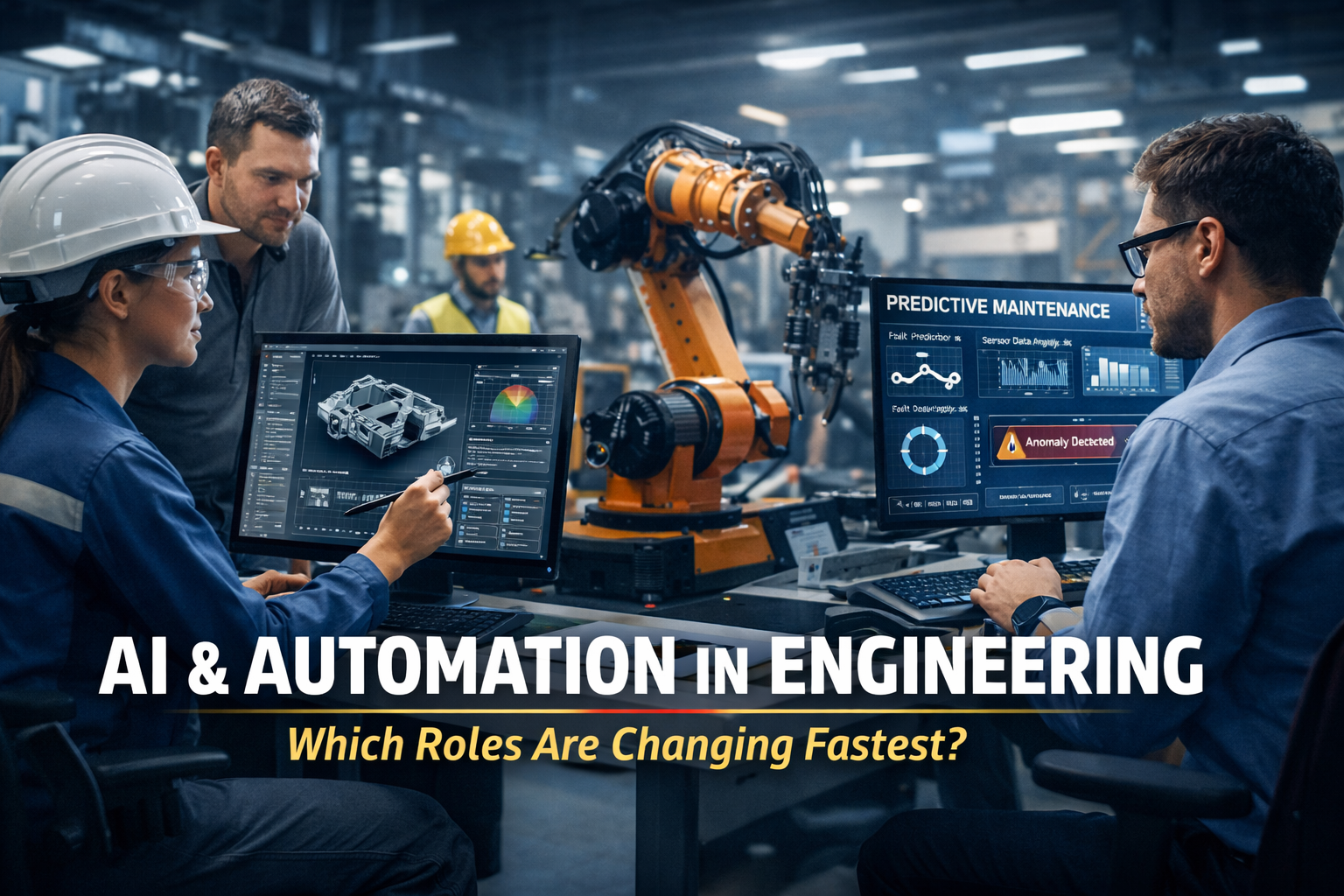
Artificial intelligence and automation are no longer future concepts in engineering—they are already reshaping day-to-day work. But despite bold headlines, AI is not replacing engineers en masse. Instead, it’s quietly changing how engineering jobs function, which roles are evolving fastest, and which skills are becoming non-negotiable.
This article cuts through the hype to focus on practical, real-world changes engineers are experiencing today—and what it means for careers in 2025 and beyond.
Engineering Roles Changing Fastest Due to AI & Automation
1. Design & Simulation Engineers
AI has rapidly transformed how designs are created, tested, and refined.
What’s changing
Generative design tools propose multiple design options automatically
AI accelerates finite element analysis (FEA) and simulation workflows
Iteration cycles that once took weeks now take days or hours
What engineers now do
Define constraints and requirements
Validate AI-generated outputs
Focus on tradeoffs, safety, and real-world feasibility
Why this role is changing fast:
Design and simulation were already digital—AI simply automated the most repetitive steps.
2. Manufacturing & Automation Engineers
Factories are one of the earliest and most practical adopters of AI.
What’s changing
Robotics with AI vision handle inspection, assembly, and material handling
Smart manufacturing systems adjust processes in real time
Fewer manual interventions on production lines
What engineers now do
Integrate robotics and automation systems
Optimize workflows using production data
Troubleshoot edge cases AI can’t handle
Fastest growth areas
Robotics integration engineers
Smart factory / Industry 4.0 specialists
3. Predictive Maintenance & Reliability Engineers
Maintenance engineering has shifted from reactive to predictive.
What’s changing
Sensors and machine-learning models predict equipment failures
Maintenance schedules are driven by data, not calendars
Downtime and safety incidents are reduced
What engineers now do
Interpret predictive analytics outputs
Validate anomalies flagged by AI
Design reliability strategies based on trends
This role has evolved quickly because AI excels at pattern detection in sensor data.
4. Software & Embedded Systems Engineers
AI hasn’t replaced coding—but it has changed how code is written.
What’s changing
AI tools generate boilerplate code and tests
Debugging and optimization are increasingly automated
Faster prototyping and iteration
What engineers now do
Review, refine, and secure AI-generated code
Focus on system architecture and performance
Handle safety-critical and edge-case logic
Key shift: Engineers are becoming code reviewers and system designers, not just code writers.
Engineering Tasks AI Is Replacing (Not Jobs)
AI is eliminating specific tasks, not entire roles.
Most automated tasks
Routine calculations and reports
Repetitive CAD updates
Basic data analysis
Visual inspection and quality checks
Tasks still requiring engineers
Engineering judgment and accountability
Safety validation and compliance
Creative problem-solving
Cross-disciplinary communication
This distinction explains why engineering employment remains strong—even as workflows change.
New Engineering Roles Created by AI & Automation
AI isn’t just transforming old jobs—it’s creating new ones.
Digital Twin Engineer – builds virtual models of physical systems
AI/ML Engineer (Engineering Domain) – applies ML to engineering problems
Robotics Integration Engineer – connects robots with production systems
Industrial IoT Engineer – designs sensor networks for smart facilities
AI Safety & Compliance Engineer – ensures responsible AI deployment
These roles exist because companies need engineers who understand both AI and real-world systems.
Skills Engineers Need to Stay Relevant
Engineers adapting fastest tend to focus on:
AI and machine-learning fundamentals
Data literacy and analytics
Automation and control systems
Cloud and edge computing
Human-AI collaboration
The winning formula: deep engineering expertise + AI fluency.
The Bottom Line: Practical Reality, Not Sci-Fi
AI and automation are:
Accelerating engineering work
Reducing repetitive tasks
Raising expectations for technical judgment
They are not eliminating engineers—but they are redefining what it means to be one.
Engineers who adapt will find more leverage, faster workflows, and broader impact. Those who don’t risk being left behind—not by AI itself, but by peers who use it effectively.
FAQ
Is AI replacing engineers?
No. AI automates tasks, not engineering responsibility or decision-making.
Which engineering fields are most affected?
Manufacturing, software, design, and maintenance engineering are seeing the fastest change.
Do engineers need to learn coding or AI?
Basic AI literacy and data skills are increasingly expected, even outside software roles.