
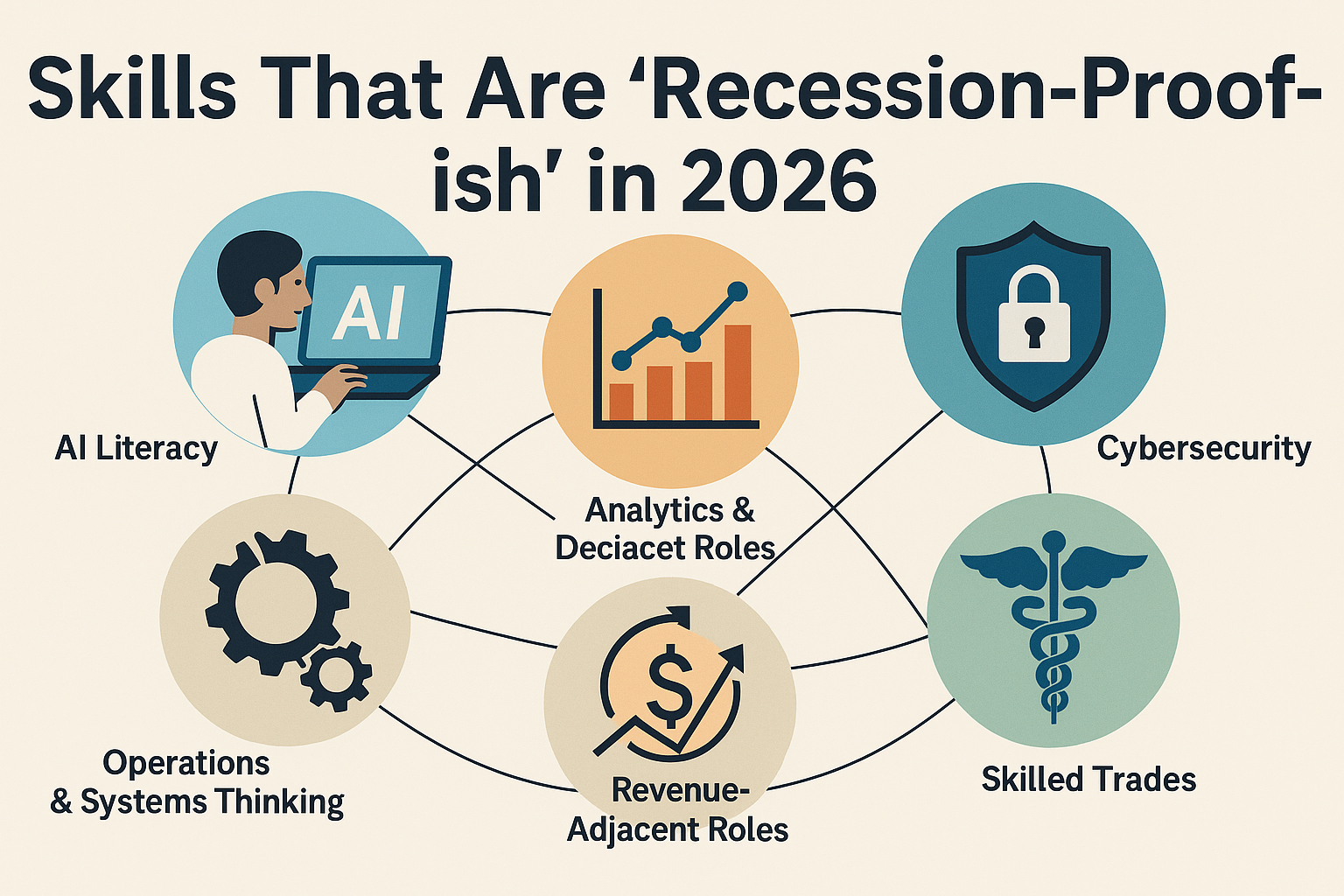
In an economy where headlines swing between optimism and uncertainty, one truth remains consistent: some skills hold their value even when markets shake. As we look toward 2026, a mix of technological acceleration, demographic pressures, talent shortages, and shifting business models are shaping which capabilities will stay resilient—or at least recession-resistant-ish. This isn’t doom and gloom. It’s simply where investment, hiring, and organizational priorities continue to flow. Across industries, leaders increasingly prioritize skills that reduce operational risk, drive revenue efficiency, or enable teams to work smarter with emerging technology. Those patterns tend to hold steady regardless of market cycles.
AI Literacy: The New Baseline Competency
AI isn’t replacing every job—but roles that use AI are outpacing those that don’t. AI literacy isn’t about becoming a machine-learning engineer. It’s the ability to prompt well, automate workflows, evaluate model outputs, and integrate AI tools into everyday problem-solving. As companies lean into efficiency and augmented performance, those who understand AI’s strengths and limitations will remain indispensable. Increasingly, AI knowledge mirrors the rise of computer literacy in the 1990s: a differentiator now, an expectation later.
Analytics & Data Fluency
Data-driven decision-making becomes even more critical during economic slowdowns. Organizations scrutinize budgets, evaluate ROI, pinpoint inefficiencies, and streamline operations—all of which rely on analytics. Skills in data visualization, basic statistics, KPI tracking, and dashboarding translate across industries, giving professionals versatility when job markets tighten. Even non-technical roles benefit: managers who can read a dashboard or interpret trends often outperform those who rely solely on intuition.
Revenue-Adjacent Roles: Anything That Makes or Protects Money
Jobs directly tied to revenue generation or revenue protection historically show strong stability. During downturns, companies prioritize activities that support customer retention, predictable revenue, and operational efficiency. Sales operations, marketing analytics, customer success, pricing strategy, and retention-focused roles often stay funded even through budget cuts. Companies may trim non-essential initiatives or experimental projects, but they rarely cut the roles responsible for keeping customers—and cash flow—alive. These roles also evolve quickly, incorporating more automation, data tools, and AI-driven personalization.
Operations & Systems Thinking
Operations is the backbone of any business, especially during lean times. Professionals who understand process optimization, workflow design, SOP creation, resource planning, or cross-functional coordination often become the “glue” organizations can’t run without. As AI begins automating repetitive tasks, human operators who think holistically about systems grow even more valuable. They identify bottlenecks, translate business needs into processes, and create stability when everything else feels unpredictable. Operational excellence is one of the clearest predictors of organizational resilience.
Cybersecurity: Risk Never Takes a Recession
Cyber threats don’t decline when budgets tighten—they increase. Companies facing financial pressure become more vulnerable, making cyber talent essential. Roles in threat detection, cloud security, identity management, penetration testing, governance, and compliance remain high-priority because the cost of not hiring cybersecurity experts is far greater than the salary line item. As more organizations adopt cloud infrastructure and AI tools, the attack surface grows—along with demand for the people who can protect it.
Healthcare: Aging Populations Drive Demand
Healthcare remains one of the most resilient sectors globally. Aging populations, chronic illness trends, and post-pandemic patient backlogs continue to drive hiring, regardless of economic cycles. From nursing to medical technicians to mental health professions, demographic forces—not market conditions—shape demand. Even adjacent roles such as healthcare administration, telehealth coordination, patient operations, and medical billing see stronger-than-average stability. Technology may streamline certain tasks, but human care and oversight remain central.
Skilled Trades: Physical Work That AI & Automation Can’t Replace Easily
Electricians, HVAC technicians, plumbers, welders, machinists, auto technicians—these roles remain in chronically short supply. Infrastructure investments, renewable energy projects, the electrification of buildings and vehicles, and an aging skilled-trades workforce make these jobs among the most future-proof in the economy. Many of these fields also offer strong wages, apprenticeships instead of degrees, and demand that spikes during construction booms and persists during downturns. These roles don’t just survive recessions; they often thrive due to backlog and essential-service status.
The most “recession-proof-ish” skills for 2026 aren’t hype—they align with long-term economic, technological, and demographic trends. If your capabilities tie to AI, data, revenue, operations, security, healthcare, or skilled trades, you’re positioned on the stable side of the job market. The common thread? These skills either help organizations operate more efficiently, reduce risk, meet essential human needs, or adapt to technological change—all priorities that persist no matter what the business cycle looks like.
FAQ
Q: Are any jobs truly recession-proof?
A: No—economic cycles affect everyone to some extent. However, certain skills consistently retain demand regardless of downturns because they support essential business functions such as revenue generation, operations, care delivery, and risk mitigation. What’s increasingly clear is that skills are more recession-resistant than specific job titles. People who can adapt, learn new tools, and pivot into adjacent responsibilities tend to weather economic shifts better than those locked into narrow roles.
Q: Is AI literacy really necessary for non-tech roles?
Increasingly yes. AI tools are becoming standard across marketing, HR, finance, operations, customer success, and even administrative work. You don’t need to code—but you do need to understand how to:
- Prompt AI tools effectively
- Evaluate whether AI-generated outputs are accurate
- Automate repetitive tasks
- Integrate AI into existing workflows
- Communicate how AI impacts team processes
In many organizations, AI literacy is quickly becoming as fundamental as Excel was in the 2000s—a baseline skill employers expect, not a bonus.
Q: What if I want to future-proof my career but don’t know where to start?
A: The best first step is skill stacking—pairing complementary capabilities that boost your versatility. For example:
- Analytics + AI tools → stronger decision-making and efficiency
- Customer operations + workflow automation → higher-value support roles
- Project management + data literacy → more effective cross-functional leadership
- Technical knowledge + communication skills → roles that bridge teams
Start small: take a short course, practice with real tools, and look for opportunities within your current job to apply what you’re learning. Employers value people who take initiative to upskill on their own.
Q: How quickly do these “recession-resistant” skills pay off?
A: Much faster than traditional degree programs. Many AI, analytics, and operations skills can be learned to a job-ready level in 3–6 months, sometimes less. Skilled trades often offer paid apprenticeships. Cybersecurity, while more technical, has “gateway” roles like support, help desk, or governance that allow you to build experience while continuing your education.
Q: Do these skills guarantee job security?
A: No skill can fully eliminate risk—but the right mix can significantly decrease it. The goal isn’t immunity, it’s resilience: the ability to pivot roles, industries, or responsibilities without starting from zero. Workers who combine technical fluency, adaptability, and problem-solving see far more stable career trajectories over time.