
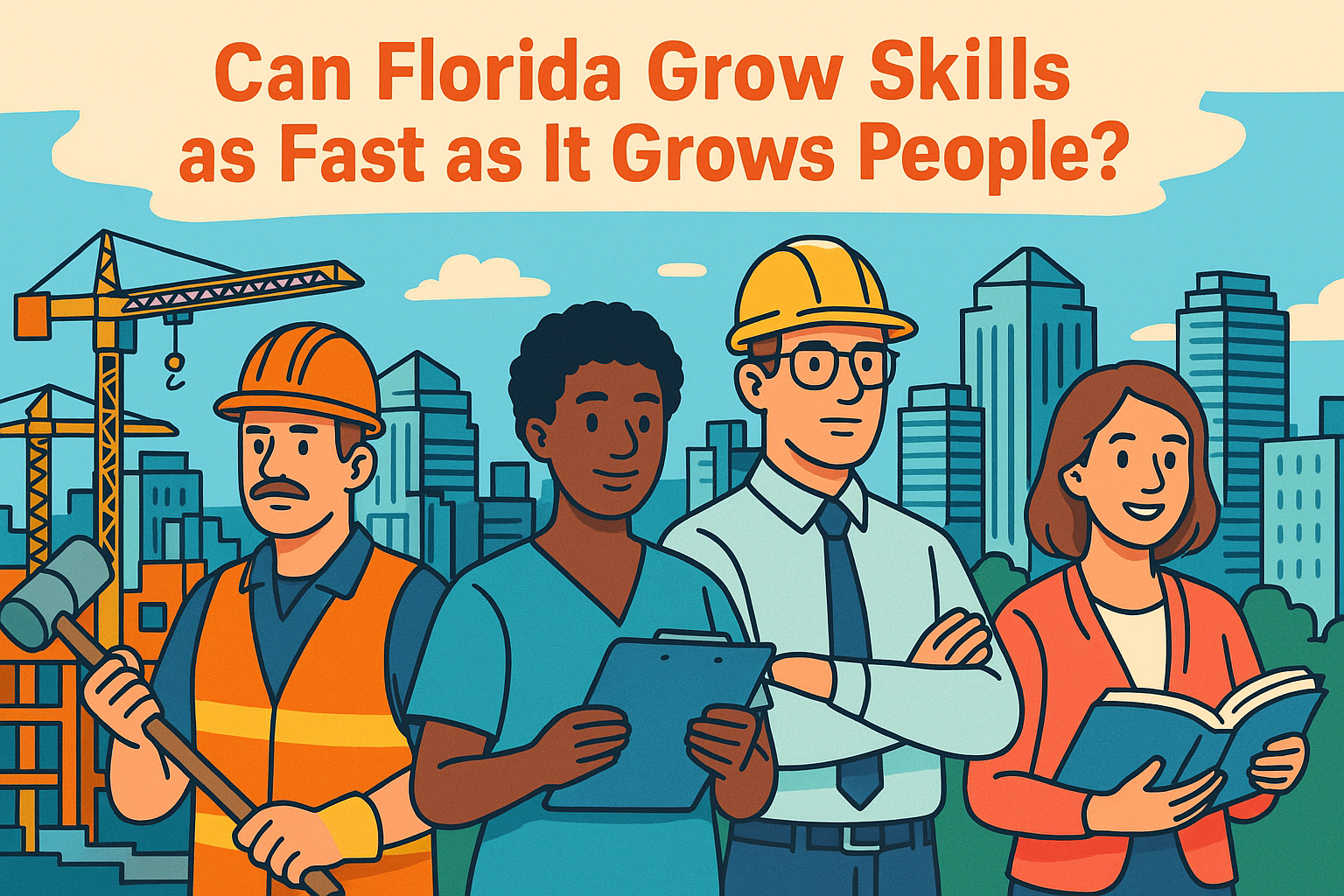
Florida is booming—again. New residents arrive daily, corporate relocations continue at a brisk pace, and the state’s construction cranes have become a permanent part of the skyline. But behind the headlines is a deeper question that will determine whether Florida’s growth surge is sustainable: is the state producing, attracting, and retaining skilled workers fast enough to match its explosive economic and population expansion?
From construction to healthcare, engineering, and education, the answer is increasingly complicated. Labor demand remains red-hot, but the talent pipeline is strained. And while wages are rising, they’re not doing so evenly, creating friction across essential professions.
Florida’s long-term competitiveness may depend less on how many people it attracts—and more on whether it can build the right workforce to support the economy it’s growing.
Florida’s Relentless Growth Is Outpacing Its Labor Supply
Florida’s appeal remains strong: pro-business policies, lower taxes, expanding transportation hubs, and a lifestyle that draws both retirees and remote professionals. Corporate relocations—ranging from finance to retail to tech—continue to flow in, adding pressure to local labor markets.
Yet even with population growth, the state consistently reports more job openings than hires, indicating that demand continues to outpace supply. Florida’s growing industries rely heavily on skilled labor, and many of those positions require years of training, education, or licensure—pipelines that can’t be expanded overnight.
The mismatch is most visible in critical infrastructure and care sectors.
Construction: Growth at a Pace Training Can't Match
Few states are building like Florida. Mega-developments in Miami, Tampa, Orlando, and Jacksonville are reshaping skylines. Residential demand remains strong, and public infrastructure—from rail projects to road expansions—is surging.
Yet contractors frequently cite worker shortages as their top barrier to completing projects on time. Older skilled tradespeople are retiring faster than new apprentices can replace them, especially in electrical, HVAC, and concrete trades.
Wages in construction have risen significantly in recent years, reflecting both inflation and intense competition for labor. But higher pay alone hasn’t solved the slow-growing pipeline. Without major expansions in apprenticeships, technical education, and workforce partnerships, Florida’s project backlog may lengthen—and construction costs may continue to climb.
Healthcare: Vacancy Rates Are Improving, but Demand Is Relentless
Healthcare tells a nuanced story. Many hospital systems have successfully reduced vacancy and turnover rates through aggressive recruitment and retention efforts. Yet Florida’s demographic reality—an aging population and high in-migration of retirees—keeps pressure on the system.
The state continues to face persistent shortages in nursing, including licensed practical nurses, registered nurses, and specialized clinical roles. Complicating the issue is Florida’s low nursing exam pass rate, which limits the number of graduates who can immediately enter the workforce.
At the same time, physician shortages persist in primary care and rural counties. While universities and medical programs are expanding seats, clinical placement availability and residency slots remain bottlenecks that slow the training pipeline.
Healthcare workers also face rising burnout, retirement waves, and expanding patient loads. Put simply: Florida can train more nurses and doctors—but demand may keep outpacing supply for years to come.
Engineering: A Skills Gap Hidden in Plain Sight
Florida’s growing aerospace, defense, manufacturing, and infrastructure sectors are fueling new demand for engineers. From Orlando’s simulation and defense corridor to the Space Coast’s rocket renaissance, engineering roles are multiplying.
Yet universities report that engineering graduates are absorbed almost immediately—and still not enough to meet employer needs. Many companies rely on out-of-state recruitment or satellite offices elsewhere to fill specialized roles in systems engineering, cybersecurity, advanced manufacturing, and structural engineering.
Corporate relocations, including tech and financial firms, exacerbate competition for these high-skill workers. Without clear pathways—starting from K–12 STEM through university programs—Florida risks losing ground to regions with deeper engineering talent pools.
Teaching: A Profession Struggling to Recover
Teacher shortages have become a fixture of Florida’s labor landscape. Districts report persistent vacancies in math, science, special education, and early childhood education. While the state has increased teacher pay in recent years, salaries still lag behind many similarly sized states, especially when adjusted for rising housing costs.
New hiring pathways and alternative certification programs have helped fill some gaps, but retention remains difficult. Florida’s rapid population growth also means thousands of additional students entering school systems each year, putting further pressure on already thin staffing.
Unless pay competitiveness, training capacity, and working conditions improve, education could become one of the most significant long-term constraints on Florida’s workforce quality.
Corporate Expansion Strategies: Hubs, Satellites, and Hybrid Work
Many companies expanding into Florida no longer rely solely on traditional headquarters models. Instead, they’re deploying distributed talent strategies:
- Satellite offices for engineering, finance, or sales.
- Remote-first hubs to access national labor pools without relocating every worker.
- Hybrid HQs, where leadership sits in Florida but technical teams remain dispersed across the country.
This approach helps companies scale despite local labor shortages, but it also means Florida risks becoming a high-profile address rather than the true engine of corporate talent development.
To convert relocations into durable economic growth, Florida must strengthen its own talent pipelines rather than rely on importing or remotely hiring skilled workers.
Is Florida Scaling Skills Fast Enough?
Not yet—but it can.
The state is making significant efforts: expanding university programs, investing in workforce training, pushing new apprenticeship models, and emphasizing STEM education. Yet these solutions take time, and the pace of population and corporate growth remains faster.
Construction shortages slow project delivery. Healthcare shortages threaten patient access. Engineering shortages challenge innovation and infrastructure. Teaching shortages limit the strength of future talent pipelines.
Whether Florida can sustain its economic rise depends on how quickly it can convert these challenges into long-term workforce capacity.
Florida’s booming economy is generating unprecedented demand for skilled workers. But population growth and corporate relocations are outpacing the state’s ability to train and retain the talent required. Construction, healthcare, engineering, and teaching all show signs of structural—not temporary—shortages. To close the gap, Florida will need deeper investments in education, apprenticeships, and workforce development, as well as stronger retention strategies across essential professions.
FAQ
Is Florida experiencing a labor shortage?
Yes. Across multiple industries, job openings exceed the available number of skilled workers, particularly in construction, healthcare, engineering, and teaching.
Are wages rising fast enough to attract talent?
Wages are increasing, but not evenly. High-skill roles in construction and corporate sectors have grown faster than salaries in teaching or frontline healthcare roles.
Are companies still moving to Florida?
Yes. Corporate relocations remain strong, though many companies use flexible hub-and-spoke models rather than fully relocating large teams.
What sectors face the biggest worker shortages?
Construction trades, nursing and clinical care, engineering fields, and K–12 education remain the most strained.