
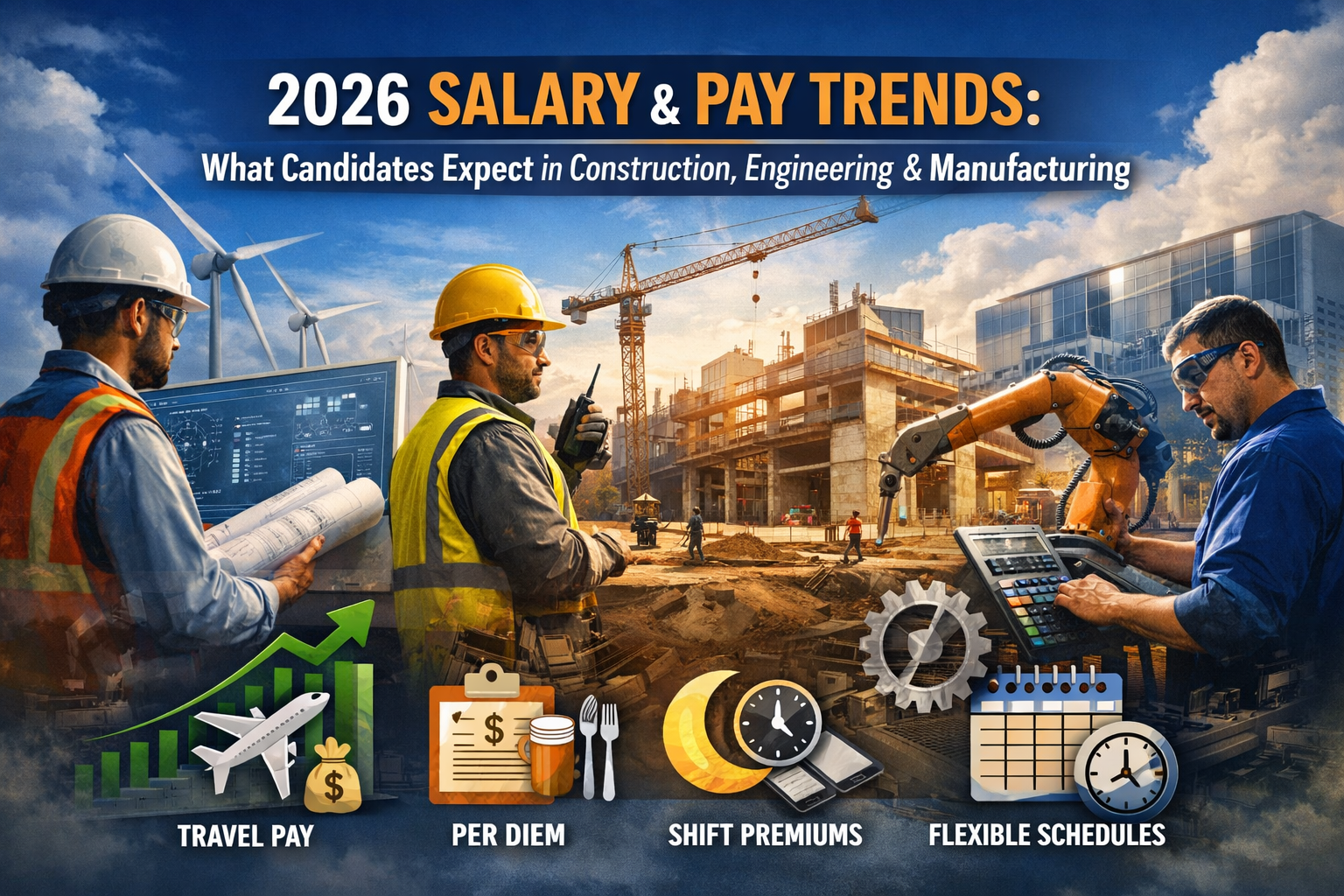
As we move into 2026, salary conversations across construction, engineering, and manufacturing are no longer just about base pay. Candidates are entering negotiations with clear expectations around total compensation, including travel pay, per diem, shift premiums, flexible schedules, and project-based incentives.
While national wage growth is stabilizing after several volatile years, competition for hard-to-fill technical and field roles remains intense. Employers who rely solely on modest annual raises are increasingly losing candidates to competitors offering more creative and flexible pay structures.
The result: companies that understand how compensation expectations differ by discipline — and by scarcity — will win the hiring race in 2026.
Market Snapshot: What’s Driving Pay Decisions in 2026
Across construction, engineering, and manufacturing, several macro trends are shaping candidate expectations:
Moderating base salary growth, with most employers budgeting roughly 3–4% increases — but making exceptions for mission-critical roles
Persistent labor shortages in skilled trades, specialized engineering disciplines, and advanced manufacturing
Project-based and travel-heavy work, increasing demand for per diem, mileage, lodging, and rotation schedules
Candidate fatigue, driving interest in flexible hours, predictable schedules, and burnout-reducing incentives
In this environment, compensation strategy is shifting from across-the-board raises to targeted, role-specific packages.
By Discipline: 2026 Salary & Pay Expectations
Engineering: Specialized Skills Command Premium Packages
Hard-to-Fill Engineering Roles
Civil Engineers (Transportation, Land Development, Water/Wastewater)
Electrical & Power Engineers
Structural Engineers
Project Engineers with multi-site or design-build experience
These roles are increasingly difficult to fill due to retiring talent, long licensing timelines, and growing infrastructure and energy investments.
What Engineering Candidates Expect in 2026
Above-average salary increases for licensed and senior engineers, often exceeding standard corporate budgets
Hybrid or flexible schedules, especially for design-focused roles
Travel pay or stipends for engineers supporting field operations, site visits, or remote projects
Clear advancement paths, including leadership tracks and paid professional development
Candidates are prioritizing employers who recognize that engineering productivity is tied to work-life balance and long-term career planning, not just pay.
Construction: Field Talent Drives Compensation Innovation
Hard-to-Fill Construction Roles
Skilled trades: electricians, welders, pipefitters, carpenters
Heavy equipment operators
Superintendents and experienced project managers
Safety professionals with multi-site experience
Construction hiring remains highly competitive, especially for candidates willing to travel or work extended project schedules.
What Construction Candidates Expect in 2026
Higher hourly rates or prevailing wage alignment, particularly on public or infrastructure projects
Travel pay and per diem that fully cover lodging, meals, and transportation
Shift premiums for night work, weekends, and accelerated project timelines
Guaranteed hours or rotational schedules to reduce burnout
For many field professionals, predictability and fairness in compensation matter as much as headline pay rates.
Manufacturing: Shift Pay and Skill Premiums Take Center Stage
Hard-to-Fill Manufacturing Roles
Maintenance technicians and electricians
Automation, robotics, and controls specialists
Quality engineers and continuous improvement leaders
Production supervisors for off-shift operations
As facilities modernize and automation increases, demand for cross-skilled manufacturing talent continues to outpace supply.
What Manufacturing Candidates Expect in 2026
Shift differentials that meaningfully compensate nights, weekends, and swing shifts
Skill-based pay premiums for certifications, automation experience, or leadership responsibilities
Flexible scheduling models, including compressed workweeks and predictable rotations
Travel reimbursement for multi-plant support or startup assignments
Candidates increasingly evaluate manufacturing employers based on how well compensation reflects operational demands, not just job titles.
Beyond Base Pay: The Compensation Elements That Matter Most
Travel Pay & Per Diem
Once considered optional, travel compensation is now a baseline expectation for candidates supporting remote or multi-site projects. Employers that underfund travel costs risk losing candidates late in the hiring process.
Shift Premiums
Flat or outdated differentials are no longer competitive. Candidates expect transparent, tiered premiums tied to inconvenience, risk, and schedule disruption.
Flexible Scheduling
Even in traditionally rigid industries, flexibility is becoming a differentiator — from hybrid engineering roles to rotating construction schedules and compressed manufacturing shifts.
Bonuses & Incentives
Retention bonuses, project completion incentives, and safety-based rewards are increasingly used to secure hard-to-find talent without permanently inflating base pay.
Key Takeaways for Employers
Competitive hiring in 2026 requires total compensation thinking, not just salary benchmarking
Hard-to-fill roles demand customized pay strategies
Travel pay, per diem, shift premiums, and flexibility are now expected, not optional
Employers who adapt faster will reduce time-to-hire and improve retention
Base pay increases may be stabilizing in 2026, but candidate expectations are not. In construction, engineering, and manufacturing, top talent is prioritizing travel compensation, shift premiums, flexible schedules, and role-specific incentives. Employers who modernize compensation strategies by discipline — especially for hard-to-fill roles — will gain a decisive hiring advantage.
FAQ
Are salary expectations higher in 2026 than 2025?
Overall increases are modest, but expectations are significantly higher for specialized and hard-to-fill roles.
Is travel pay becoming standard?
Yes. Candidates increasingly expect full travel reimbursement or per diem for remote and multi-site work.
What matters more than base salary?
Flexibility, predictability, and transparency in total compensation packages are often deciding factors.
Sources & References
Addison Group — Engineering Hiring Trends & Workforce Planning Guide (2025–2026)
For Construction Pros — Construction Outlook & Labor Trends
WorldatWork — U.S. Salary Budget Forecasts
Industry compensation benchmarking reports and labor market analyses (2025–2026)