
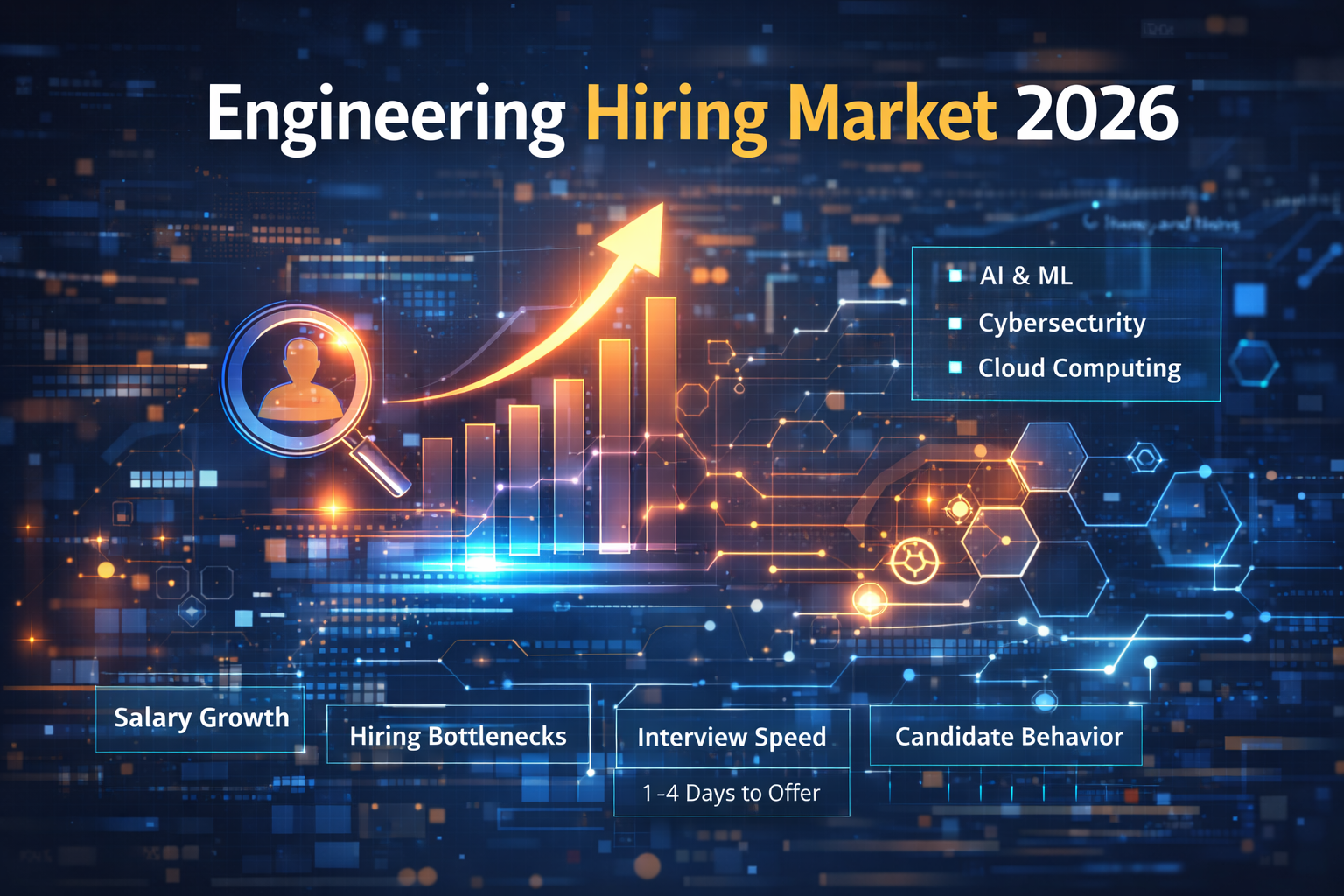
The engineering hiring market in 2026 is no longer defined by boom-and-bust cycles. Instead, it has settled into a more disciplined — and more demanding — environment where specialization, speed, and strategy determine who wins talent.
For employers, this is not simply a recruiting challenge. It’s an operational and competitive one. The companies that adapt their hiring models to current market realities are building stronger teams faster, while those relying on outdated assumptions are quietly falling behind.
This trend and authority-driven overview breaks down what employers need to understand about engineering hiring in 2026 — and why these insights are increasingly being shared internally across leadership, HR, and talent teams.
Salary Movement: Targeted Increases Replace Broad Inflation
Engineering compensation in 2026 is rising, but not evenly. Rather than across-the-board increases, the market is rewarding scarce, high-impact skills with meaningful premiums while keeping generalist pay relatively stable.
Base salaries for many traditional engineering roles have flattened or increased modestly, but candidates with niche expertise are seeing significantly stronger offers. In many cases, total compensation packages — including bonuses, equity, flexibility, and long-term stability — are now more influential than base pay alone.
Employers that continue to benchmark salaries by title instead of by skill set are finding themselves outpaced. Compensation strategy in 2026 is less about averages and more about understanding exactly which capabilities are hardest to replace.
The Most In-Demand Engineering Skills in 2026
Demand has shifted decisively away from broad technical knowledge toward deep, applied expertise. Employers are no longer hiring engineers for potential alone; they are hiring for immediate impact.
AI-related roles remain in high demand, but the emphasis has moved from theory to implementation. Engineers who can integrate machine learning models into production systems, manage infrastructure, and maintain performance at scale are far more valuable than those with purely academic experience. Similar patterns are playing out across cloud infrastructure, cybersecurity, data engineering, and automation-heavy manufacturing environments.
Alongside technical depth, employers are placing renewed emphasis on engineers who understand the business context of their work. The ability to collaborate cross-functionally, communicate clearly, and ship production-ready solutions is now a core expectation, not a bonus.
Hiring Bottlenecks Employers Still Underestimate
Despite widespread discussion about candidate experience, many engineering hiring processes remain longer and more complicated than the market will tolerate.
Extended technical assessments, excessive interview rounds, delayed feedback, and slow internal approvals continue to be common — and costly. In 2026, top engineering candidates are far less willing to endure drawn-out processes, particularly when competing employers can move decisively.
Highly qualified engineers often exit hiring funnels quietly after weeks of inactivity or redundant interviews. The assumption that strong candidates will wait is one of the most persistent — and damaging — hiring myths still in circulation.
Interview Process Speed: A New Baseline Has Formed
Speed has become one of the clearest signals of organizational competence. Engineering candidates now expect prompt outreach, clearly defined interview stages, and timely decisions.
Companies that can move from initial screen to offer within a few weeks are no longer viewed as reckless; they are viewed as organized and confident. In contrast, prolonged timelines increasingly lead to offer rejections, candidate drop-off, and brand damage that compounds over time.
In 2026, hiring velocity is not about rushing decisions — it’s about removing unnecessary friction.
How Candidate Behavior Is Changing
Engineering candidates today are more informed and selective than ever. Many are passively exploring opportunities rather than actively searching, which means employers are often being evaluated just as closely as candidates.
There is a growing emphasis on leadership quality, team stability, and clarity around role expectations. Engineers are asking sharper questions about roadmaps, decision-making authority, and long-term direction. Vague job descriptions and inconsistent messaging are increasingly interpreted as warning signs rather than oversights.
Just as importantly, candidates are comparing hiring experiences. Transparency, communication, and respect throughout the process now play a measurable role in whether an offer is accepted.
What Forward-Thinking Employers Are Doing Differently
The organizations succeeding in the 2026 engineering hiring market are treating recruitment as a strategic function rather than a reactive one. They are aligning hiring managers early, tightening interview loops, and paying competitively where scarcity truly exists.
Rather than chasing headcount, these employers are hiring for impact. They understand that strong engineers are not simply available — they are evaluating where they can do their best work.
FAQ: Engineering Hiring in 2026
Is the engineering talent shortage over?
No. It has evolved. General availability has improved, but competition for specialized skills remains intense.
Are remote and hybrid roles still competitive?
Yes, but candidates expect clear structure, communication norms, and leadership accountability.
What is the most common hiring mistake employers make in 2026?
Moving too slowly and assuming strong candidates will wait.