
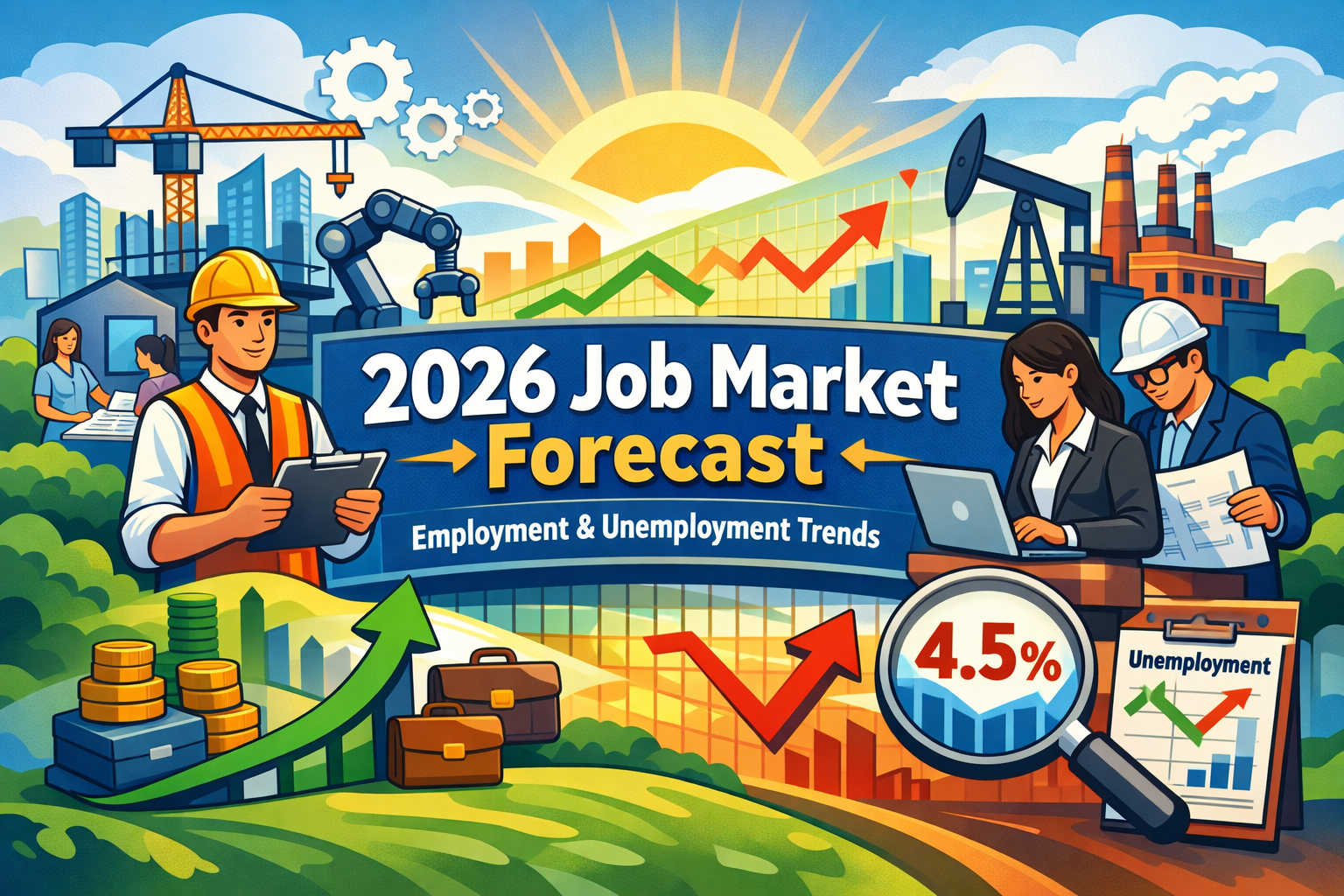
The U.S. labor market is entering 2026 with mixed signals. While employment is expected to continue growing, most economists agree that job gains will slow compared with the post-pandemic surge. At the same time, unemployment is projected to edge higher, signaling a cooling — but not collapsing — labor market.
Professional forecasters, economic surveys, and major financial institutions largely agree: 2026 will likely bring moderate hiring, stable employment conditions, and growing competition for jobs in some sectors.
Unemployment Rate Forecast: A Modest Rise, Not a Crisis
Most expert projections show the U.S. unemployment rate rising into the mid-4% range in 2026.
The Philadelphia Federal Reserve’s Survey of Professional Forecasters projects unemployment averaging around 4.5% in 2026.
Independent economic forecast aggregators cluster estimates between 4.4% and 4.8%, reflecting slower hiring rather than recession-level job losses.
Recent labor data already points to gradual softening, reinforcing expectations that unemployment may remain elevated through early 2026 before stabilizing.
While higher than the historic lows of 2022–2024, these levels still align with long-term labor market equilibrium and continued economic expansion.
Job Growth Outlook: Slower, but Still Positive
Despite rising unemployment projections, job creation is expected to continue in 2026 — just at a more measured pace.
Healthcare, construction, education, and professional services are forecast to remain key job-creating sectors.
Energy and manufacturing may face headwinds, particularly in regions tied to oil and gas production.
Overall hiring is expected to be selective, with employers focusing on essential and high-skill roles.
This combination suggests that while jobs will still be added, employment growth may not be strong enough to significantly lower unemployment.
Key Forces Shaping the 2026 Employment Rate
1. Economic Growth
GDP growth is expected to remain modest, generally in the 1.7%–2.0% range, which supports hiring but limits aggressive workforce expansion.
2. Interest Rates and Inflation
Federal Reserve policymakers have signaled a willingness to adjust interest rates to support growth, acknowledging a cooler labor market while continuing efforts to manage inflation.
3. Policy and Labor Supply
Immigration policy, trade restrictions, and demographic shifts could constrain labor supply, influencing both hiring patterns and wage growth.
4. Technology and Automation
AI and automation continue to reshape labor demand, increasing opportunities in technical and analytical roles while reducing demand in some administrative and repetitive jobs.
What This Means for Workers and Employers
For job seekers, the 2026 market may feel more competitive — particularly in entry-level and general roles. However, workers with specialized skills or industry experience may still find strong demand.
For employers, the outlook points to greater leverage in hiring, slower wage growth, and more stable workforce planning compared with the volatility of recent years.
Frequently Asked Questions
Will unemployment reach 5% in 2026?
Most forecasts do not expect unemployment to exceed 5% under baseline economic conditions, though downside risks remain.
Which industries will hire the most in 2026?
Healthcare, education, construction, and professional services are expected to lead job growth.
Is the 2026 job market heading toward a recession?
Current forecasts suggest a cooling labor market, not a recession — with continued, though slower, employment expansion.
Sources
Philadelphia Federal Reserve – Survey of Professional Forecasters (2025)
https://www.philadelphiafed.org/surveys-and-data/real-time-data-research/spfEconomics Insider – Forecast of the U.S. Unemployment Rate for Fiscal Years 2026–2035 (2025)
https://economicsinsider.com/forecast-of-the-u-s-unemployment-rate-for-fiscal-years-2026-to-2035Factually – U.S. Unemployment Forecast 2026 (2025)
https://factually.co/fact-checks/finance/us-unemployment-forecast-2026-b3440cFinancial Times – U.S. Jobs Data Signals Labor Market Cooling (2025)
https://www.ft.comReuters – Federal Reserve Outlook on Inflation and Employment (Dec. 2025)
https://www.reuters.comHouston Chronicle / Chron – Regional Employment Forecasts for 2026 (2025)
https://www.houstonchronicle.com
https://www.chron.comJPMorgan – U.S. Labor Market Outlook (2025)
https://www.jpmorgan.com